The parent community also wanted more skilled trades and culinary arts in the day-to-day curriculum, Laho said. For example, parents noted the slow decline in shop classes offered in public schools, so Copper Island made a concerted effort to bring them back.
The group considered many education models, Laho said, including Montessori and hybrid models, but ultimately they landed on the Finnish education model.

The Finnish education model is marked by teacher autonomy and collaboration, frequent breaks, inclusive practices and differentiation, according to Tim Walker, Copper Island Academy’s Finnish education model consultant, who has written several books about teaching in Finland.
Teachers in Finland are highly respected professionals, and it’s difficult to obtain teaching credentials. Teachers are allotted ample time for planning and prep, and they’re expected to leave school at the end of the day alongside their students. In the U.S., teacher shortages are common, morale and teacher pay are low and planning and prep periods are painfully short.
Calumet and the surrounding area are home to the highest percentage of people of Finnish heritage outside of Finland itself. But that didn’t mean schools in the area operated like their cross-Atlantic counterparts. For the Lahos, the Finnish model represented what parents and families in the area wanted most out of their children’s education: hands-on classrooms, real-world life skills and a focus on joy.
What’s so great about Finland?
In the early 2000s, Finland emerged as an unexpected global leader in education after the first Programme for International Student Assessment (PISA) scores, published in 2001, ranked Finland number one among the 31 other participating countries. The U.S. showed middle-of-the-road academic scores and was ranked in the 15th spot that same year.
In 2001, the Bush administration also reauthorized the Elementary and Secondary Education Act (ESEA) and rolled out the No Child Left Behind Act in public schools across the country in 2002, so education reform was already top of mind in the U.S.
In the decade following the 2001 PISA scores, Finland continued to rank in the top three participating countries. Within that time, the U.S. was one of many countries that looked to Finland’s balanced approach to learning for guidance on pedagogical practices, which included differentiated learning and early intervention practices.
But by the 2010s, Finland’s PISA scores began to fall, and the hype died down. And organizations like the Organization for Economic Co-operation and Development (OECD), which administers the PISA exams, began to encourage schools to focus more on student well-being beyond academic success, said Walker, an American teacher who taught in Finland for more than 10 years.
However, the draw to a Finnish model still remains today in education circles, and for Copper Island Academy, it landed close to home.
And for parents like Dan, Copper Island had the added benefit of an inclusive special education program. He said enrolling Oliver at Copper Island Academy “was the best decision we possibly could have made.”
Special education, the Finnish way
Oliver has an Individualized Education Program (IEP), a highly detailed, legally binding document, requiring an official diagnosis. The family asked we not use their last name because of privacy concerns for their child. IEPs adjust the curriculum for an individual student in order to meet their goals. Part of Oliver’s education plan includes push-ins during general education classroom time with Jennifer Gervais, one of Copper Island Academy’s special education teachers.
Push-ins are a form of support that keeps students in the classroom alongside their peers rather than in a siloed special education classroom.
During a push-in on one of his more difficult mornings, Gervais sits next to Oliver and quietly prompts him to participate. The other students are used to her presence in their classroom and aren’t phased. Oliver’s responses are very quiet, but he does take part in a phonics lesson led by his teacher, Ms. Erva. And if you listen very carefully, you can hear his peers encouraging him with a “good job, Oliver,” after his turn to play the phonics game is over.
Although Oliver’s experience at Copper Island Academy has been positive, many students struggle to get the services they need.
There are 7.5 million students receiving special education services in the U.S. — the majority of whom are diagnosed with specific learning disorders like dyslexia, dysgraphia or dyscalculia. Even for those students who are identified as needing to receive special education services early on, the path to receiving these supports is hard to navigate.
Most often in the U.S., students must exhaust Tier 1 and Tier 2 support services, which consist of specialized, small group instruction from a general education teacher, specialists or paraeducators, before receiving an IEP — a Tier 3 special education service.
However, the special education system in Finland is marked by teacher and family collaboration, personalized learning and trust in teacher expertise; special education intervention in Finland is seen as a preventative and inclusive practice.
“Everybody’s getting support,” said Helmi Betancourt, an elementary special education teacher in Helsinki, Finland. Like many special education teachers in Finland, Betancourt is assigned to many different classrooms. Throughout the week, she spends a couple of hours in each of her assigned classrooms teaching alongside the general education teacher. If there is an individual student or smaller group of students who need extra help outside of their general education classroom, Betancourt has the flexibility to pull them into a separate learning environment.
The decision to support a student with special education resources is seen as a pedagogical one, and is accessible for any student in the classroom who is struggling with academic or behavioral issues, according to Betancourt and her colleague in special education, Anna-Mari Vuohelainen. Teachers are free to make these decisions without the explicit consent of parents and without waiting for a diagnosis for additional support.
“It’s based on the benefit of the child,” not on a diagnosis, Betancourt said. They use a classroom-based support system to be more inclusive of special education students in their general education classrooms, and to make sure that other students who are not yet receiving support, but might need it, get it as early as possible. This also makes for less paperwork.
“The idea is that nobody has to wait for the support that they need,” said Betancourt, because sometimes, getting a diagnosis takes a long time and it’s unfair to a student if they can’t get support for years. And the students identified as having the most intensive needs receive them in a setting that makes the most sense for their needs.
But there isn’t necessarily a one-to-one application of the Finnish education model to the U.S. special education system.
Early intervention and measuring student growth
Early intervention is one of the hallmarks of the Finnish education model, and is one that Copper Island has emulated. According to Laho, early intervention allows Copper Island to tackle problems as they emerge and before a formal special education referral needs to be placed.
In order to identify student needs, teachers across departments regularly meet to hold student success meetings. These meetings occur outside of traditional IEP or special education meeting requirements, and all students are considered. This is where they identify students who are struggling, collaborate on how to help the student and regularly check in. Student success meetings often happen before parent involvement, and if the plan to remediate doesn’t work, then they might have to call a parent in to work out a more robust support plan.
Special education teachers attend student success meetings, but not necessarily to provide special education services. They’re there because of their expertise in Tier 2 and Tier 3 intervention. It’s a seemingly small distinction to make, but a rather important one that advances a culture of trust and respect in educators who are highly regarded for their pedagogical expertise.
The success of these meetings is measured in individual student growth, not achievement. The teachers and admin focus on answering questions like: Where did this student start the year? Where are they mid-year, and where did they end the year? And according to Laho, student growth is the most useful measurement that Copper Island tracks, and they do so without compromising measurable achievement.
Students at Copper Island Academy score very high on traditional indicators of student achievement. Most notably, they received a score of 99.03 in the 2024-25 Michigan School Index — a state-run public school accountability system that evaluates overall school achievement on a scale of 0-100 — placing the school in the top 3.5% of all Michigan public schools.
Inclusion first for special education students
The school’s unwavering stance on inclusion of all students in general education classrooms was a big deal for Gervais.
In other schools throughout her experience in special education, which spans more than a decade, Gervais has had to fight to get special education students included in the general education classroom, she said. Self-contained special education support is not an uncommon practice in public schools across the U.S., in which students receiving differing levels of special education support are kept from their general education peers for much of the day.
Although some level of inclusion in general education classrooms is a North Star for special education in the U.S. public school system, it isn’t always possible or recommended for every student. The Individuals with Disabilities Education Act does not have a number or percentage of general education classroom time that each student with an IEP is required to meet. Rather, inclusion is measured by Least Restrictive Environment practices. But across special education, the measurable benchmark for “good” general education classroom integration time per student hovers around 80%, although classroom time alone doesn’t automatically lead to improved outcomes, said Chris Lemons, a professor who specializes in learning disabilities at Stanford University’s Graduate School of Education.
Special education teaching presents its own unique challenges, but according to Jeremy Jarvi, who has taught in self-contained, mild-to-moderate and moderate-to-severe special education classrooms in the Bay Area, the prominent issues that come to mind are systemic and bureaucratic in nature.
“We can’t force it,” said Jarvi, of inclusion in all cases.
For parents like Daniel Willingham and his wife, navigating the special education system for their daughter, Esprit, over a decade ago was challenging and frustrating. Willingham is an education expert, and his wife is a teacher, but even then, it took a lot of time and expertise.
“To be clear, my child was profoundly disabled and so education for her looked quite different,” Willingham said. “It’s not like she was having trouble reading … she couldn’t speak.” So education for Esprit looked like setting up systems for her to be able to communicate “yes” and “no,” and inclusion in a general education classroom wasn’t possible or the best option for her.
Although Esprit’s medical conditions required in-home care and schooling, Willingham and his family experienced many of the common failures and triumphs of the U.S. special education system. They dealt with the frustration that comes with “tangling with bureaucracy,” but also benefited from interactions with educators and therapists who were “working very, very hard under very difficult circumstances trying to help children,” Willingham said.
“We frequently marveled that anyone was able to navigate through this system,” especially families without a stay-at-home parent, Willingham said.
Paraeducators and classroom staffing
Classroom staffing can be an issue, according to Jarvi, and at previous schools he found himself spending a lot of time each week training paraeducators.
“On top of working with the kids, I’m training adults … you hope that they get it the first time,” but they don’t always, and this takes time away from individualized instruction, Jarvi said of his past experiences. He now works with experienced paraeducators who have made a big difference.
Paraeducators are recognized by many states as essential to the K-12 classroom. And for some, like Lemons, the Stanford professor, the idea of paraeducators in the classroom is promising. This is not only because there are more paraeducators than special education teachers in the public school system, but also because they are with students throughout the entire school day, including in special education and general education classrooms, Lemons said.
In the U.S. paraeducators only need a high school diploma, and “in many districts, [paraeducators] receive the least amount of training, the least amount of support; they’re paid the least, but in many ways, they’re kind of the cog in the system that makes everything work, especially for kids with more extensive support needs,” Lemons said.
So far, Copper Island has had a positive experience with their paraeducators because of their willingness to go through the extra training and credentialing that the school requires outside of Michigan’s academic standards, according to Laho. The school’s paraeducators are trained on Orton-Gillingham or Morphology, which are touted for their detailed and unique approach to literacy education, especially for students who struggle. Laho said having paraeducators trained in these two methods allows for flexibility “to use multiple different people to attack a problem.”
Trust in special education teachers
In Finland, conversations between special education teachers and general education teachers happen on a regular basis, and pedagogical approaches to addressing all student learning are shared.
For Walker, the special education teacher who assisted in his Finnish classroom was seen as an “instructional coach who’s not at a higher level than the general ed teacher, but is still this trusted colleague … who has specialized knowledge in assisting kids who need more support in the classroom.”
A second set of discerning eyes can go a long way. Knowing that he wasn’t alone in providing attentive and individualized instruction for students with IEPs or those who needed a little bit of extra help with a specific subject matter was a relief to Walker. This practice of part-time, in-classroom special education instruction also allowed for Walker to exercise intellectual humility. He acknowledged that the special education teacher’s presence in his classroom two times per week exposed growth areas to better meet student needs, a ritual that he welcomed.
“For a lot of teachers out there, especially in the United States — when they don’t have this type of [inclusive] model — it’s very easy for you to feel alone in your classroom,” Walker said.
These types of experiences have roots in teacher training programs.
In the U.S., “typically, teachers who are trained to be general education teachers receive way too little training related to supporting kids with disabilities,” said Lemons, pointing out that some graduate schools of education, like Stanford’s, offer only one course focused on students with disabilities to elementary teacher candidates. On top of that, he said there’s almost zero training on how general education teachers can build effective working relationships with special education teachers.
Even at Copper Island, where teachers are trained in differentiation, general education teachers have had some trepidation about approaching differentiated learning practices. But experts like Gervais are available and willing to work with general education teachers to adjust their lessons so that everyone can learn with their peers.
“I told every one of them, ‘I will gladly show you because in special ed you learn to differentiate anything that’s thrown at you,’” Gervais said.
And offering to help general education teachers with differentiating their work also benefits other students outside of special education.
“We don’t just teach to that middle student. It helps everybody,” Gervais said.
Brain breaks for everyone, outside
Like schools in Finland, Copper Island prioritizes outdoor time for all students, which happens at a greater frequency than a typical U.S. school. This was one of the major draws for Dan and his family, and regular outdoor time during the school day has helped Oliver come out of his shell, connect with friends and focus in the classroom, Dan said.
But time outside at this school doesn’t just happen during recess and lunch; it happens every 45 minutes for 15 minutes at a time. This is Copper Island’s version of “brain breaks” — a tried and true method of allowing for, typically, classroom time spent away from academic subjects.
Brain breaks are used in both American and Finnish schools, but the way that Copper Island does brain breaks is different from most U.S. schools. Typically, brain breaks in American classrooms are occasional, very short, in-class and not necessarily physical.
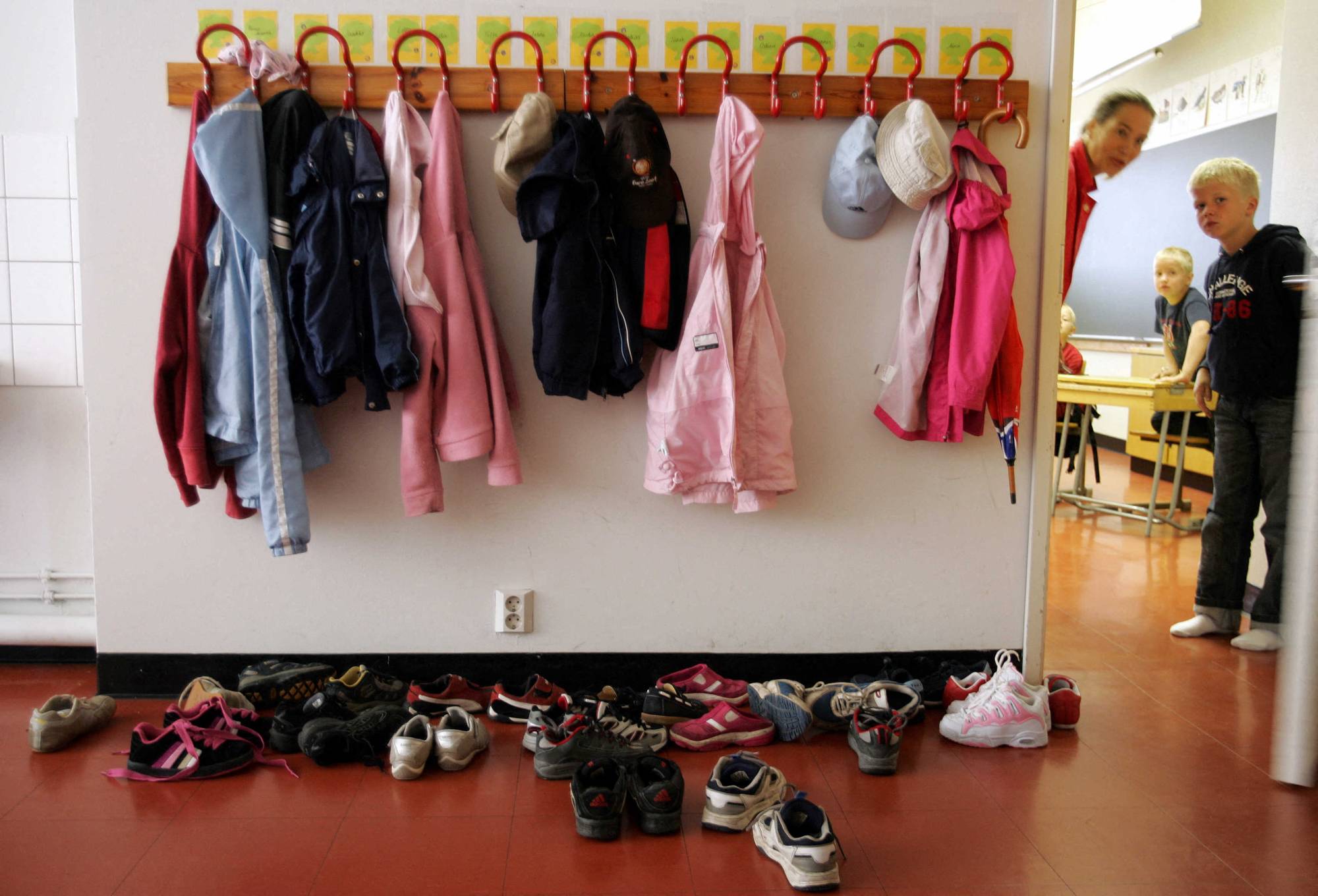
Brain breaks at Copper Island are always spent outside — rain or shine or snow — and they happen seamlessly at all grade levels. When the brain break begins, students walk quietly through the hallways and out into the schoolyard. Once the break is over, a whistle is blown, and the students quickly and quietly pile through the school’s back doors, returning to their classrooms with minimal prompting.
Usually, moments of transition like these are a stress point for teachers, who are tasked with managing energetic or even disengaged students itching to get away from the lesson plan, and then coaxing them back into the lesson plan. It might even be unfathomable to some teachers across the U.S. to get all students outside for a brain break and then settled and back into the classroom, all within 15 minutes, multiple times per day.
But there wasn’t any yelling or running down hallways to get to a brain break at Copper Island when I visited. And when asked, teachers repeatedly brushed off any potential stress or anxiety around transitions in and out of brain breaks. It turns out these breaks aren’t just good for students, they’re good for the teachers too, who spend most of their classroom time executing highly engaged and individualized lesson plans for all of their students.
There’s only one rule during brain breaks at Copper Island Academy — sports balls aren’t allowed. “The minute that you give a sports ball to somebody, you put rules and limitations on [their play],” Laho said.
Instead, kids in elementary school are encouraged to play with each other and throughout the various outdoor spaces, like their play structure, the perimeter of surrounding woods, in the garden or on the structure made of industrial-sized rubber tires.
Sports balls are reintroduced during brain breaks for middle schoolers, who Laho said might need additional motivation to move their bodies and spend time outdoors.
Can Copper Island be replicated? It depends
Calumet and the surrounding Houghton County area are a pocket of the U.S. that has preserved old town Americana charm, for better or for worse. Some people don’t lock their front doors, and they leave their keys in their cars when they are away, just in case someone needs to borrow them. The people are kind and welcoming, and very quick to recommend their claim to fame: the meat pasty. And Copper Island Academy reflects these unique traits.
The families in the community had worried that the Finnish model in a location with such an overwhelmingly large population of people with Finnish heritage would be seen as exclusionary.
According to Laho, the diversity at Copper Island Academy reflects that of the surrounding area.
“So far we haven’t seen any discrepancies between, you know, one demographic or another,” Laho said about student academic achievement and behavioral data.
The school has also made a significant effort to support teachers beyond their professional development days with Walker and more than what you might find in an average American public school classroom.
Something fundamental took place during the pandemic, Walker said. In the scramble to overhaul in-person learning to virtual learning, along with the pressure to mitigate learning loss, teachers started to publicly acknowledge their dismal working conditions, Walker said. And American society took notice, too.
“There was something about COVID that broke many educators,” he said.
But paying attention to teacher well-being in a holistic manner at Copper Island has paid off. The school’s baby pilot program allows new mothers, who are only allotted 12 weeks of unpaid maternity leave by federal standards, to ease their way back into teaching full time again after having a baby. On certain days, babies are allowed in the classroom, and teachers meet their hours without having to choose continuous, outsourced child care for their infants.
The teachers also created a support group they call “Tsemppiä,” a Finnish word that doesn’t have a direct translation, but one that Walker compared to terms like “godspeed” or “strength” and is used in Finland as a word of encouragement. And the Tsemppiä group at Copper Island does just that — it exists as a support group made by and for teachers experiencing difficulties in their personal lives.
Although Tsemppiä was established before Walker came on as an educational consultant, he quickly recognized its purpose from his days teaching in Finland. The U.S. has a habit of creating and encouraging “super teachers,” Walker said — individuals who exceed, above and beyond, which harbors competition to be “the best.” In his experience, “super teachers” don’t really exist in Finland, Walker said, and instead there’s more of a spirit of teamwork and collaboration between teachers. The adoption of this part of Finnish culture is a big part of why Copper Island has been able to be so successful, Walker said.
Additionally, the administrators don’t seem to hover at Copper Island; rather, as Laho said, they trust their teachers to get their work done. If lesson planning needs to happen at home, then that works for the school administrators. If teachers need to leave the building with the students at 3:20 p.m. when the school day is over, that also works.
Copper Island Academy experiences the everyday limitations that many American schools and educators face. “I wish we could pay our teachers what they’re worth financially,” said Laho, adding that the school does “find ways to leverage what [they do] have to help” their teachers in other ways.
“We want to try to find ways to support the teachers in what they’re doing, knowing that we’re asking them to do a lot within our model,” Laho said.
As for students, the school has put into place measures to encourage their belonging in the community. Students are grouped intentionally in classrooms, which gives them the opportunity to work and play with the peers that they may not organically gravitate toward, Laho said. This practice of belonging and empathy extends throughout the school culture, both in the classroom, outdoors and in the community, Laho said.
And when Dan is out in the neighborhood with his son, or at a local hockey game, all of the hard work that Oliver and his teachers have done to face challenging social situations has paid off. Now, when Oliver sees someone familiar outside of school, “[he] always points out, ‘Hey, there’s my friend from school’ or ‘there’s my teacher,’” Dan said.
He described enrolling Oliver in Copper Island as one of the best decisions he’s recently made and is glad he did it.
Source link
#Finnish #Education #Inspires #U.S #Schools #KQED