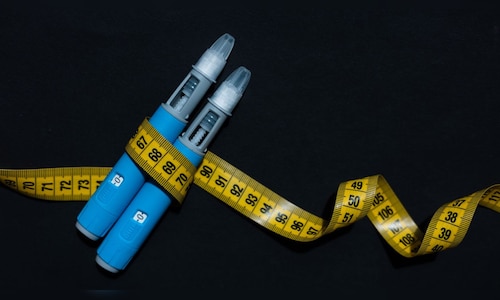
GLP-1 drugs, widely known for their role in weight loss and diabetes management, are seeing rapid global adoption. Semaglutide, which has gone off patent in India and is losing exclusivity across several emerging markets, is at the centre of this growth. The market for the drug is estimated at about $34.5 billion and is expected to expand to over $85 billion by the mid-2030s, driven by rising demand and improved access.



Explaining the cost differential, Sharma said, “Yes, it is significantly more expensive. However, the key benefit is convenience. Patients can self-administer at home, typically once a week. Vials do not offer that ease. Pens are more complex to manufacture, which reflects in the price.”
The manufacturing process begins in highly controlled sterile environments where human intervention is kept to a minimum. At the core of production is an isolator-based filling system that ensures no contamination during the critical stage when the drug, already formulated into liquid form, is filled into cartridges.
“This is really the first major step in the entire value chain of GLP-1, where the drug… is filled on this line,” Sharma said, adding that the automated system can fill 150 to 200 cartridges per minute. However, actual daily output depends on batch sizes, with current production at around 50,000 to 55,000 cartridges per day, and the potential to scale up to 1.2–1.3 lakh units.
Each filled cartridge undergoes rigorous quality checks before moving to the next stage. Traditionally done manually, this process has now been automated to handle scale. Machines inspect every unit for even the smallest defects, such as micro air bubbles, which may not be visible to the human eye.
“A human eye may miss certain defects, but a machine can detect them… the machine is extremely sensitive and can detect even minor inconsistencies,” Sharma noted. Any rejected units are discarded entirely, adding to wastage and cost.
The complexity increases further during the assembly stage, where cartridges are integrated into injection pens using robotic systems. These pens consist of multiple precision-engineered components and must be assembled with high accuracy to ensure proper dosing and patient safety.
Unlike simple vials, pens also require compatibility across different device platforms. OneSource currently handles 11 such platforms, each with varying designs, technologies and user interfaces, requiring frequent recalibration of machines and specialised components.
Beyond assembly, the final product must be labelled, packaged with needles and patient information leaflets, and maintained under strict cold chain conditions. GLP-1 drugs must be stored at 2 to 8 degrees Celsius throughout the supply chain, adding further logistical complexity.
Also Read | OneSource Specialty sees Canada leading semaglutide volumes; Brazil, Turkey next
Sharma said the company operates as an end-to-end contract development and manufacturing organisation (CDMO), supplying to global pharmaceutical players including Dr Reddy’s and Natco, along with their partners.
Looking ahead, OneSource is investing $100 million to expand capacity, betting on sustained demand for GLP-1 therapies, including newer molecules such as tirzepatide. While semaglutide remains a key driver, the company is also diversifying into biologics and other drug-device combinations.
Source link
#semaglutide #injection #pens #cost #vials #OneSource #CEO #explains #manufacturing #complexity #CNBC #TV18