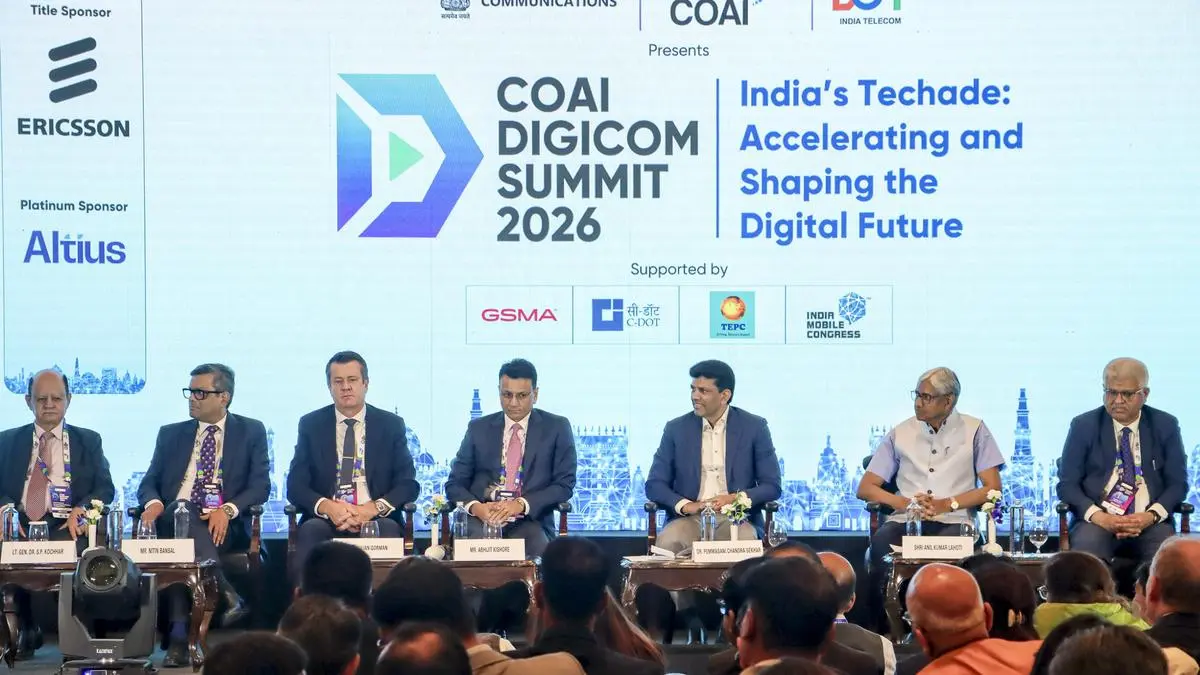
MoS Pemmasani Chandra Sekhar along with TRAI Chairman Anil Kumar Lahoti, second right, Vodafone Idea Limited CEO Abhijit Kishore, fourth left, Head of Asia Pacific (APAC), GSMA, Julian Gorman, third left, and others during the inauguration of the second edition of the COAI Digicom Summit 2026 with the theme ‘India’s Techade: Accelerating and Shaping the Digital Future’, at Le Méridien, in New Delhi, Friday, April 24, 2026.
The COAI DigiCom Summit 2026 called for an AI-led, secure and resilient digital ecosystem, with government officials, regulators and industry leaders emphasising stronger collaboration and proactive measures to tackle spam and digital frauds.

The summit concluded with stakeholders advocating “a secure, resilient and innovation-driven digital ecosystem, underpinned by next-generation telecom networks and emerging technologies such as Artificial Intelligence and 5G.”
Highlighting India’s telecom progress, NK Bhola, Wireless Advisor, said the country is “gearing up for a 6G-ready ecosystem” amid strong progress in 4G and 5G spectrum availability. He added that “as automation increases, ensuring security and trust will be paramount.”
AI takes centre stage
Industry leaders also stressed the growing role of artificial intelligence in transforming networks. Sajan Paul, General Manager – HPE Networking, India, noted that “artificial intelligence is reshaping networking, both in structure and operations,” adding that the focus is now on embedding AI to enable “smarter, more efficient and transformative telecom ecosystems.”
A panel discussion on building intelligent networks highlighted that “the future of telecom networks will be increasingly AI-led,” with a shift towards compute-driven infrastructure and the need for collaboration across the ecosystem.
On policy and governance, Manish Sinha, Member (Finance), Department of Telecommunications, said artificial intelligence is emerging as a “key transformative force,” but also flagged concerns around frauds and spam, stressing the need to “prioritise trust, security and human impact.”
Another panel on tackling spam and digital frauds underscored that addressing the issue requires “a proactive, ecosystem-wide approach, combining AI-led detection… and stronger coordination across Government, industry and digital platforms.”
What the future holds
On future technologies, Dr Punit Rathod of Qualcomm said the convergence of 6G and AI is driving “unprecedented demand for higher bandwidth,” making additional spectrum critical for innovation.
Experts also highlighted that the next phase of connectivity will be driven by “5G Advanced,” with increasing focus on enterprise and mission-critical applications, while calling for policy frameworks that enable innovation and sustainable monetisation models.
On infrastructure and manufacturing, Deb Kumar Chakrabarti, Member (Services), Department of Telecommunications, said telecom manufacturing remains a “strategic imperative for India,” while stressing the need for cost-efficient and targeted production decisions.
Meanwhile, Dr Devesh Tyagi, CEO of NIXI, said that with India surpassing 1 billion internet users, the next phase of growth will be driven by Tier 2 and Tier 3 cities, highlighting the need to ensure service parity across regions.
The summit concluded with stakeholders highlighting that India has the “foundational strengths of scale, talent, capital and policy support to emerge as a global digital infrastructure hub,” while emphasising the need to accelerate fibre expansion, invest in submarine cables and build sovereign AI capacity.
Published on April 25, 2026
Source link
#fight #fraud #Key #takeaways #COAI #DigiCom #Summit