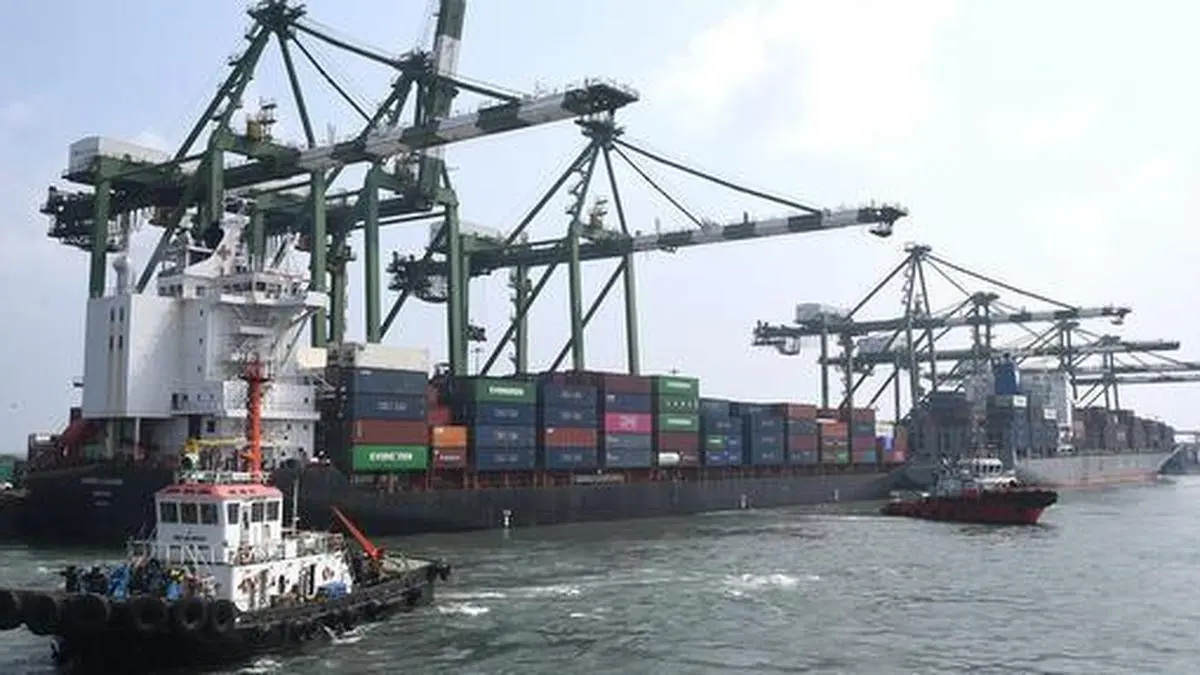
The Centre has not acted a moment too late in introducing the Bharat Maritime Insurance Pool as a strategic response to deal with geo-political stress on the high seas.
| Photo Credit:
JOTHI RAMALINGAM B
The Iran war has exposed a major frailty in our export-import ecosystem. About 70 per cent of India’s exports and imports by value move by sea (amounting to $800-850 billion), and these consignments and vessels are almost wholly insured overseas. A group of 13 international clubs based in Europe and US control global ‘protection and indemnity’ insurance, and in times of sanctions or war the cost of this cover either rises astronomically, or is withdrawn altogether. As a result, Indian exports and import consignments of about $10 billion are probably stranded now.


The situation would have been less dire, had the insurers been Indian. Our insurers could have responded on India’s own terms to the Gulf crisis — or for that matter to any sanctioned country (such as Russia) or entity. Therefore, the Centre has not acted a moment too late in introducing the Bharat Maritime Insurance (BMI) Pool as a strategic response to deal with geo-political stress on the high seas. The BMI sends out a strategic message that India seeks to secure its trade flows from the crossfire of sanctions or conflict. It has three elements — a ₹950 crore ($100 million) war-risk fund that will be managed by GIC Re, with contributions from public sector insurers and oil companies; a $300 million industry claims pool to be used to ease the trade finance crisis for exporters and importers whose consignments and payments are stranded; and finally, a $1.2 billion sovereign guarantee as a long term corpus, possibly to back up war-risk claims if they exceed, say, $100 million, besides funding crises in trade finance. Over the next two decades, BMI can potentially evolve on the lines of P&I pools created by Japan and China.
To place this effort in perspective,India’s foreign exchange outflow on account of maritime insurance is $350-500 million annually, given that insurance costs are about 0.7 per cent of the value of the freight in normal times. This figure has likely risen since 2022 on account of geo-political disruptions. BMI would not just reduce this outgo, but also bring down business uncertainty. However, for the BMI to gather momentum, it needs to wean away shippers and businesses from Western P&I clubs by offering attractive rates. Since insurance works on defraying costs and risks, it needs a wide customer base. However, Indian shippers account for barely 1 per cent of global shipping capacity and 1.5 per cent of the world’s registered vessels, or about 1,500 ships. This does not make for a large pool. India must emerge as a hub for registering ships.
The Centre has been promoting GIFT City for maritime financing and leasing. Shipbuilding itself has received a boost. An Indian P&I model can gain momentum if shippers can create insurance cooperatives, as in Japan; the corpus will rise with membership. This, however, is not readily permissible under current regulations. Indeed, atmanirbharta in marine insurance is a long voyage; the reliance on global pools will not go away overnight.
Published on April 27, 2026
Source link
#Anchoring #trade