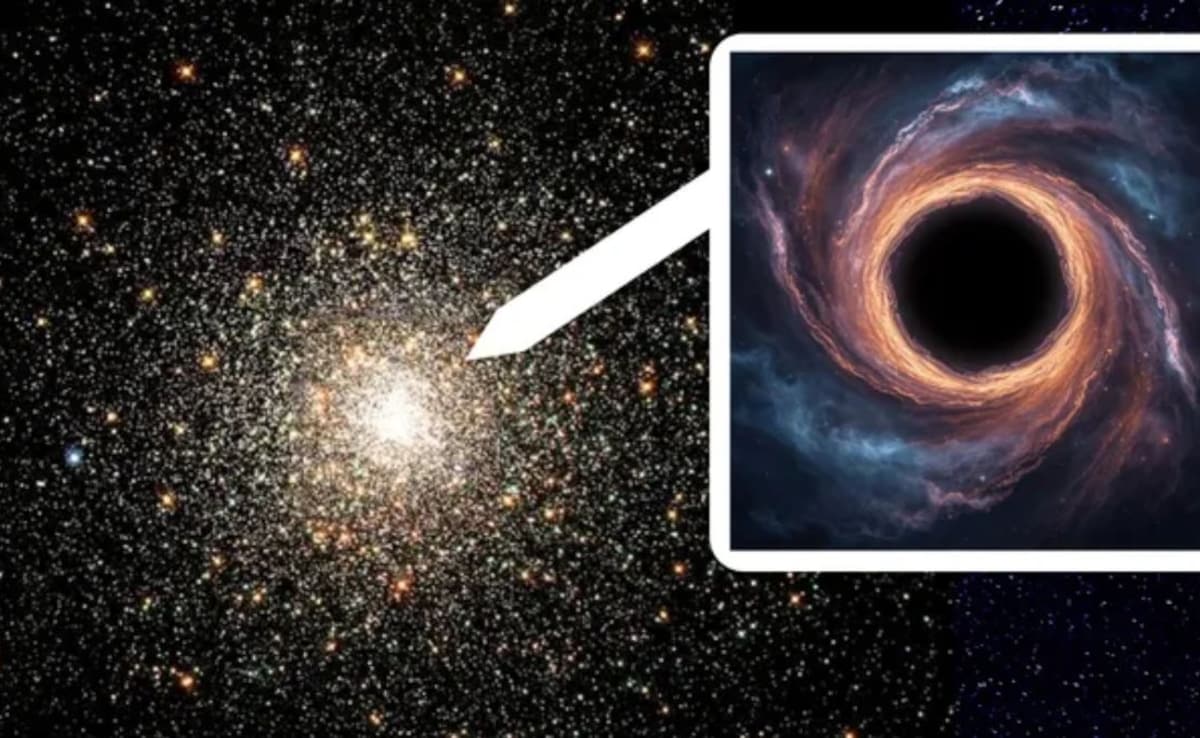
The largest black holes discovered in space could have been formed differently than previously thought by astronomers. Recent research, which studied gravitational waves that occur due to changes in the space-time continuum itself, indicates that these objects are formed due to a cycle of collisions within dense clusters of stars. The study, which appeared in the journal Nature Astronomy, is based on data from 153 mergers observed by the LIGO, Virgo, and KAGRA observatories.
Two Populations, Two Histories
In this study, the researchers used data from the Gravitational-Wave Transient Catalogue (GWTC-4) of the LIGO-Virgo-KAGRA collaboration to determine whether the largest black holes are formed through successive mergers within dense clusters of stars rather than the collapse of massive stars. Their findings were clear in two different populations. The less massive black holes have slow and aligned spins, which is characteristic of the collapse of the core of massive stars. In contrast, more massive black holes show fast and random spin alignments.



The Forbidden Zone
The pair-instability mass gap (also called the mass desert) is one of the important reasons for this. The ‘forbidden zone’ of mass, between about 50 and 130 times that of the Sun, is the result of the fact that some very massive stars do not form a black hole when they die, but explode violently because their thermonuclear explosions run out of control. The results are presented, and the mass threshold for this gap is found to be approximately 45 solar masses, with rotational properties of black holes of higher mass being consistent with hierarchical mergers. That is, the biggest black holes that have been detected appear to be made of the wreckage of smaller black holes.
Source link
#Scientists #Giant #Black #Holes #Cosmic #Collision #Chains