

Businessman touching the brain working of Artificial Intelligence (AI) in the futuristic business and coding software development on interface and synchronize network connection, IoT, innovative and technology of business. istock photo for BL
| Photo Credit:
ipopba
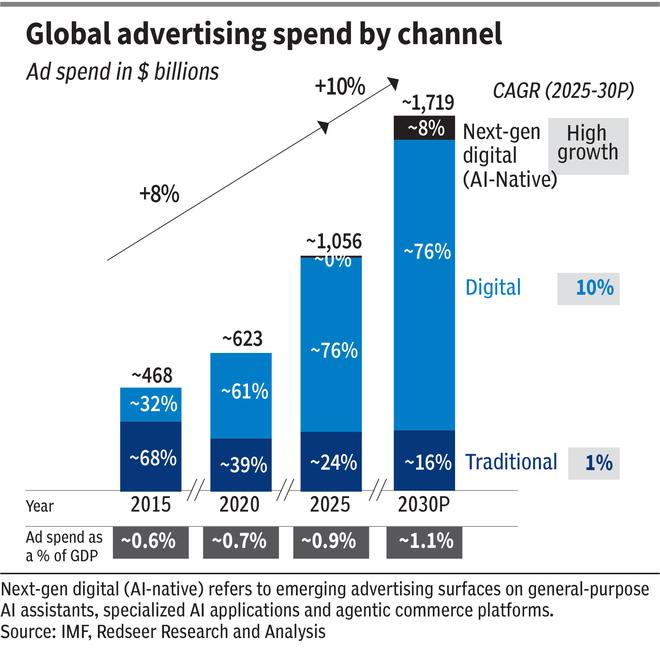
Redseer Strategy Consultants has published a report outlining AI’s role as the next growth catalyst in advertising. Currently valued at $1 trillion, the global advertising market is growing faster than the global economy and AI is reshaping its entire organisational structure. For decades, the advertising industry competed along the same metrics – clicks, views and traffic. However, AI is redefining the turf.



In this new era, purchase decisions aren’t purely influenced by textual search parameters and static messages (the same, fixed, non-interactive content displayed to every user), but rather through conversations with an AI interface. For instance, a consumer getting to know whether a cosmetic item would suit her skin from an AI model before clicking on ‘Add to cart’. That said, its impact is not limited to consumers alone. Businesses also use AI to eliminate the guesswork in the decision making process, enabling informed decisions based on data. From auctioning ad slots to selecting bids, AI can help nullify the prediction problem.
Digital advertising, therefore, as the report puts it “sits at the top of the AI disruption curve: a rare sector where every layer of the business, from creative production to bidding to outcome analysis, is undergoing simultaneous AI-led transformation.”
Evolving landscape
As AI reshapes how users discover, consume, and make purchases, it is creating entirely new surfaces where ads can exist: AI-native platforms (for example, Anthropic), agentic commerce (Amazon Rufus) and other hyper-personalised applications. Unlike traditional search methods, conversational environments facilitate higher understanding and personalised engagement at the query level, thereby chipping away at legacy generic/ awareness led advertising that were once very effective — like Coca-Cola’s ‘Share a Coke’ Campaign, featuring consumers’ first names on their bottles.
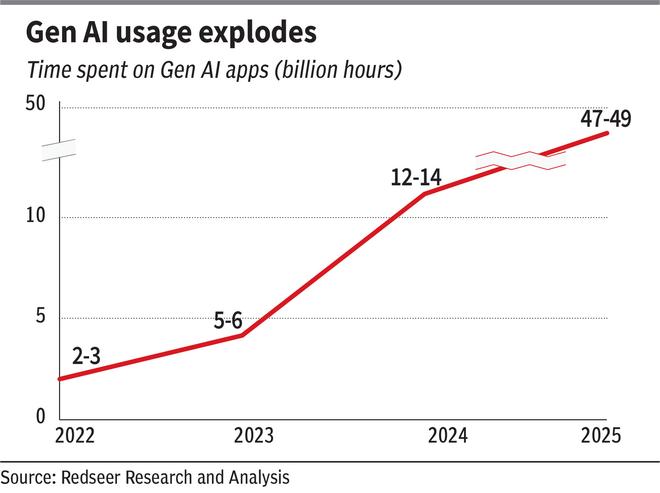
As previous channels of advertising become less effective, newer avenues emerge. With more people spending time and searching on these Generative AI and AI assistant platforms (like ChatGPT) than ever before, these platforms create significant new opportunities for top-of-funnel (discovery and awareness focused) and bottom-of-funnel campaigns (targeting high-intent users to convert into users). Furthermore, the influx of hyper-specific and niche apps (like FujiXWeekly for Fuji camera shooters) turns each of these platforms into a publisher and presents advertisers with an opportunity to monetise the fragments/ niche segments.
The report also outlines how the popularity of these AI assistants have led consumers to increasingly consider AI-assisted shopping or agentic commerce, helping them sort through search clutter and optimise their purchases. According to the report, by 2030, Agent-driven Commerce is expected to intermediate 10-25 per cent of the United States e-commerce sales. As agentic systems research, compare, and transact on behalf of consumers (agentic Commerce), the entity being influenced is no longer only human, and the relevant metric is no longer a click, it is an agent’s decision. These shifts don’t just signal what fades, but where new advertising inventory is emerging.
Multipicative effects
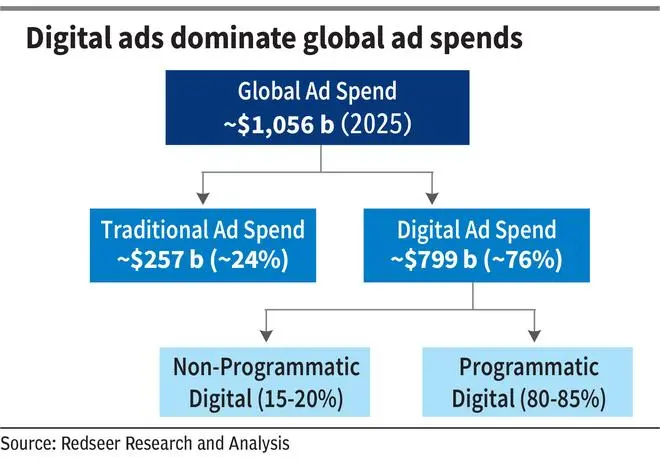
While global ad spend is split into 3 main categories, the shifting AI landscape is pushing programmatic advertising through the biggest transformation of all. Programmatic advertising refers to an automated digital ad auction where the minute you click on a website, software platforms instantly bid and buy the empty ads spaces on your screen in the split second your page loads. These systems use audience data (browsing history, cookies) and real-time bidding (RTB) to buy and place ads within milliseconds, enabling highly targeted ad deployment and reducing the gap between ad spend and business outcomes drastically.
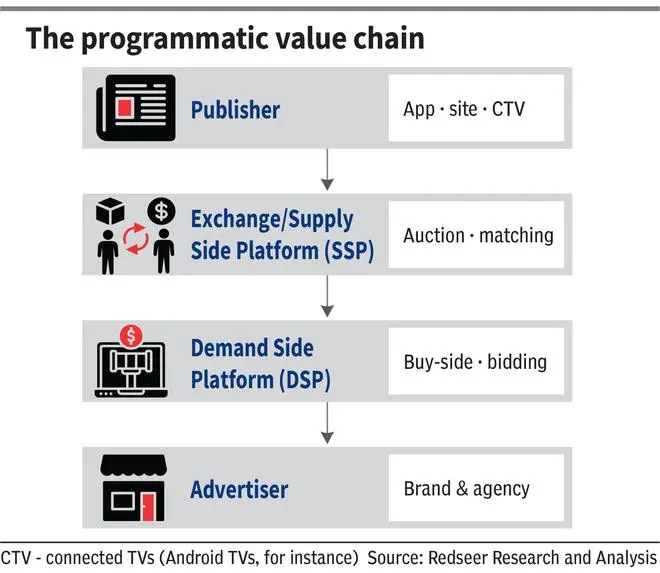
The programmatic value chain runs from advertiser to publisher through an intermediary layer: demand and supply side platforms (DSPs and SSPs) and unlike other segments, every aspect here is driven by AI.
For publishers (website owners, OTT platforms, etc.), AI is transforming how publishers manage, price, and protect their inventory. The report highlights how publishers with the same audiences can generate very different revenue per session, based on the extent of AI adoption in advertising.
In tandem, AI optimization in SSPs (which auction and match that inventory) boosted publisher revenue by up to 20 per cent, while boosting both bid selection and significantly improving fake traffic detection (by bots, for instance).
For DSPs, AI is reshaping bidding and targeting, significantly improving advertiser outcomes on the same budget through real-time optimization of users, pricing, creative decisions, and channels.
Finally, for advertisers, AI is reshaping how ad campaigns are planned and optimised, accelerating the idea stage and increasing ROAS (return on ad spend) up to 20 per cent.
India’s role
In this evolving landscape, the report positions India as where the global AI adtech is being rebuilt. From the engineering work to agentic systems, India hosts the exact talent pool required: systems engineers, machine learning practitioners, and infrastructure specialists.
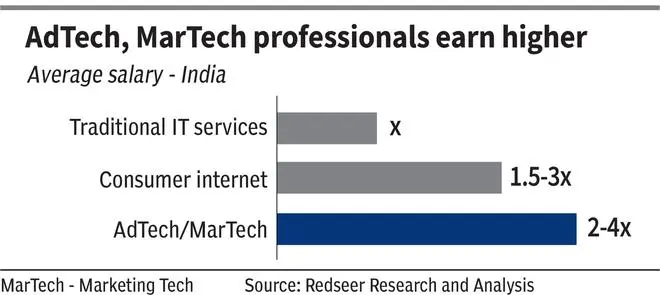
The report estimates professionals in AdTech receive 2-4x compensation compared to Indian IT services, allowing these firms to attract higher-end engineering talent domestically. What’s more is that India also hosts majority of the world’s global capability centres, generating nearly $65-75 billion in exports. India’s first adtech unicorn, InMobi, currently operates in 50+ countries, showcasing what India’s next decade in adtech can look like at scale.
To summarise, the report shows how the advertising industry is rapidly moving away from traditional models, powered by AI. However, the impact of AI is not uniform across players. AI plays into the hands of those with more data, broader distribution, etc., leading to a wide gap being formed between AI-mature and AI-laggard advertisers.
The author is an intern with bl.portfolio
Published on May 28, 2026
Source link
#redefining #advertising #ecosystem