It did what social media platforms today were originally meant to do, which is to let users add friends, family, and acquaintances through a common portal, and exchange interests with them. Its scale, of course, wasn’t a match to the reach and impact of today’s platforms, even though at its peak it had more than 3.5 million users worldwide, representing 3 per cent of all internet users active then.


Thirty years since SixDegrees.com opened an unexplored world rife with potential, social media has raced past all other internet activity to become the most widely used digital service. Today, nearly 97 per cent of all internet users log on to a social media service every day, spending an average of 2.5 hours on the activity, according to the Digital 2026 Global Overview report by We Are Social UK, a London-headquartered agency specialising in social media marketing, strategy, and research.
Among these users are teenagers and young adults, to whom the digital world comes as second nature — to the extent that it often blurs the line between what is real and what is virtual. Hence, the rising concern about its impact on the mental health, self-image, and overall behaviour of this cohort. As a result, several governments have increased their scrutiny of these platforms, their algorithms, and their impact.
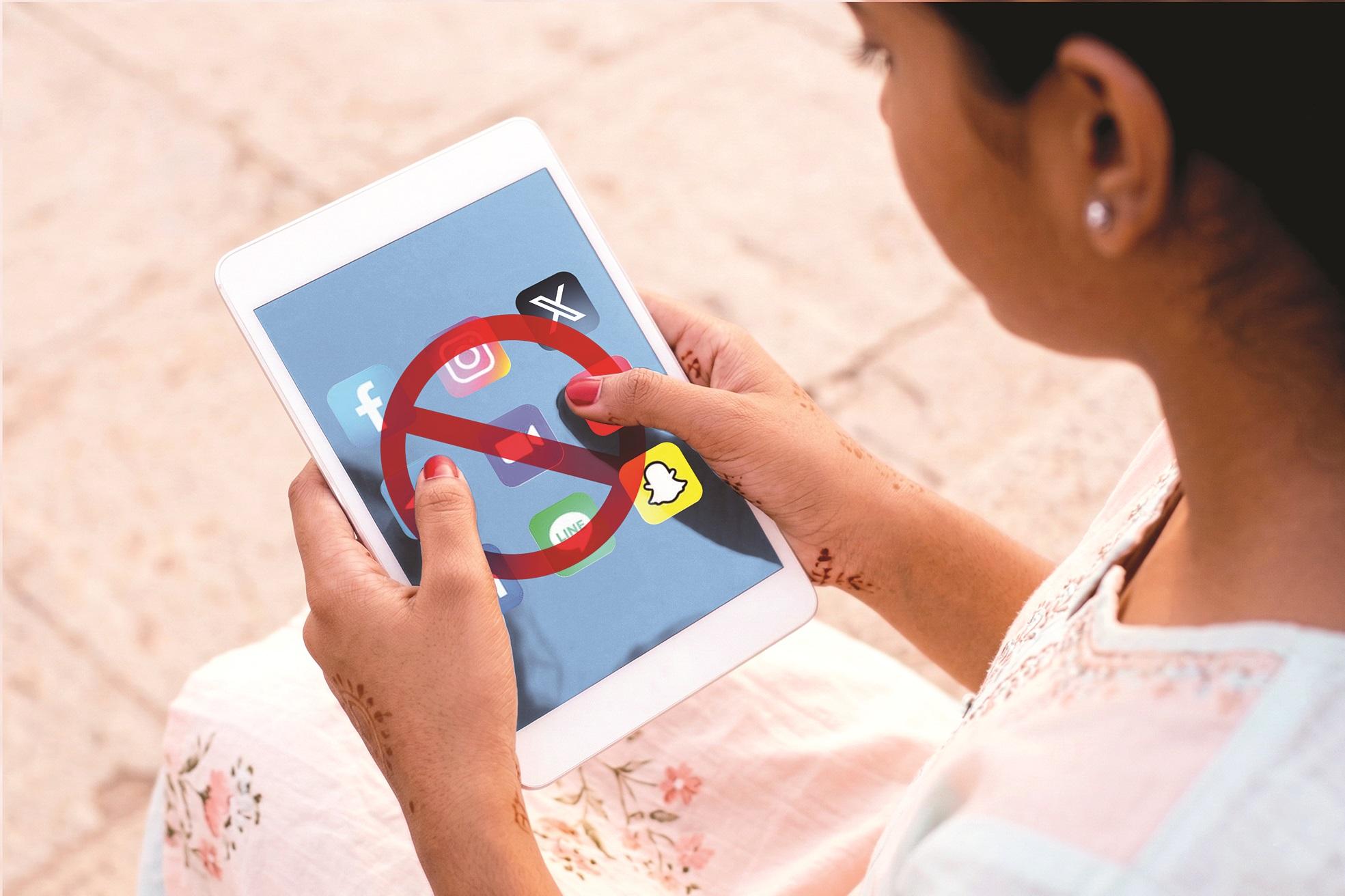
On December 10, 2025, Australia became the first country to take decisive action and ban the use of social media for those aged under 16. Others, such as Indonesia, South Korea, Austria, France, the United Kingdom, and the Philippines, have followed suit and are either considering banning social media for children under a certain age or regulating its usage.
India, which is one of the largest markets and user bases for social media intermediaries of all kinds, has also started considering measures such as banning these platforms or heavily regulating their use by children.
The use of social media by children in India is already regulated under the provisions of the Digital Personal Data Protection (DPDP) Act, which requires all social media users below the age of 18 to obtain verifiable parental consent while logging on to such platforms.
Besides this, governments at both the central and state levels are stepping up efforts to further regulate social media usage, especially by children. The debate is about imposing a complete ban or adopting a regulatory stance, which would mean certain restrictions.
Soon after Australia banned social media for those under 16, Andhra Pradesh’s Minister for Information Technology, Electronics and Communications Nara Lokesh also hinted at bringing in a similar regulation.
Karnataka became the first state to propose strict restrictions on social media for children. However, the state’s IT minister, Priyank Kharge, later said the idea was to regulate what children are exposed to on the internet rather than impose a complete ban.
“I think ‘ban’ would be a very harsh word. And it’s very difficult to ban these things because, first, if we ban them on regulated
platforms, people go to unregulated sites, which is even more dangerous,” Kharge told Business Standard in March.
Not long after Karnataka’s proposal, made public in the state’s annual Budget, Andhra Pradesh Chief Minister N Chandrababu Naidu announced that the state would introduce a law by June to regulate the use of social media by teenagers and young adults, and ban it completely for those under 13.
The general view among those who work with this cohort is that an outright social media ban is unlikely to protect children
Uma Subramanian, founder and co-director of RATI Foundation, a Mumbai-based organisation focused on child protection, technology, and rights, is of the view that a blanket ban would be detrimental to children from marginalised segments of society since they mostly use shared devices, unlike those from well-off backgrounds who have access to personal devices.
“One should instead set accountability standards for these platforms,” she said.
“When we put a blanket ban, the risk-taking behaviour shifts to unregulated platforms.”
When contacted, Tara Hopkins, the global director of public policy at Instagram, said: “We do share the same views as the vast majority of policymakers that teenagers, especially younger teenagers in the 13-15 age group, have the safest, most protected experience when they come to use social media platforms run by Meta.”
Protecting children in their digital lives and ensuring they have a safe experience, however, is a “societal challenge”, which cannot be solved solely by barring them from accessing certain platforms or services, Hopkins added.
Outright bans, as in the case of Australia, are blunt instruments that leave open “an awful lot of concerns and questions” for
the government, the social media intermediary, as well as the parents, she said.
Although all social media intermediaries have complied with the law of the land, industry estimates indicate that Australian children are increasingly using virtual private networks (VPNs) to access their social media accounts.
Australian children have also resorted to using “logged out” versions of these platforms, while also logging on to other lesser-known social media services that may not have as strict safety features, a senior executive at a social media intermediary said, asking not to be named.
To prevent similar problems, India will need to put in place safeguards, along with adopting a more controlled, regulated approach to exposing children to online platforms, Namita Viswanath, a partner at law firm CMS Induslaw, said.
Placing the onus entirely on social media intermediaries may not work in the long run, she said, since children will find ways to circumvent the restrictions placed on them, and the platforms might find it difficult to stop such logins completely.
“It is important to strike a balance, to incentivise platforms to also play a responsible role in this. Platforms cannot devote all their resources to trying to build technology to curb such usage,” Viswanath said.
The India case
Studies have shown that teenagers and young adults in India use the internet and social media platforms very differently compared to similar-age users globally.
A 2024-25 study by the RATI Foundation found that the digital safety of teenagers in India is largely “fragmented”.
“Many teens adopt practices in a piecemeal way, such as setting strong passwords yet missing foundational protections, such as avoiding password sharing or enabling recovery options.
Platform safety features remain underused, leaving accounts especially vulnerable in shared-device contexts,” the study covering 1,277 teenagers in the 13-17 age group across economic strata revealed. Though Meta’s Instagram will soon introduce stricter age-gating and content norms for children in India, lawmakers will also need to identify children’s online behaviour and their behaviour on their devices before enacting laws that regulate social media usage, Hopkins said.
Most teenagers, including those in India, use their devices by switching between apps and services such as Instagram, artificial intelligence tools and chatbots such as ChatGPT and Claude, as well as educational and sports applications of their respective schools, she said.
The challenge in enacting a law prohibiting children’s use is, therefore, not limited to device and digital usage patterns. For example, even though the DPDP Act prohibits behavioural monitoring and targeted advertising, stakeholders believe it could lead to children losing out on the benefits of a personalised internet.
“Without personalisation, children could experience irrelevant content, reducing their ability to engage meaningfully online and also limiting innovative services to them,” policy advocacy body CUTS International said in a report.
Such prohibition under the DPDP Act can expose children to inappropriate content, such as material promoting self-harm, violence, or misinformation. It could result in them facing an overwhelming flow of irrelevant or harmful material, posing risks to their online safety and diminishing their digital experience, the report said.
A similar approach, if used to implement the social media ban, could have an adverse, unintended impact on children,
Viswanath said, adding that the states and the central government will have to work in tandem to ensure the restrictions are
“The ability to enforce this will depend heavily on the central government’s cooperation,” she said. I think it will come down to what the threshold of expectation and obligations on social media intermediaries is, and what the impact of non-compliance is.”
When it comes to impressionable minds and something as intense and all-pervasive as social media, there is clearly
Source link
#debate #unscrolled #India #weighs #social #media #curbs #children