Published by Penguin India


In January 2015, Aniruddhan Vasudevan translated Perumal Murugan’s Facebook note in which the author stated, “Author Perumal Murugan has died. He is no god, so he is not going to resurrect himself. Nor does he believe in reincarnation. From now on, Perumal Murugan will survive merely as a teacher, as he has been.” This was the aftermath of right-wing groups protesting against his novel One Part Woman in which he portrays a childless couple engaging in a ritual that allowed free sexual relations between men and women for one night. Realistic depictions of social issues were a hallmark of his novels and short story collections. In the time he spent in exile in 2015-16, he wrote a poetry collection that added to his literary oeuvre, and marked a return to writing. After the controversy, his writing changed in terms of depicting social issues in imagined worlds rather than specifying place and caste names as he did before. His fiction writing after 2015—Poonachi (2018), translated by N Kalyan Raman and Estuary (2020), translated by Nandini Krishnan — continues to be simple, empathetic and poignant.
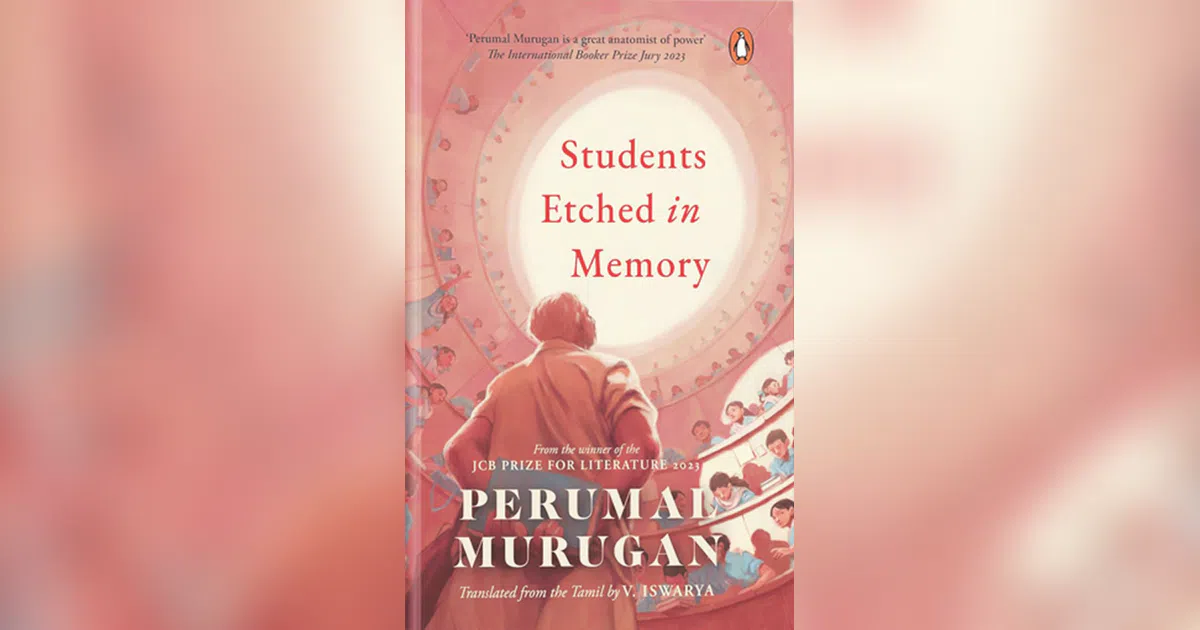
His non-fiction shares the same qualities. In Students Etched in Memory, impeccably translated by V Ishwarya, readers get a glimpse of Murugan’s life as a teacher, the role he held on to during his literary death. This collection of 40 essays on as many students draws heavily on the author’s affectionate engagement with his students throughout his teaching career. The essays were first published in 2017 as columns in The Hindu supplement —Flag of Victory —in Tamil. The experiences shared in the book are based on his time teaching Tamil literature, foundational Tamil and journalism.
In the introduction to the book, Murugan questions the education system including the curriculum and provides potential answers that can help students. He argues that “students need to be introduced to the landscape of ancient Tamil writings, but primarily they should study in depth the writings that engage with our own times.” He adds, “It is said that students show no interest in learning, but this complaint is plainly a ruse to scapegoat students for every shortcoming in the system.”
Murugan is a first-generation learner in his family and hence, has a rather caring approach to his students when he begins teaching at the Arignar Anna Government Arts College, Attur, in 1996. In these essays, he features many eclectic students, admitting that it’s often the mischievous ones who are memorable. In his anecdotes, he recalls Sudhakar, who loves to cook; Rajendran, who hides behind a tamarind tree to escape riding pillion with him; Sarala, who becomes a policewoman; Gopalkrishnan who’s known as the parotta master; Balamurugan, who works at a mill; Maanvizhi, who decides to stand for college elections only to back out later for her safety; Kalaichelvi, whose paper presentation upsets the head of the department; Silambarasan, who gets into trouble for flipping his hair; Nandkumar, who prostrates himself every time he sees his teacher, and many others. Most of these students, being first generation learners from rural backgrounds, worked part-time to make ends meet. Murugan highlights the difficulties that even the men face in completing their education while making ends meet for their family, and sometimes they are bound to drop out as they are married while in college.
As he describes his students, Murugan also creates a self-portrait, but without glorifying himself. He extends himself beyond the classroom to take an interest in the students’ lives and guide them towards a better future than a blue-collar job. He firmly believes that higher education will help improve his students’ living standards. Despite the seriousness of his concerns, he often brings a playful energy into the classroom. He is receptive to changing fashion and nicknames and attempts to learn modern teaching methods, including using a mobile phone, to bond better with his students.
It’s also interesting to note how often he comes across his students long after they have left the college. Murugan’s kids often complain that they find his students everywhere they go. And these students often come to his service without being asked to do so. He opened his house to students, requiring them to participate equally in household duties. When he learns of a student marrying beyond caste and religious barriers he is overjoyed, and allows the student to stay at his home. This is testimony to the author’s inclusive practices as a result of which even foundational course students from other streams remember him. Murugan reiterates that, “A teacher unbeknownst to themselves may have altered the student’s personality in some way. It is also possible that they failed to make any difference in their lives.” As he shares many fond memories, he also shares his grief at failing some students in life. One such instance is that of Balamurugan who dies by suicide after a failed love affair.
V Ishwarya, in her debut full-length book, has kept the translation breezy and retained the nuances of Murugan’s recognition of shared vulnerability with his students. Students Etched in Memory is, thus, an enjoyable read—to be savoured slowly. It makes readers wish they had teachers like Murugan while also appreciating his presence in an archaic education system that needs change to better students’ lives and futures.
The reviewer is an independent writer based in Sambalpur, Odisha. Instagram/X: @geekyliterati
Source link
#Students #Etched #Memory #Perumal #Murugans #learning #curve #bond