After international student enrollment crashed in fall 2025, a report from Shorelight, an international education firm, illuminates one factor that led to that decline: a bump in F-1 visa rejections, especially for students from a handful of countries that typically supply large numbers of international enrollees.
Shorelight’s annual report on visa refusals showed that denials reached a decade high of 35 percent worldwide in 2025, exceeding the previous peak in 2020. Those refusals were mainly concentrated in Africa, the Middle East and South Asia. Nearly two-thirds (64 percent) of all F-1 visa requests from Africans were rejected, up from 43 percent in 2015 and up five percentage points from the previous year. A few countries, including Sierra Leone and Somalia, reached rejection rates over 90 percent. And India, previously the largest provider of international students to the United States, jumped from a refusal rate of 36 percent in 2023 to 61 percent in 2025.


Meanwhile, visa refusal rates for South Americans have actually decreased in the past four years, from a peak of 31 percent in 2022 to 22 percent in 2025—though that rate is still higher than they were a decade ago. The student visa denial rate among European applicants has remained steady over the past 10 years, sitting at 9 percent in 2026.
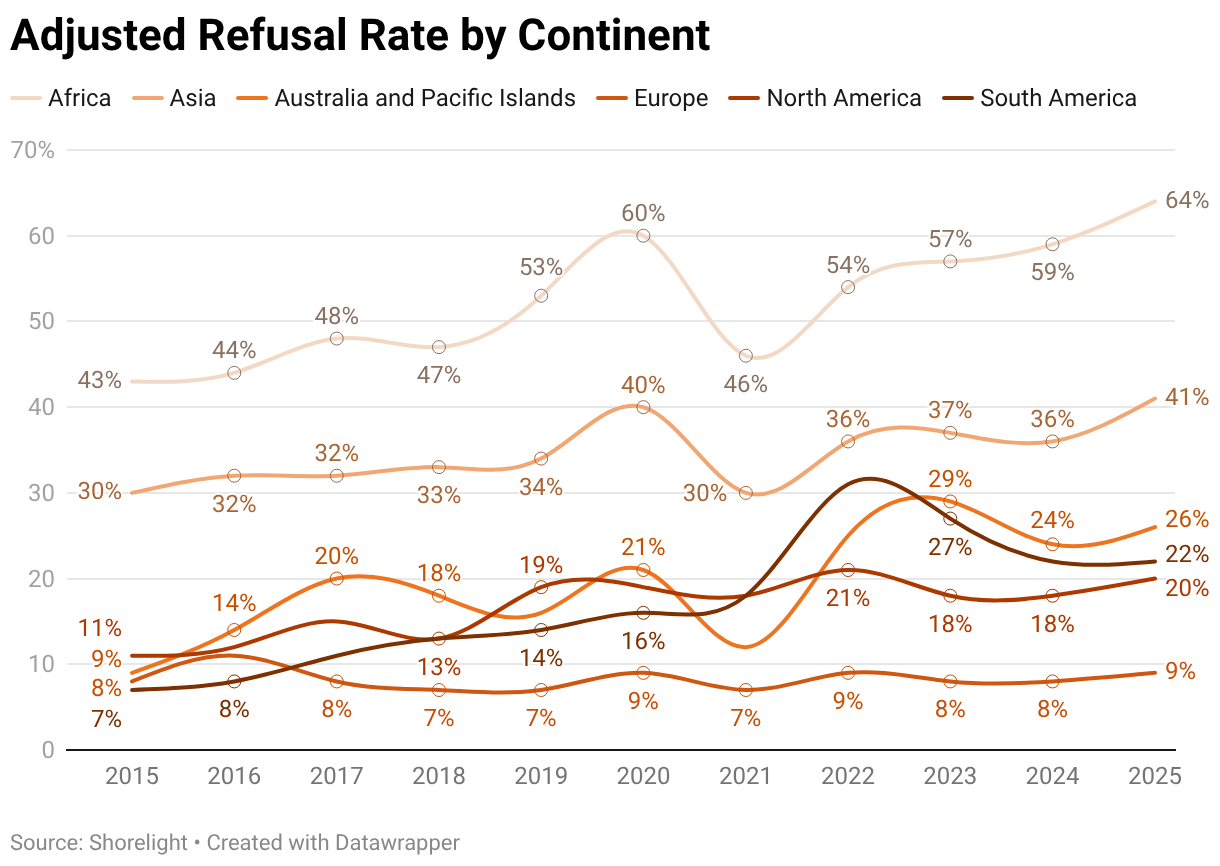
The report also notes that the refusals aren’t consistent by region. In Latin America, for example, visa rejection rates varied vastly by country; in Venezuela, for example, rejections were up 22 percentage points from the previous year, but for students from Colombia, they have been on a steady decline the past three years.
Shorelight, which acquires student visa rejection data from the U.S. Department of State via a public information request every year, criticized these clusters of rejections, arguing that they show that each visa request is not being judged on its own merit.
“This current adjudication landscape undermines the principle of merit-based entry by creating localized refusal clusters. When a student’s likelihood of entry depends more on their country of origin than their academic credentials or funding, the integrity of the U.S. visa system is compromised,” the report said. “The 2025 data confirm the consolidation of a ‘high-refusal tier’ that now encompasses the vast majority of the Global South.”
The research provides a new lens into the Trump administration’s crusade against international students, which kicked off about a year ago when the administration paused visa interviews to implement new social media reviews for applicants. Since then, prospective students have struggled to find visa interview appointments, particularly in a subset of countries, including India. Government officials also terminated a swath of current students’ statuses on SEVIS, the database that tracks international students in the U.S., though most of those were later reversed.
The Trump administration has also sought policy changes that would make it more difficult for international students to study in the U.S., such as a planned rule change that would cap at four years the amount of time a student can stay in the U.S. without getting an extension.
More broadly, the administration has spearheaded a massive and widely criticized deportation effort nationwide over the past year, boasting in January that it had deported over 675,000 undocumented immigrants.
Last month, the State Department released data showing the impact of these actions: The number of new student visas issued from summer 2024 to summer 2025 declined a massive 35.6 percent.
But Shorelight’s new data shows that those declines reflect not just the inability of students to secure visa appointments, but also the rising number of visa refusals.
The report warns of the dire economic consequences of international student declines, estimating—based on the State Department visa numbers—a $3 billion loss in tuition revenue for universities this year. The report also calls for a number of legislative and administrative reforms, such as requiring “tailored training” for consulates in countries with refusal rates over 70 percent and mandating that consular officers provide clear explanations for all denials.
“Beyond immediate financial losses, these trends raise longer-term concerns,” the report states. “Fewer international students mean reduced contributions to research, innovation, and campus diversity, as well as a shrinking pipeline of globally trained talent entering the U.S. workforce. As competitor countries continue to strengthen their strategies to attract and retain international students, the U.S. risks not only short-term economic losses but also diminished competitiveness in the global talent market.”
Source link
#Student #Visa #Refusals #Surged