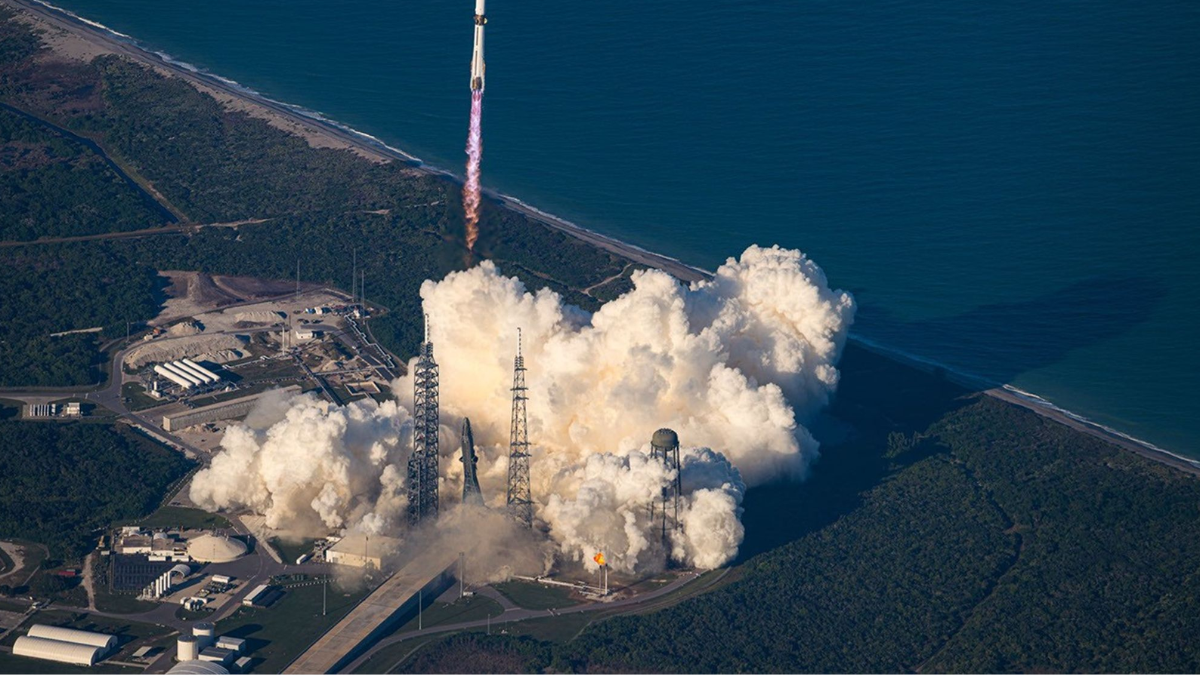
NASA’s ESCAPADE mission will use two identical satellites to study space weather from Earth to Mars. Scheduled to launch in 2025, it will observe how the Sun’s charged particles (the solar wind) interact with Mars’s magnetic field and atmosphere. By tracking these interactions, ESCAPADE aims to learn why Mars lost its once-thick atmosphere (which may have supported liquid water and life) and how solar storms shape the planet’s environment.
NASA’s Twin-Satellite Mars Mission
According to NASA, ESCAPADE is the first mission to pair two orbiters around Mars. The two spacecraft will orbit Mars side by side, giving a stereo image of the Martian magnetosphere. They will follow each other in the same orbit and then change to different orbits, enabling scientists to establish cause and effect. For example, one spacecraft can measure the solar wind conditions while the other spacecraft measures the atmospheric response. The two-point sampling will show how solar wind causes atmospheric escape and climate change on Mars. ESCAPADE is a UC Berkeley mission that is scheduled to arrive at Mars in 2027.



Why Space Weather Matters
Space weather is a term that describes conditions caused by the Sun, such as solar flares, coronal mass ejections, and the solar wind. Solar storms can affect Earth’s technology, causing currents that destroy power grids or disrupt communications and GPS. Solar storms also increase the radiation exposure of astronauts. Mars, on the other hand, is more affected by space weather because it does not have a magnetic shield to protect it from the solar wind, which has stripped Mars of its atmosphere, making it the planet it is today.
Source link
#NASAs #ESCAPADE #Mission #Study #Space #Weather #Earth #Mars