


Anyone who grew up in the ’90s and early 2000s will likely have the Pokémon phenomenon as a core memory. Whether you watched the show and all the “Pokémon” movies, collected the trading cards, played the Gameboy game, or did all three, Pokémon played a huge role in so many kids’ lives. Even if you somehow abstained from all of it, the IP was just part of the cultural wallpaper. As was its de facto mascot, Pikachu, who became a cultural icon in and of himself. Somehow, however, this cute little guy also managed to stir up controversy. No, we’re not cancelling Pikachu. This is a controversy that is really no fault of the beloved yellow pocket monster.
With Pokémon being so ubiquitous for so long, the last thing you’d expect to arise from this multi-generational phenomenon would be a disagreement over how one of its most popular characters looked. Yet, it seems Pikachu is at the center of this unlikely debacle. In fact, he’s at the center of one of the most prevalent examples of the Mandela Effect in recent years.
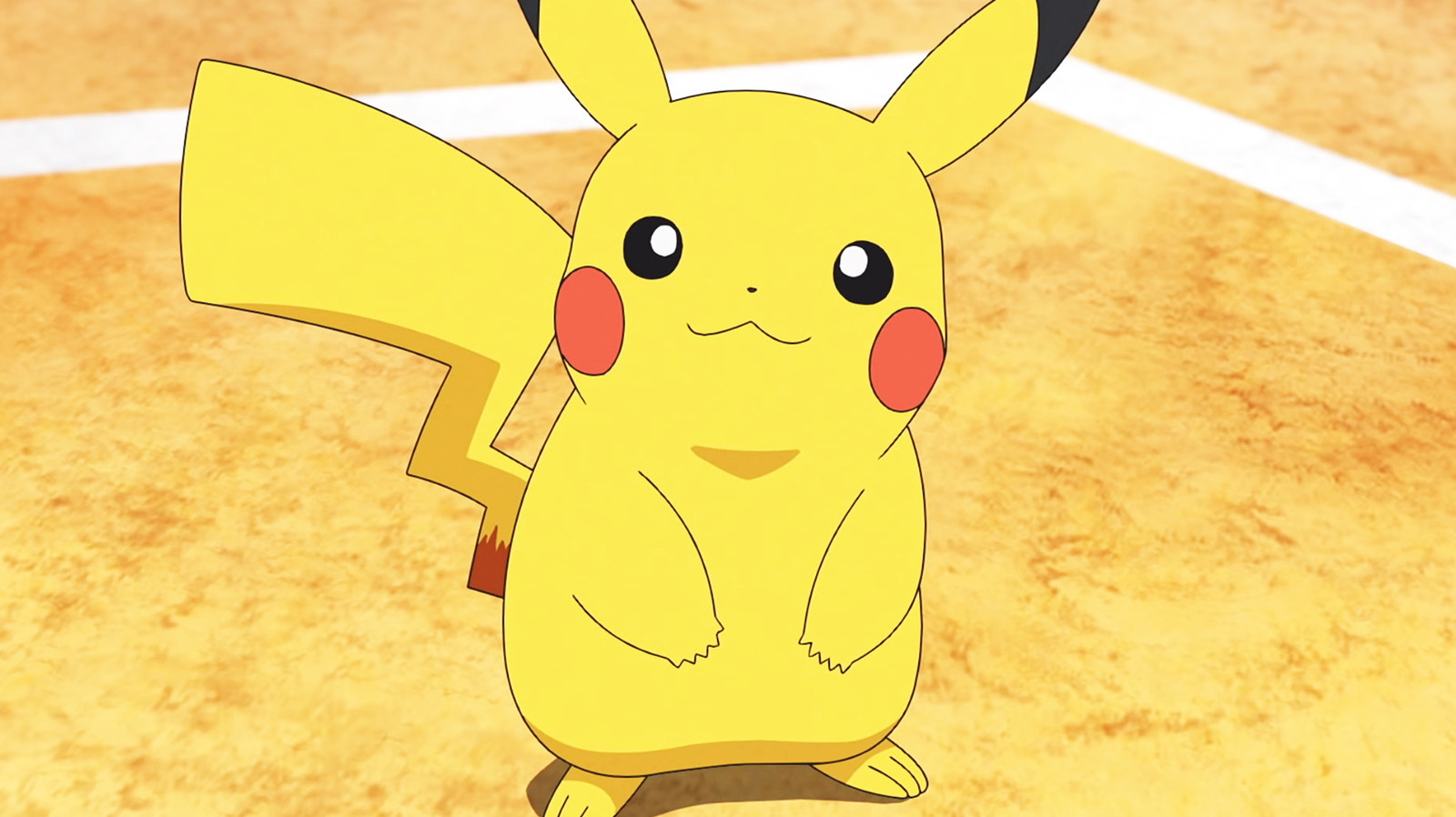
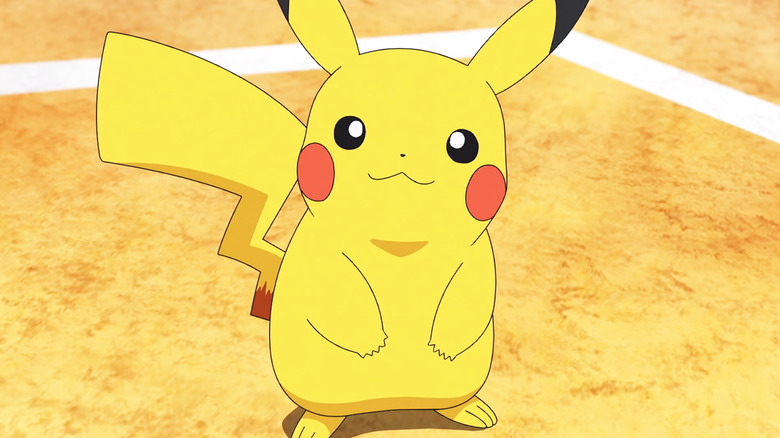
It seems many of us ’90s and 2000s kids remember Ash’s sidekick having a black tip to his tail but in reality, Pikachu’s tail has always been all-yellow. If that seems weird to you, then you too are a victim of this Poké-Mandela effect. But fear not. Below is everything you need to know in order to understand this strange and perplexing phenomenon.
Pikachu never had a black-tipped tail
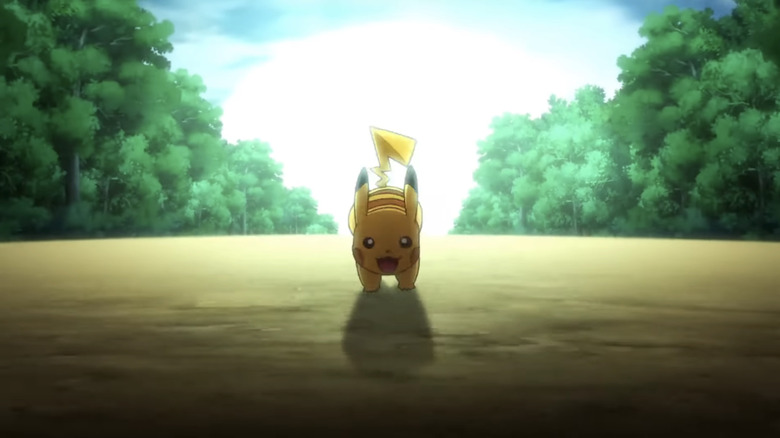
“Pokémon” first debuted as two Gameboy games: “Pocket Monsters Red” and “Pocket Monsters Green.” Both were released in Japan in 1996 before the United States received its own versions of the games in “Pokémon Red Version” and “Pokémon Blue Version.” These games saw players choose between three starting Pokémon: Bulbasaur, Charmander, or Squirtle. But when the “Pokémon” anime debuted in 1997, its protagonist Ash Ketchum was joined by an electric-type Pokémon called Pikachu.
Pikachu had been a part of the original games but was by no means a mascot for the franchise at that point. But by the time the anime caught on and “Pokémon Yellow Version: Special Pikachu Edition” arrived in Japan and the United States in 1998 and 1999 respectively, he had come to represent the entire IP. His appearance during those early years was slightly different, but only in the sense he was a more plump Pokémon. In both the games and on the trading card illustrations, Pikachu was less athletic than he would become by the time “Pokémon” concluded the journey of Ash and Pikachu in 2022. One thing that he didn’t have back in those days, however, was a black tip on his tail.
From the moment he was introduced, Pikachu had a mostly yellow tail. That said, the original Pikachu Pokémon card and the Gameboy version of the creature depicted him with a brown hue at the base of his tail, a design feature that has remained in various forms throughout the Pokémon franchise. Even the nostalgic, heartfelt adaptation “Detective Pikachu” featured a CGI version of the critter with a brown section on the base of his tail. Otherwise, Ash’s Pokémon always had an all-yellow tail.
Some fans are convinced Pikachu originally had a black-tipped tail

The Mandela Effect is well-known by now, but for those who have yet to encounter this odd phenomenon it essentially refers to a mass misremembering of a specific detail or event from history. The phrase comes from paranormal researcher Fiona Broome, who in 2009 started a website dedicated to her experience of believing former South African president Nelson Mandela had died in prison in the 1980s. In fact, Mandela passed away in 2013. Broome noted how numerous others had the same false memory and coined the term “Mandela Effect” to describe it.
Since then, there has been all manner of similar mass delusion. Today, the Mandela Effect subreddit is full of claims that the “Berenstain Bears” were once called the “Berenstein Bears” and that the Fruit of the Loom logo once featured a cornucopia. Heck, even one of James Bond’s worst movies is a prime example of the Mandela Effect and Sinbad almost made the Mandela Effect real with a “Shazam! Fury of the Gods” cameo. Pikachu is just another of these numerous examples.
So what is it exactly that fans are claiming? Well, it’s as simple as believing that when Pikachu first appeared and for most of the early years of the Pokémon franchise, the tip of his tail had a black marking. Some say it had jagged edges like those of the Pokémon’s tail itself. Others say it was just a simple black line at the top of the tail. But the claim essentially is that Pikachu had a black-tipped tail and that at some point the Pokémon overlords switched things up and pretended he always had an all-yellow tail.
What might explain the Pikachu Mandela Effect?
As with most examples of the Mandela Effect, there is plenty of ostensible evidence to suggest that the yellow tail believers are correct. None of it proves anything, but for adherents, it appears to be convincing. Reddit is full of users claiming to have “solved” the issue with images of knockoff Pikachu plushies, figurines,and supposed official illustrations.Unfortunately for the faithful, none of these examples prove the claim that Pikachu had a black tail tip. But there may be some explanations as to why so many remember the electric pocket monster in that way.
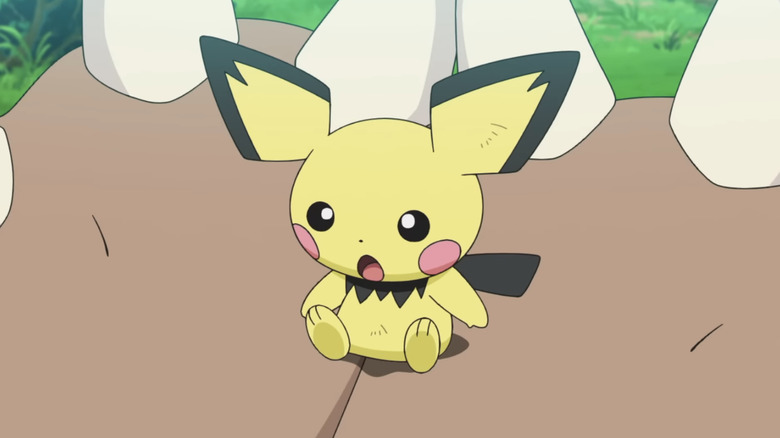
First up is Pichu, the pre-evolution of Pikachu that was introduced in the Generation II video games, “Pokémon Gold,” “Pokémon Silver,” and “Pokémon Crystal.” This Pokémon had an all-black tail and it’s possible this might have contributed to the confusion around Pikachu’s own tail. Another potential contributor to this Mandela Effect could be the Pikachu introduced in the 2014 games “Pokémon Omega Ruby” and “Pokémon Alpha Sapphire.” Cosplay Pikachu, as this female variant was called, featured a black heart shape at the tip of her tail, and this may have helped bolster the false memory of a black tail tip on the original Pikachu.
Beyond that, there’s the fact that Pikachu did have a dark brown tail base, which he retained in “Detective Pikachu,” a film that revived many Poké fans’ love for the franchise. There’s also the fact that his appearance has changed in subtle ways over time. Then, there are the believers who claim we’ve all had our memories wiped by CERN or the illuminati or something. Otherwise, you could watch the entire “Pokémon” franchise in order and find no actual proof that the character ever had a black tail tip.
Source link
#Pokemon #Black #Tail #Pikachu #Mandela #Effect #Explained #SlashFilm