Labour market resilience in the UK has spiked in recent years, thanks to a strong structural and policy response to the potential of AI technologies – a new study suggests. However, as other countries make ground on Britain’s early technological leadership, the path ahead may not be so clear.


Whiteshield is a global advisory firm known for our ability to respond to global challenges rapidly and incisively. In collaboration with the Global Alliance in Management Education (CEMS) and hosted by IHC, the consultancy has launched the Global Labour Resilience Index (GLRI) 2026 at the IHC House in Davos, alongside the World Economic Forum Annual Meeting. The Index assesses labour-market resilience across 120 economies in a world increasingly shaped by rapid AI-driven technological change and deepening global fragmentation.
It also considers what skills business graduates will need to secure entry level employment in a rapidly changing world. While artificial intelligence continues to dominate global debate, this year’s findings show that trade disruption has become a major additional force shaping jobs, wages, and labour-market stability.
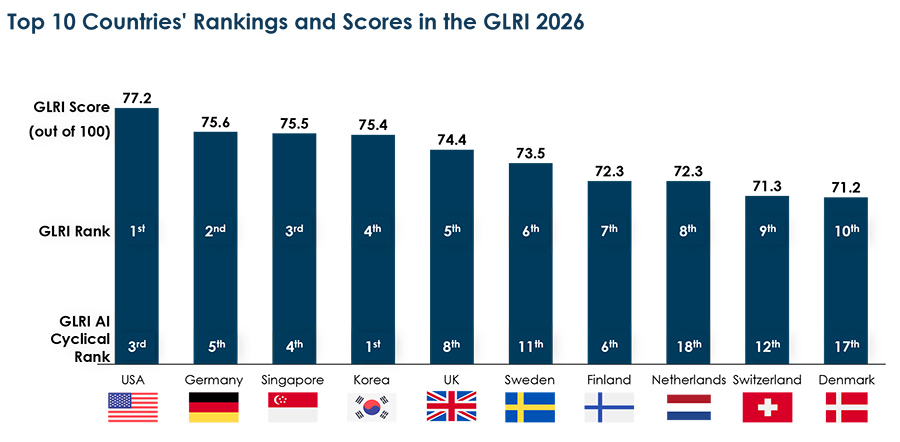
Source: Whiteshield
According to the researchers, the 2026 index shows that labour markets are now shaped by the interaction of two structural forces: rapid technological acceleration and a more fragmented, shock-prone global economy. As technology advances faster than institutions adapt, and global integration gives way to disruption, labour-market resilience has become a central test of economic governance.
Sir Christopher A. Pissarides, Nobel Laureate and Professor of Economics at the London School of Economics, commented, “The era of temporary shocks is over. With AI reshaping work from within and fragmentation reshaping economies from the outside, resilience is no longer about recovery. It is now the ability to keep pace with a world that never stops changing and to build labour-market systems that can adapt before pressures turn into crises.”
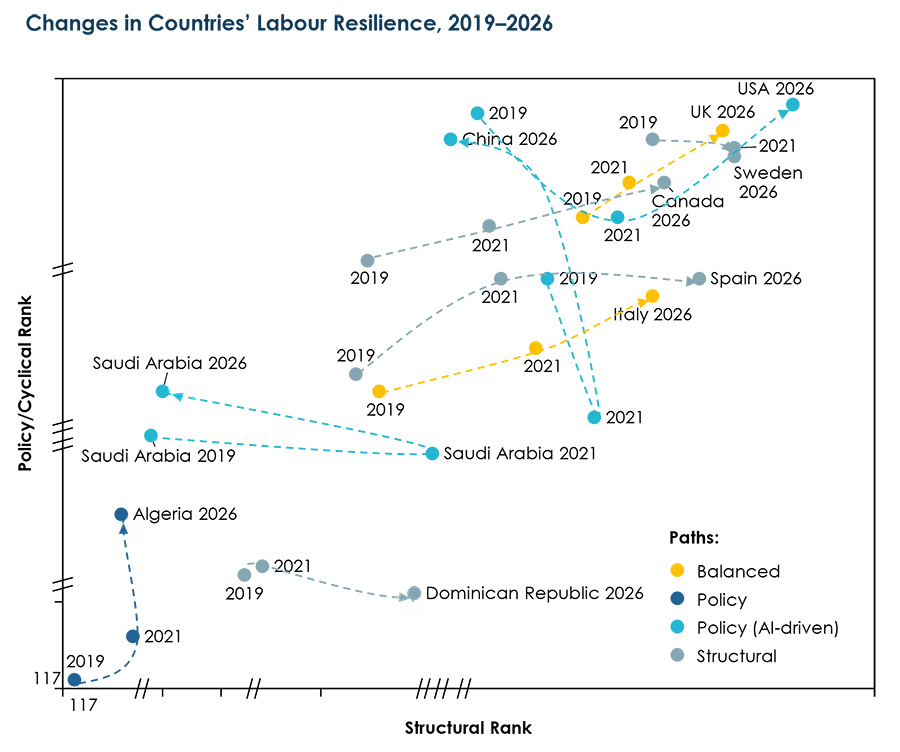
While the United States remains the world’s most resilient labour market, according to the researchers, its position is coming under challenge due to this trend around AI. In particular, the US no longer leads in AI-specific labour resilience, now topped by China and Korea. Overall, therefore, Germany and Korea recorded the strongest gains among top-ranked countries, rising to second and fourth place, while China remains in the second decile of the global ranking.
Source: Whiteshield
The UK also saw significant improvement, however. The researchers found that because AI disruption initially widened global labour-resilience inequality, benefits concentrated among early technological leaders, which alongside the US and China, included Britain.
While the variation in AI-dimension rankings has decreased in the last year, indicating that more countries are catching up in AI adoption, innovation, and integration, it has still helped the UK to boost both its structural and policy maturity for labour market resilience. But the national economy will need to do more to continue this improvement in the coming years, as the surrounding pack catch up.
Fadi Farra, managing partner at Whiteshield, added, “Technological leadership alone is not enough and neither is traditional openness. The economies that will define the next phase of globalisation are those that build institutional agility and align their approaches to technology, trade and skills. That alignment is the basis of a more competitive and more inclusive future.”
Source link
#labour #resilience #rises #due #policy #response