At Cengage, we believe every student deserves access to high-quality tools and meaningful educational experiences. That’s why accessibility best practices are an ongoing process integrated into our product development lifecycle.


We recently spoke with Justin Tumelaire, Senior Manager of Accessibility at Cengage, to discuss the work our teams are doing to advance educational equity.
Describe your role at Cengage
As Sr. Accessibility Manager, I work with a team that supports different groups across Cengage to evaluate our products against accessibility requirements, including WCAG 2.2 guidelines. We evaluate products, create accessible documents and participate in cross-functional working groups to plan and implement enhancements. This is across a portfolio of thousands of digital resources. The work is complex and dynamic, but central to what we do.
Equally important, we directly support our customers when they have questions or experience challenges related to accessibility.
What do you wish people better understood about accessibility?
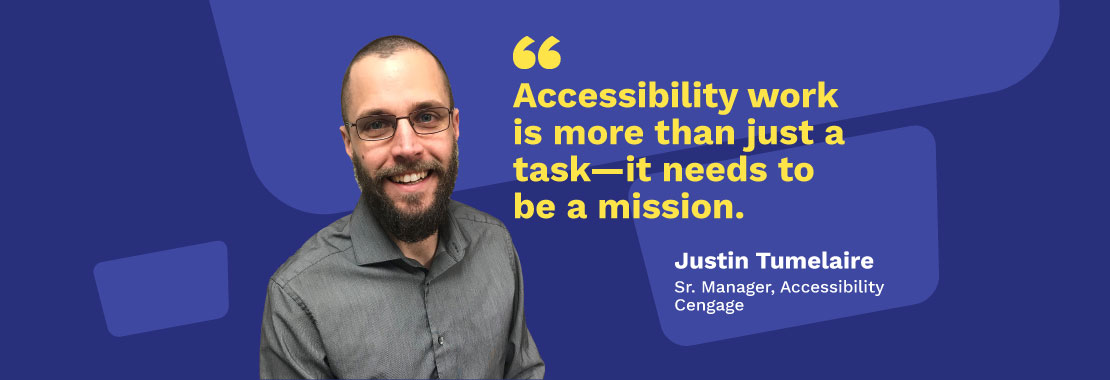
Accessibility work is more than just a task — it needs to be a mission. There are criteria that guide the development of accessible products. However, people are the driving force that makes these products come to life. This is only possible when we’re conscientious and deliberate in our efforts. Accessibility must not be an addition to workflows, but an integrated part of them.
Accessibility isn’t just about compliance. The question shouldn’t be, “Are you accessible?” It should be, “Do you provide students and educators with the tools they need for a meaningful classroom experience?” While compliance is critical, usability can get lost in the quest to comply. It’s not just compliance we need to achieve. It’s also about enriching teaching and learning for all.
What is Cengage’s approach to learning experiences?
If learning isn’t accessible for everyone, we can’t achieve our goals. And worse, we’d be preventing students from achieving theirs. Our aim is to create an impactful experience for all our students and instructors who rely on us to help provide quality learning.
How is Cengage working to improve accessibility?
Across our products and videos, we include features like alternative text, closed captions and transcripts to support diverse learning styles. We also embed accessibility best practices throughout product development, backed by clear guidelines, ongoing training and built-in accessibility checks, as part of our ongoing process for evaluating alignment with Cengage guidelines and WCAG standards.
Additionally, our nationwide Research Advisory Board, made up of accessibility professionals from higher education institutions, reviews our features and helps guide our strategy. This review process provides feedback on how our features align with WCAG 2.2 Level AA criteria, while continuously improving the overall user experience. We also have a dedicated team of Digital Accessibility Specialists who partner closely with Disability Support Services offices to better understand and address learner needs.
We remain committed to improving accessibility across Cengage’s Learning Platforms, including MindTap, WebAssign and CNOWv2. Updated Voluntary Product Accessibility Templates (VPATs) will also be available in the summer of 2026 for each platform.
What are you excited about when it comes to Cengage’s accessibility efforts?
The future. As we progress in our journey, I am thrilled with our transformation from accessibility being something we “do” to being who we are, part of our identity. It’s more than checking a compliance box. It’s about creating transformative learning experiences that can positively influence our students and future generations.
Interested in learning more about accessibility and educational equity at Cengage? Visit our accessibility page.
Source link
#Advancing #Educational #Equity #Accessibility #Cengage #Blog