
The design of your consulting firm determines your bottom line profit.
(Note: If you’re a solo consultant, firm design applies to you too.)



Reading articles should be fun, so hum a throwback tune from the 1980s for the next couple of minutes: Walk Like an Egyptian. (Performing the associated hand motions will enhance your reading experience.)
Pyramid
Most traditional companies resemble an Egyptian pyramid: roughly triangular with underlings toiling away at the grunt work.
Huge consulting firms follow this model with a few high-paid pharaohs reigning atop a cascade of increasingly junior people.
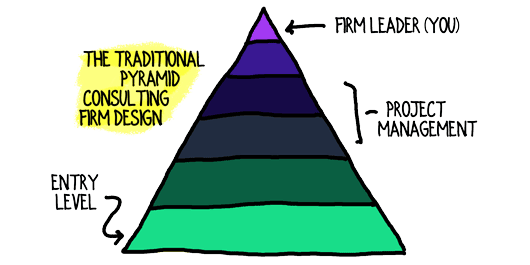
Unfortunately, pyramids work poorly for boutique consulting firms—it’s frustratingly difficult to increase net profit per partner while revenue grows.
Flat
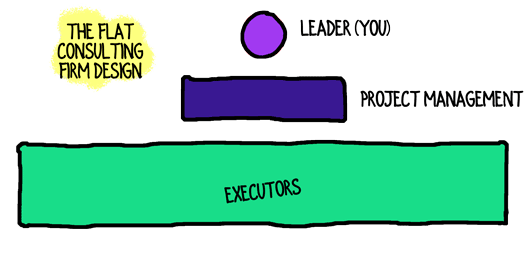
Flat organizations are one answer. They cut out layers of bureaucracy and are akin to the pharaoh overseeing the hordes of laborers himself. Alas, flat designs introduce a host of other problems.
Barbell
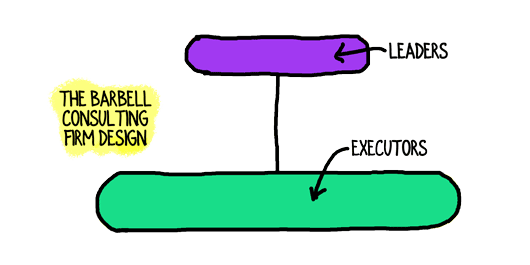
Quite a few boutique consulting firms operate in a variation of the flat organization: the barbell.
In a barbell firm, partners hire a cadre of entry-level analysts to take on the grunt work, but leave out the project-management layer.
Barbells are heavy to lift and the growth potential is painfully limited.
We also see reverse barbells, where a large group of partners try to operate with virtually no organization other than a few analysts and a pool of contract analysts.
These days, more reverse barbells are being attempted with AI filling much of the bottom layer.
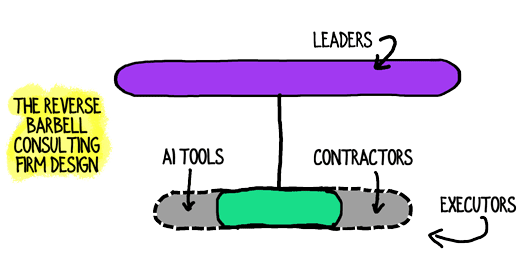
Reverse barbells can succeed up to a point, if the layer of contractors is very robust.
However, the top of reverse barbells tends to be unstable and as the top expands, the structure usually breaks.
Dot
The dot describes many solos operators. One person doing everything. Zippo leverage, plenty of stress, and capped revenue.

Diamond
A much more workable structure is the (ancient Egyptian) girl’s best friend: diamond.
The diamond design focuses on the overseers project-management layer. Strong project-management creates the maximum leverage.
Diamonds are becoming more popular as AI tools replace the need for entry level personnel who can perform basic tasks.
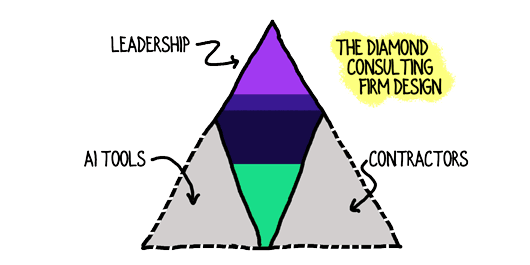
An advantage of the diamond design is the project-management layer allows you, at the top, to focus your energy on what you do best: win business, manage relationships, and add value to projects with your experience and insights.
However, diamonds also leave open the question of how you source a strong, project-management layer.
The answer?
Christmas Tree
Ancient Egyptians didn’t have Christmas trees—hence, they didn’t develop this design.
A Christmas tree structure emphasizes the project management layer, while preserving a narrow trunk of in-house personnel at the junior levels.
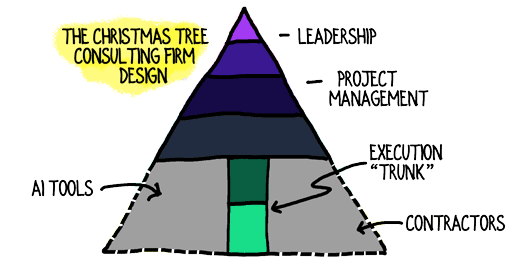
Among the many advantages of the Christmas tree structure is the built-in feeder pool for the project management layer.
Of course, there are also the presents under the tree–but you’ll have to sort through the meaning of that part of the metaphor yourself. ????
Your Next Step
Outsource most of your execution, analysis, number-crunching and other low-level tasks to AI and contractors. (If you want help understanding how to do that effectively, contact me.)
Simultaneously, level up the quality of your project/account management layer.
(If you’re running a solo shop, add outsourced project-management to your setup and, of course, a virtual assistant.)
Shape your organization to maximize your value as the firm’s leader.
Most of your contribution to a typical project, after you’ve won it, can be boiled down to a few minutes of insight, correction and direction.
Almost everything else in your engagements can be outsourced if you stand on a layer of outstanding project management.
What do you see as the ideal shape for your consulting firm?

Text and images are © 2026 David A. Fields, all rights reserved.
Source link
#Reimagine #Consulting #Firms #Shape #Boost #Bottom #Line #David #Fields #Consulting #Group