Assam is poised to witness a polarised election, with the ruling BJP raising the Bangladesh bogey in a bid to retain power for a third consecutive term. On March 15, at a youth conclave organised by the BJP in Guwahati before the announcement of the election dates, Union Home Minister Amit Shah and Chief Minister Himanta Biswa Sarma set the tone for the party’s campaign by focussing on the issue of infiltration. Shah promised to “drive out infiltrators” not just from Assam but also from the country if the BJP wins in Assam again. Sarma said he would roll out bulldozers to evict “Bangladeshis” occupying even one katha (267 square metres) of land if his party was re-elected.
The Congress and other opposition parties, however, have been punching holes in such claims by saying that those evicted are not deported to Bangladesh but are allowed to settle elsewhere. They also accuse the BJP-led coalition of targeting Muslims and creating a big noise over eviction to cover up its handing over of approximately 40,000 bighas (in Assam, 7.5 bighas are equivalent to 1 hectare) of tribal land to “Adani, Ambani, and [Baba] Ramdev” in the name of development projects, a move that has gone largely unnoticed.


On March 1, the second day of the Jan Ashirwad Yatra (February 28–March 9) flagged off by the BJP in the countdown to the election, BJP workers in Jagiroad gave the “bulldozer salute” to Sarma and showered him with flower petals to celebrate the party’s claim that it had evicted “Bangladeshi encroachers” from forest and satra (Vaishnavite monastery) lands.
For his part, Sarma claimed that in his tenure the government had freed 1.5 lakh bighas from “Bangladeshi encroachers” by evicting them from reserved forests, tribal belts, blocks, and government-owned areas. He promised to continue the eviction drive after the election to reclaim more than 5 lakh bighas still under encroachment. BJP State president Dilip Saikia and Sarma’s Cabinet colleagues joined him in the yatra, which covered 34 constituencies. It witnessed an overwhelming turnout.
Assam will have a single-phase Assembly election on April 9 to elect a new 126-member House. This will be the first Assembly election after the delimitation of constituencies in 2023. The delimitation exercise reduced Muslim-majority seats from 29 to 22, effectively eliminating the 7 constituencies where Muslim voters of East Bengal origin could have had a decisive say. This Assembly election will also test Sarma’s popularity: the BJP won the 2021 election under the leadership of Sarbananda Sonowal, who was then replaced by Sarma and moved to the Union Cabinet.
Sarma vs Gaurav Gogoi
Sarma is in the thick of controversy as he tries to consolidate his position within the party with the help of Congress defectors while sidelining the old BJP leaders. Reportedly, internal rifts within the BJP over ticket distribution delayed the finalisation of the party’s list. The Congress came out with two lists for 65 party candidates plus additional 15 seats for its allies—the Assam Jatiya Parishad (AJP), the CPI(M), the All Party Hill Leaders’ Conference (APHLC), the CPI (Marxist-Leninist) Liberation, or CPI(M-L)L—even before the announcement of the election dates on March 15. It announced the third list of 22 candidates on March 19.
Priyanka Gandhi Vadra visits Zubeen Khetra to pay tribute to the late singer Zubeen Garg, in Sonapur, on February 20.
| Photo Credit:
@INCAssam-X/ANI
But the BJP took its time to finalise its seat sharing with the Asom Gana Parishad (AGP) and the Bodoland People’s Front (BPF) and to reach a consensus over tickets given to its own party candidates. Both the BJP and the AGP witnessed revolts over seat sharing and candidate selection. The Congress has already seen resignations over ticket distribution and seat sharing.
With Gaurav Gogoi—the Congress MP from Jorhat and president of the Assam Pradesh Congress Committee—as the opposition’s chief ministerial face, the election in Assam this time will be a direct fight between him and Sarma for the post. Gogoi’s victory from Jorhat Lok Sabha constituency in 2024 rattled the ruling BJP-led alliance as it triggered speculation about the Congress regaining its lost bastions in eastern or Upper Assam and making larger electoral gains in the 2026 Assembly election. The BJP, however, swept the panchayat election of 2025, making it confident of being able to retain the eastern Assam districts, where Assamese and other indigenous communities are in the majority.
The BJP announced its list of 88 candidates on March 19: it features no Muslim candidate. Sarma will contest from his Jalukbari seat while former Assam Assembly Speaker and sitting BJP MLA Hitendra Nath Goswami will contest against Gaurav Gogoi in the Jorhat constituency. The BJP has left 26 seats for the AGP and 11 for the BPF. Veteran Congress leader, Pradyut Bordoloi, who recently quit the party to join the BJP, has been given the Dispur seat. Notwithstanding setbacks like his defection, the Congress is upbeat about the response to the Samay Parivartan Yatra launched by Gogoi in Guwahati on February 5 as a programme to expand voter outreach.
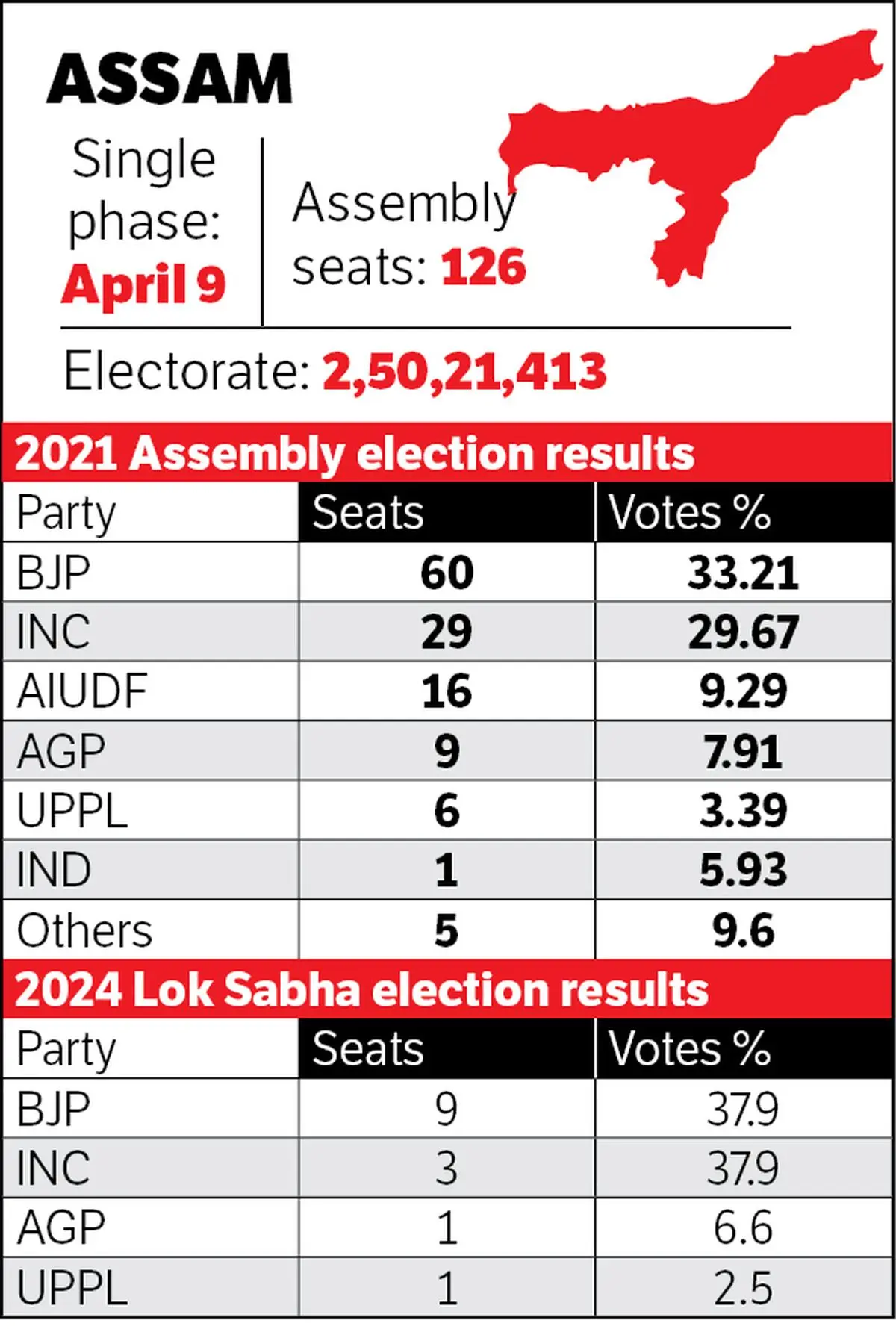
In the 2021 Assembly election, the BJP won 60 seats, the Congress 29, the All India United Democratic Front (AIUDF) 16, the AGP 9, the United People’s Party Liberal (UPPL) 6, the BPF 4, while the CPI(M) and the Raijor Dal won 1 seat each. Before the election, the BJP had forged an alliance with the AGP and the UPPL while the Congress had joined hands with the AIUDF, the BPF, and the Left parties. The mahajot (grand alliance) of the opposition parties managed to win 50 seats. The Raijor Dal and the AJP—two regional parties born as offshoots of the movement against the Citizenship (Amendment) Act—fought each other in 25 seats in 2021.
Modi’s presence
Prime Minister Narendra Modi visited Assam on March 13 and 14, 2026. At the unveiling of infrastructure projects in Guwahati and Silchar, he launched an attack on the Congress.
“For many decades after Independence, Congress governments kept the north-eastern region distant from Delhi and from their hearts. Congress virtually forgot the north-eastern region. But the BJP’s double-engine government has connected the north-eastern region in a way that is being talked about everywhere. Today, the north-eastern region is at the centre of India’s Act East Policy, becoming a bridge that connects India with South-East Asia,” he said.
A woman shows the credited amount under the Orunodoi scheme, in Guwahati, on March 10.
| Photo Credit:
ANI
“The farmers of Assam have received more than Rs.20,000 crore. Just think, in 10 years, we have put Rs.20,000 crore in the pockets of the farmers here. The Congress ruled for 10 years, [one of its] Prime Ministers [a reference to Manmohan Singh] was even elected from Assam, and yet not a single penny was given to farmers,” he said, highlighting the PM Kisan cash payout scheme.
On Day 2 of Modi’s visit, bulldozers were rolled out in Bongora in Kamrup district to evict about 500 families—most of them indigenous Assamese Muslims—from an area that the government claims is a tribal belt.
The eviction came three days after the State Cabinet decided to rename Fakhruddin Ali Ahmed Medical College and Hospital as Barpeta Medical College and Hospital. The medical college was named after the former President who was an indigenous Assamese Muslim with roots in Golaghat district.
After Sarma’s anti-Miya campaign, Assamese Muslims now seem to be in the line of fire. This is being seen as an attempt by the BJP to present an even stronger Hindutva narrative and further polarise the election along religious lines. It is a departure from its earlier strategy of distinguishing Assamese Muslims from Muslims of East Bengal origin, who are often derogatively called Miyas.
The BJP seems confident of retaining power. It is pinning its hopes on lakhs of women voters who are beneficiaries of cash payout schemes like Orunodoi and Lakhpati Baideo implemented by the Sarma government.
On March 10, the Sarma-led BJP coalition government transferred Rs.3,600 crore to the bank accounts of 40 lakh women beneficiaries of the Orunodoi Scheme. Each beneficiary received Rs.9,000. The amount includes Rs.5,000 paid as instalments over four months (Rs.1,250 each month) and an additional Rs.4,000 as a Bihu bonus.
Even though the amount was credited online under the Direct Benefit Transfer system, the beneficiaries were asked to attend official programmes at 3,800 locations across the State to virtually witness the ceremonial transfer of the money by the Chief Minister in Guwahati. But many beneficiaries alleged wrongful exclusion of their names and the inclusion of ineligible candidates.
During his Samay Parivartan Yatra, Gaurav Gogoi alleged that women were being compelled to attend BJP rallies to get the benefits of the schemes. He said that if the Congress came to power, the schemes would be improved and there would be no political pressure on women to attend party meetings.
Sarma claims that Rs.17,000 crore has been transferred so far to women beneficiary accounts under the Orunodoi Scheme. Opposition parties allege that the State government has ended up with a loan amounting to over Rs.2 lakh crore in its effort to fund various cash payout schemes and development projects. But the BJP also hopes to get the support of the 70 lakh households that benefit from the free rice distribution scheme under the Pradhan Mantri Garib Kalyan Anna Yojana.
Confusing arithmetic
The election arithmetic of the opposition parties was on the verge of going haywire, with the Congress and the Akhil Gogoi-led initially Raijor Dal failing to reach a consensus over seat sharing, particularly in a few Muslim-majority constituencies. Efforts were on to field a single opposition candidate against the National Democratic Alliance (NDA) and the AIUDF, but the Raijor Dal announced that it would go it alone. After negotiations, the Congress has left 11 seats for the Raijor Dal and agreed to a friendly contest in two seats.
The opposition alliance this time consists of the Congress, AJP, Raijor Dal, CPI(M), CPI(ML) and APHLC. Congress will contest from 98 seats, AJP 10, Raijor Dal 13, CPI(M) 2, CPI(ML) 1, and APHLC 2. Akhil Gogoi upheld Gaurav Gogoi as chief ministerial face of the opposition bloc and urged people to defeat Himanta Biswa Sarma and the BJP-led alliance.
Gaurav Gogoi ruled out any electoral alliance with the AIUDF this time. Several legislators and leaders have deserted the AIUDF as its influence wanes among its chief support base: Muslims of East Bengal origin. Hoping to gain from the shift, the Congress is keen not to let the Raijor Dal replace the AIUDF.
Hagrama Mohilary, chief executive member of the Bodoland Territorial Council (BTC) since 2025, hopes to be the kingmaker this time as the 15 seats in the Bodoland Territorial Region (BTR) have become a significant electoral bloc. Mohilary’s BPF recently made a comeback in the BTC, a tribal autonomous council under the Sixth Schedule of the Constitution. The BTC enjoys legislative, judicial, and administrative autonomy in the BTR. The backing of Muslims of East Bengal origin played a crucial role in Mohilary’s win in the 2025 BTC election.
The BJP has reached a seat-sharing agreement with the BPF. Of the 15 seats in the BTR, the BPF will contest in 11 and the BJP in 4. The BJP has kept the door open for a post election tie-up with the other BTR party, UPPL, too in case it requires its support to form the government.
The BJP wanted to enter into an agreement both the BPF and the UPPL as constituents of the National Democratic Alliance. That did not happen as Mohilary ruled out any seat adjustment with the UPPL within the BTR. The UPPL has now decided to quit the NDA and contest all the 15 seats in the BTR and the 6 seats outside it, while keeping the post election options open.
Tribes’ damands
A major plank for the opposition has been the list of Scheduled Tribes. This list has been sought to be expanded with the inclusion of six more communities: Tai-Ahoms, Koch-Rajbongshis, Morans, Mataks, Chutias, and tea-tribe Adivasis.
The movement gained momentum in 2025 when lakhs of people belonging to the six communities took to the streets and issued an ultimatum to the BJP-led coalition government to grant them ST status before the 2026 Assembly election. In November 2025, the State Cabinet approved the report of the Group of Ministers (GoM) proposing the creation of another category, ST (Valley), in addition to the existing categories: ST (Plains) and ST (Hills).
Meanwhile, organisations representing the existing 14 ST communities in Assam have insisted that the granting of ST status to the 6 communities must not affect their rights and reservation. The issue is still hanging in the balance as the State government is yet to send the GoM report to the Central government for the necessary constitutional amendments and framing of rules. The opposition parties have taken up this issue.
Prime Minister Narendra Modi distributes land pattas to tea workers of Assam on March 13 in Guwahati.
| Photo Credit:
ANI
Meanwhile, the BJP also hopes that the granting of land pattas (deeds) to tea garden workers’ families, increasing the daily wage of garden workers to Rs.280 in the Brahmaputra valley and to Rs.258 in the Barak Valley, the release of one-time financial assistance to permanent and casual garden workers, and development initiatives like the construction of schools and roads will work to its advantage in the garden areas. The opposition campaign in these parts has centred on the grievances of the Adivasi and other tea garden communities over the delay in the recognition of their ST status.
Modi distributed digital land pattas among tea garden workers in Guwahati on March 13. The Prime Minister’s frequent visits to Assam suggest that the BJP is leaving no stone unturned in putting up a formidable challenge to the Congress under Gaurav Gogoi.
On February 19, Congress leader Priyanka Gandhi Vadra (who is also chairperson of the Assam Congress screening committee for the 2026 Assembly election) released a 20-point “people’s chargesheet” against the BJP-led government in Assam, alleging widespread corruption against its leaders, its failure to fulfil electoral promises, and accusing Sarma’s family of acquiring 12,000 bighas of land.
Interestingly, a cultural icon is becoming an important factor. The clamour to institute a fast-track court to decide the case of the death of the Assamese music legend Zubeen Garg, who drowned in Singapore in September 2025, is growing. This might turn into a major issue, as Garg has a huge fanbase that supports the secular ideology he upheld in his songs and films.
Sushanta Talukdar is a senior independent journalist based in Guwahati who has extensively covered the north-eastern region. Formerly a writer with The Hindu, he currently edits a bilingual online magazine called nezine.com.
Also Read | Scapegoating, sovereignty, and the unmaking of nations
Also Read | Hate wears a crown in Assam
Source link
#Assam #election #Polarisation #shapes #BJP #Congress #fight