

Equity risk is one of the first things investors notice after entering the stock market, even if they do not know the term at first. You buy shares expecting growth, but prices begin moving almost immediately. Some days they rise, and on other days they fall without any clear warning. At times, even a financially strong company sees its stock price drop.
That is equity risk – the possibility that your investment value may fall because markets react to factors beyond your control.



Take this example
You invest $10000 in shares of different companies.
A sudden market correction of 10 percent brings the value down to $9000 in a short time.
This does not automatically mean the investment is weak. It simply shows how quickly equity markets respond to inflation, interest rates, global events, and investor sentiment.
This article explains equity risk in detail and shares practical ways to manage it inside an equity investment portfolio.
What is equity risk?
Equity risk refers to the chance that an investor may earn less than expected or lose part of the invested capital because stock prices keep changing with market conditions. In equity investing, returns are never fixed in advance.
Here is an example
You invest $6,000 in shares of an airline company before the holiday season, expecting strong travel demand.
A sudden rise in fuel prices increases operating costs across the sector.
Within a few weeks, the share price falls by 5 percent.
Your investment value drops to $5,700.
Even though passenger bookings remain strong, investors may still worry about lower profit margins and start selling the stock.
Equity risk does not always lead to long-term loss. Sometimes prices recover once market pressure reduces. In other cases, the decline continues if the business faces larger financial or operational problems.
Why equity risk exists in every stock market
Equity risk exists in every stock market because prices react to many things at once, not just how a company is performing. Investors watch economic signals closely and even small changes in the broader environment can affect buying decisions. At times, the pressure comes from outside the company itself. A business may continue operating normally but its stock can still face weakness if market confidence starts falling across sectors.
● Slower economic growth often makes investors more cautious
● Inflation can reduce future earnings comfort
● Higher interest rates usually attract money toward safer options
● Policy decisions sometimes affect entire sectors at once
● Global uncertainty often creates sudden market pressure
● A weak result from one major company can influence similar stocks
● Fear during uncertain periods usually increases selling activity
● Wars and geopolitical tensions can disrupt oil prices, trade routes and global investor confidence
Main types of equity risk investors should know
Equity risk does not always come from the same source. Sometimes the pressure affects the whole market, while in other situations the problem begins inside one company or one sector. Here are the main types:
Market risk – Market risk affects a large number of stocks at the same time. This happens when the broader market starts weakening and most stocks face pressure together. During such periods, even companies with stable earnings may not remain unaffected.
Business risk – Here the concern is linked directly to one company. Weak quarterly numbers, rising debt, management issues, or poor expansion decisions often create this type of pressure.
Sector risk – At times, one industry faces difficulty while others remain stable. A rise in fuel prices may affect airlines – while stricter regulation can slow down technology or banking stocks.
Liquidity risk – Liquidity risk appears when a stock does not have enough active buyers or sellers. In such cases, exiting an investment quickly becomes difficult without affecting price.
Event risk – Unexpected developments often create immediate reaction in equities. Elections, new regulations, geopolitical tension or sudden policy announcements can influence prices very quickly.
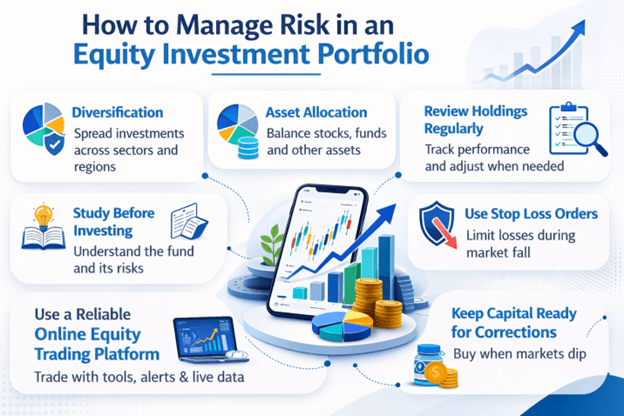
Practical ways to reduce equity risk in a portfolio
Reducing equity risk is less about finding perfect stocks and more about building habits that protect you when markets become unpredictable. Here are some practical tips you can follow:
Diversification
Putting all your money into one part of the market can make your portfolio vulnerable very fast. If banking stocks are under pressure, healthcare or consumer businesses may still remain stable. This is why investors usually spread money across different sectors instead of depending on one area to deliver all returns.
Asset allocation
It also helps to decide how much money should go into each stock before you invest. A company may look promising, but giving one stock too much weight can create avoidable pressure later. If half of your portfolio depends on one company, one weak quarter can affect your confidence and returns together.
Review holdings regularly
Markets change quietly. A stock bought two years ago may now carry more weight than you originally planned. That is why reviewing your portfolio every few months matters. You are not trading constantly, just checking whether any stock has become too large, too weak, or no longer fits your investment thinking.
Use long term discipline
Not every fall needs action. Sometimes prices weaken because of temporary market nervousness and recover later without any major business damage. Many investors create losses by reacting too quickly. If the company remains financially sound – patience often works better than emotional buying and selling.
Study before investing
Before buying a stock, spend a little time understanding how the company actually makes money. A business may look good because the share price has performed well, but that alone is never enough. Check whether sales are steady, debt is under control, and profits are coming from a business model that can sustain itself even when market conditions become difficult.
Use stop loss orders
A stop loss order is simply a safety level you decide before entering a trade. It helps when a stock starts moving against you faster than expected. For instance, if you buy a stock at $1000 and place a stop loss at $920, the order closes automatically once that level is reached.
This way, one wrong entry does not keep turning into a larger loss while you wait and hope for recovery.
Use a reliable online equity trading platform
The platform itself also matters more than many investors realize. When prices move quickly, you need clear information in front of you instead of switching between different sources. A reliable online trading platform helps you track positions, check price alerts, and place orders without unnecessary delay.
Standard Chartered’s online equity trading platform gives access to 10 global stock exchanges, including NYSE and NASDAQ, so you can follow international opportunities from one place. It also allows you to set stop-loss orders, monitor real-time pricing, and manage trades with better control when markets become active.
Keep some capital ready for corrections
One useful habit that many investors ignore is leaving a small portion of capital unused. If markets correct suddenly, you are not forced to watch from outside. You already have room to enter quality stocks at lower prices when valuations become more attractive in the market.
Equity risk vs market volatility
Market volatility means short term price fluctuation. Equity risk means the possibility of losing money if the investment weakens over time.
For example
A stock falls from $500 to $470 after a weak market session and returns to $510 next week. That is volatility. But if the same stock keeps falling because profits decline and debt increases, that becomes equity risk.
In simple terms, volatility is temporary price movement, while equity risk is the deeper possibility of capital loss.
How to measure equity risk before buying stocks
Before buying a stock, it helps to check a few signals that show how much uncertainty may come with it.
Beta – Beta gives a rough idea of how strongly a stock reacts when the broader market changes. A higher beta usually means sharper movement.
Historical performance – Past price behaviour shows how the stock handled corrections earlier, though future movement can still be different.
Financial strength of company – Revenue growth, debt level, and earnings consistency often tell you whether the business can handle difficult periods.
Sector comparison – It also helps to compare the stock with similar companies because risk often looks clearer within the same industry.
Common mistakes that increase equity risk
Many investors add unnecessary risk through decisions that look small at the time but affect returns later.
● Following market hype usually means entering after a stock has already become expensive
● A valuation check matters because even good companies can be overpriced
● Strong price movement should never replace checking business fundamentals
● Too much buying and selling often creates avoidable mistakes
● Short-term market noise pushes many investors to exit too early
Can equity risk be fully eliminated?
No, equity risk cannot disappear completely in stock investing. It can only be managed with better choices, proper allocation, and patience over time. Every stock with growth potential carries some uncertainty, so a certain level of risk always stays part of the investment journey.
Wrapping up
Equity risk will always remain part of stock investing because returns never come without uncertainty. What matters more is knowing how much risk you are taking and whether your portfolio can handle it. Investors who understand this early usually make steadier decisions, especially when markets become uncomfortable for a while
Source link
#Manage #Risk #Equity #Investment #Portfolio





