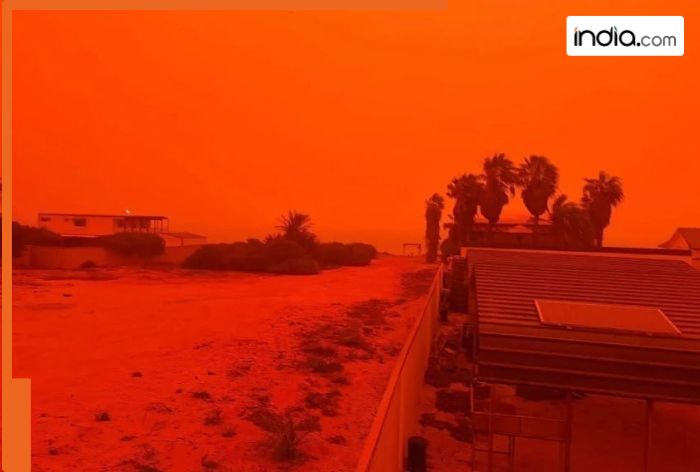



In a shocking phenomenon, the skies in Western Australia turned an eerie shade of red. This turned the atmosphere apocalyptic leading people to question the phenomenon. Several users took to social media platform X to raise concerns

Published: March 29, 2026 3:56 PM IST
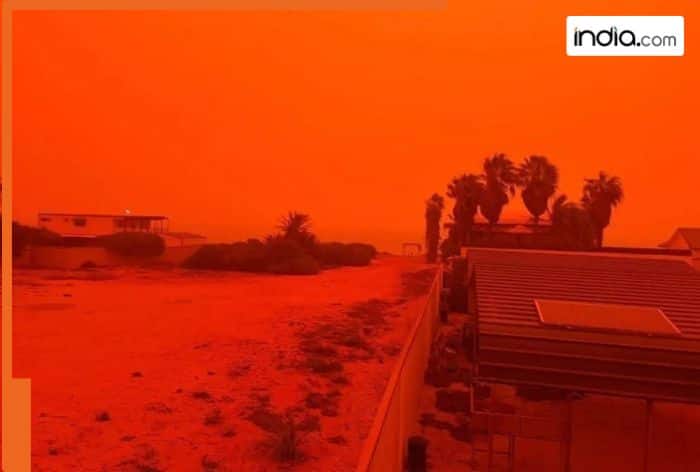
An apocalyptic scene unfolded over the skies of parts of Western Australia when they turned an eerie shade of red. The scenes unfolded due to massive dust storms triggered by Tropical Cyclone Narelle.
The incident took place on March 27 when the horizon in regions including Shark Bay and Pilbara turned a deep shade of red. While people may wonder if it is a filter used while capturing the videos and images, it is actually a natural occurrence.
Here is all you need to know about the occurrence.
What happened in Australia?
In a head-scratching incident, the skies of Australia turned red on March 27. The regions along the Shark Bay and Pilbara experienced a deep, red hue after a powerful atmospheric event took place, triggered by Tropical Cyclone Narelle.

INCROYABLE !#viral
❗ Une tempête de poussière d’un cyclone tropical transforme le ciel en rouge
Carnarvon, Australie pic.twitter.com/twuukSG5Sx
— Philippe T (@brain_stimulus) March 28, 2026
Residents reported the lack of daylight, visibility dropping to zero, and air becoming thick with dust. Videos of the phenomenon went viral on social media quickly. Some of the users claimed that the videos used trickery. While some claimed that the scene looked too dramatic to be real, others added the caption ‘no filter’ to their shares. Yet others argued that the colour had been boosted to enhance the picture.
Why did the skies turn red?
The shift in colour can be attributed to the Tropical Cyclone Narelle, which vacuumed up massive quantities of iron-rich dust from the arid Australia outback, suspending it in the atmosphere to create an eerie crimson daylight.
The dramatic colour shift is explained by the physics of light scattering. Usually, the sky appears blue because of Rayleigh scattering. This occurs when the sunlight strikes the small molecules of nitrogen and oxygen in our atmosphere.
These molecules are much smaller than the wavelength of visible light; they scatter shorter wavelengths, blue and violet, which is why we see a blue sky during the day.
During a cyclone, larger particles like dust and mineral aerosols are lifted from the land. This phenomenon is called ‘mie scattering’ takes over. Mie scattering takes place when atmospheric particles are similar in size to the wavelength of light, unlike Rayleigh scattering.
Here, the dust in Western Australia is rich in iron oxide, also known as hematite, which naturally reflects red light. The larger particles filter out blue and green wavelengths, allowing the longer red wavelengths to dominate, producing a striking crimson glow similar to Mars.
What is Cyclone Narelle?
Cyclone Narelle has been a rare and persistent ‘triple-strike’ storm crossing multiple Australian states. The system initially hit Cape York Peninsula in Queensland on March 20, passed through the Northern Territory, and later picked up strength over the Indian Ocean before arriving in Western Australia.
Reaching Category 4 intensity, the system produced wind gusts exceeding 200 km/h, leading to significant damage, including roofs being ripped off in Exmouth and Coral Bay. By March 29, Narelle had eased to Category 3 and is forecast to weaken further into a subtropical low as it tracks southeast toward the southern coast of Western Australia.
A similar situation occurred in 2009 that turned Sydney’s skies orange. Natural wind erosion, exacerbated by drought, is behind these dramatic scenes.
Source link
#Skies #Australia #turn #bloodred #due #presence #iron #dust #atmosphere #Watch #viral #video