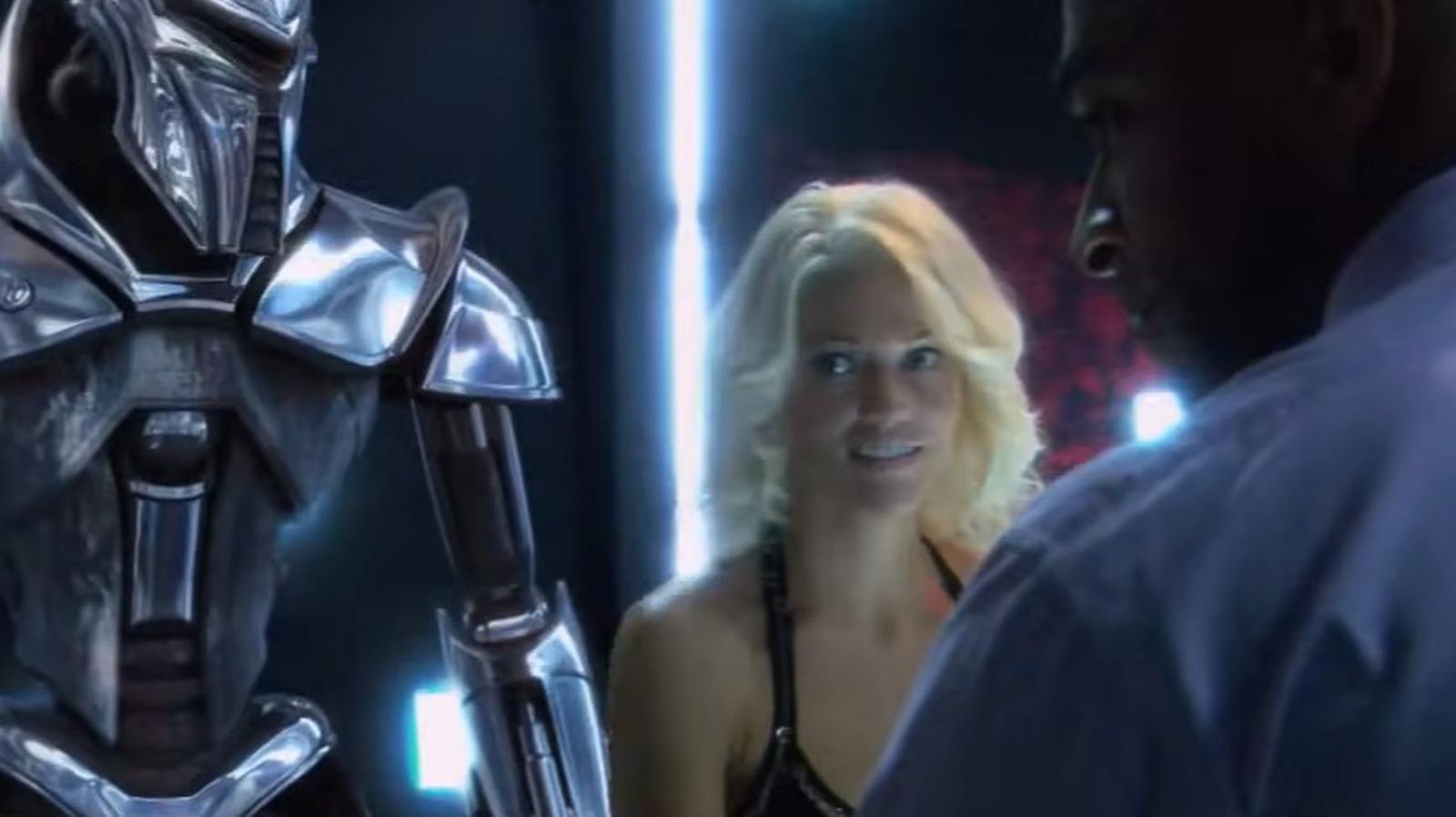

The reimagined “Battlestar Galactica” did some of its most substantial reimagining with the robotic Cylon villains. The original Cylons were boxy robots with synthesized voices created by a vocoder (an effect also used for Soundwave’s voice on “Transformers”). In the remake, the Cylons had some chrome-plated Centurions as soldiers, but the leaders of the Cylon race looked and behaved like humans.
“The Cylons were created by man,” the opening text of every “Battlestar Galactica” episode reminds us, but now they’ve evolved. In co-creator Ronald D. Moore’s series bible for “Battlestar Galactica,” he wrote that: “Just as western Man believes himself to be created in God’s image, the Cylons molded themselves into the likeness of their own creator.”
Ron Moore broke into science-fiction TV writing for “Star Trek: The Next Generation.” On “Battlestar Galactica,” he was motivated to tear down the conventions of “Trek” that had grown to frustrate him. You can see that in his series bible, where he emphasizes the writers should “beware the temptation to make the Cylons into some kind of hive mind,” specifically comparing them to the Borg from “Star Trek.”
“[A hive mind] would only make [the Cylons] automatons constantly linked to some kind of group think. The Cylons are scary and intriguing because they are individuals, yet share a linkage to their brethren unlike anything that mortal man can conceive.”
In a subsequent section outlining the limits of the Cylons’ technology (like no time travel or Death Star style super-weapons), Moore reiterated: “They are not the Borg. When in doubt, remember they are not the Borg!”
On Battlestar Galactica, the Cylons are — despite appearances — individuals
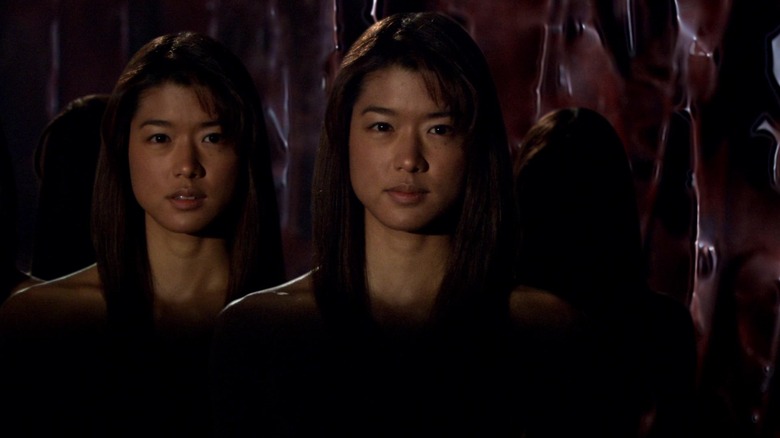
The parts that most mark the humanoid Cylons as machines are the limited number of models, i.e. the Cylons aren’t quite unique individuals but legions of mass-produced clones, and their resurrection technology. When a Cylon dies, they can download their mind into a new body, the way you can backup and transfer computer data.
Yet, even the Cylons that share a model number are still individuals with their own unique minds separate from others of their model. They might share overlapping personality traits, but they have distinct memories and experiences from their “siblings.” Tricia Helfer, who played Cylon Number Six, got to show off her versatility as an actress by playing so many different iterations of Six.
The divide between identical Cylons is also seen with the characters of Boomer and Athena, both Cylons of model Number Eight (played by Grace Park). Boomer is a sleeper agent placed on Galactica as pilot Sharon Valerii, unaware she’s a Cylon but slowly discovering the truth across “Battlestar Galactica” season 1.
Another subplot that season is Boomer’s co-pilot Helo (Tahmoh Penikett) being stranded on Cylon-occupied planet Caprica … where “Sharon” comes to rescue him. The Cylons want to procreate like humans, and they’re convinced the missing ingredient is love. Their plan goes too well because this Sharon loves Helo enough to defect.
While Boomer dies and resurrects with the Cylons, the other Sharon comes to Galactica and is eventually accepted as part of the crew, taking her own pilot call-sign: “Athena.” Late in season 4, Boomer (who has embraced being a Cylon) confronts Athena about how she essentially stole her life, and gets payback by pretending to be Athena.
The Cylons’ lack of a hive mind made them more enduring villains than the Borg
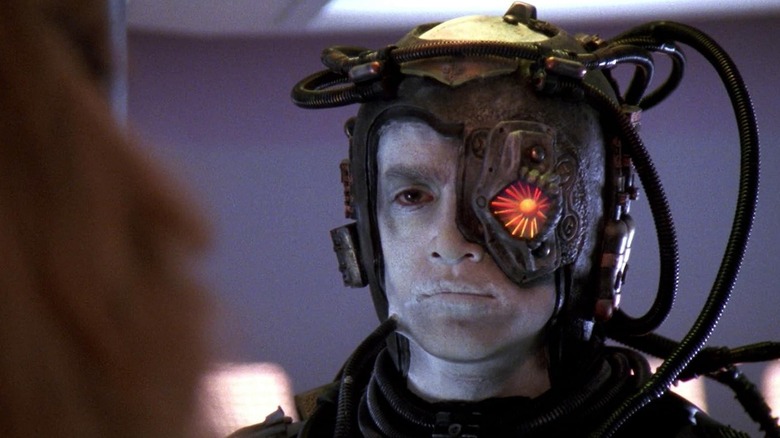
The Borg’s decline as villains is a famous tale to “Star Trek” fans. When the Borg debuted in “The Next Generation” episode “Q Who” they were genuinely terrifying, and easily the scariest villains any “Star Trek” had served up by that point. They’d sacrificed their individuality to a hive mind and their flesh to cybernetics to achieve “perfection.” Individual lives were a resource to consume, and Starfleet had as much luck negotiating with the Borg as ant does with a boot.
But as Borg appeared more and more, they inevitably lost their mystique. An invincible villain can’t stay invincible if you want to have a serialized story. The Borg also slowly became more and more personified, even gaining a leader — the Borg Queen — who humans could talk to individual-to-individual. Thus, their original impression as an incomprehensible terror faded.
In Ronald Moore’s aforementioned series bible, he identified the ethos that “Star Trek” assigned to the Borg (that “perfection” is robotic logic) and discouraged giving it to the Cylons. He wrote:
“[The Cylons] should not develop a ‘better’ Cylon that is no longer modelled on the human form or which tries to purge all the ‘bad’ qualities of humanity. The human form is part of who they are.”
This notion did eventually come up with Cylon Number One/John Cavil (Dean Stockwell), who loathed the confines of his human form and aspired to be a “better” machine. Yet in spite of that, he was just as petty and emotion-driven as any human villain. The Borg were scary at first because of how inhuman they were, but the Cylons remained compelling (and scary) reflections of humanity, because children often repeat their parents’ sins.
Source link
#Battlestar #Galactica #CoCreator #Star #TrekRelated #Rule #Cylons #SlashFilm