

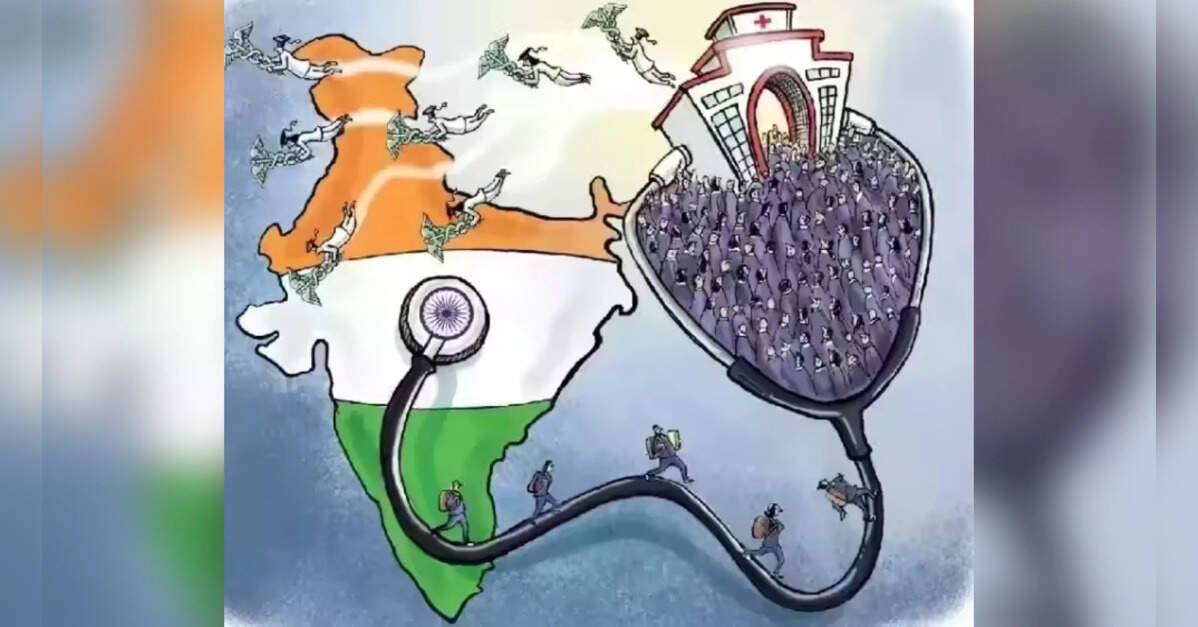



New Delhi: As India prepares for the next phase of parliamentary delimitation, a critical question emerges beyond politics is does changing political representation reshape national healthcare priorities and the way health funding is distributed?
K. Madan Gopal, Senior Health Sector Expert and former Senior Consultant at NITI Aayog, informed us that political representation inevitably influences national policy focus including healthcare investments.
“If more populous states gain a stronger voice in Parliament following delimitation, they may push for greater national attention to maternal and child health, nutrition, primary healthcare, district hospital strengthening, medical education, diagnostics, and human resources for health. These areas remain critical in states with high population density and significant public health challenges,” K Madan Gopal said.
However, he cautions that healthcare financing cannot be determined by population size alone.
“Population reflects scale, but not the full extent of need. Public spending must also reflect disease burden, infrastructure gaps, service deficits, and health outcomes. Only then can health financing remain equitable and evidence-based,” he noted.
Balancing Population and Performance
The debate is particularly sensitive for states such as Kerala and Tamil Nadu, which have historically invested heavily in public health systems and population stabilisation. Some experts worry that if parliamentary seats are redistributed purely based on population growth, these states could lose political influence despite their developmental achievements.
According to NFHS-5, Bihar’s infant mortality rate stands at 47 per 1,000 live births, compared with 6 in Kerala and 15 in Tamil Nadu, illustrating the stark regional disparity in health outcomes across India.
Dr Gopal believes these concerns deserve careful consideration.
India’s fiscal transfer system already attempts to strike a balance. The Finance Commission uses multiple criteria when allocating resources to states, including demographic performance alongside population and other indicators. The ongoing work of the 16th Finance Commission continues to reflect this approach.
“This framework recognises both current need and developmental effort. That balance is essential in a federal country like India,” he said.
Addressing Regional Healthcare Gaps
Several large states, including Uttar Pradesh and Bihar, continue to face significant shortages in doctors, hospital infrastructure, and diagnostic capacity.
According to the World Health Organisation (WHO), the commonly cited benchmark for doctor availability is one doctor per 1,000 population. In India, the doctor–population ratio is estimated at 1:834 when both allopathic and AYUSH practitioners are included, based on data from the National Medical Commission cited by the Ministry of Health and Family Welfare.
Greater political representation for such states could accelerate investments in health infrastructure and help correct long-standing disparities, Dr Gopal observed. However, he emphasised that infrastructure expansion should not be viewed merely in terms of building new facilities.
“Allocation decisions should consider district-level needs, existing facility gaps, human resources availability, diagnostic capacity, referral linkages, and the functionality of healthcare institutions,” he explained.
Primary Healthcare May Gain Renewed Focus
If political influence shifts toward states with higher maternal mortality, malnutrition, and infectious disease burdens, national health policy could see a stronger emphasis on primary healthcare and preventive public health programmes.
But Dr Gopal argues that India must maintain balance across the entire continuum of care from primary care and district hospitals to advanced tertiary services.
Budget allocations already reflect this balance. According to analysis by PRS Legislative Research, around 37 percent of the Union health budget for 2026–27 is allocated to the National Health Mission, while the government’s flagship insurance programme Ayushman Bharat Pradhan Mantri Jan Arogya Yojana accounts for about 9 percent.
Tier-2 and Tier-3 Healthcare Expansion
A shift in political attention toward underserved regions could also accelerate hospital expansion in tier-2 and tier-3 cities. Investments in district hospitals, medical colleges, diagnostic networks, and critical care facilities may become a priority.
Public–private partnerships (PPPs) could support areas such as diagnostics, telemedicine, and equipment maintenance. However, Dr Gopal emphasises that the public health system must remain the backbone of healthcare delivery.
“PPPs should complement a strong public system, not substitute for it. Universal access, emergency care, and public health functions must remain anchored in the public sector,” he said.
The Need for Financing Reform Beyond Delimitation
Public health expert Dileep Mavalankar, Distinguished professor, IIPHG, argues that the debate should go beyond representation and focus on the structure of healthcare financing itself.
According to Dr Mavalankar, nearly 60 to 65 percent of public health spending in India comes from state governments, while the Union government contributes the remaining share. Despite public spending, a large portion of healthcare costs still comes directly from households, placing a disproportionate burden on poorer populations.
He also notes that budgeting processes often create a misleading picture of health spending.
Funds are frequently released late in the financial year sometimes in the final quarter, which limits the ability of states to utilise them effectively. Complex administrative procedures and strict year-end spending rules often cause unspent funds to lapse, creating the impression that allocations were not used.
“In many cases, the budgeting system itself creates a false impression that funds were allocated but not utilised,” he explained.
Dr Mavalankar points out that similar challenges existed in the United States in the past. During the 1990s, some local governments reformed budgeting frameworks to allow unspent funds to roll over into the following year, focusing more on outcomes and estimated expenditure rather than rigid annual allocations.
In contrast, India’s budgeting systems remain largely inflexible and may require deeper structural reform.
Representation, Redistribution and Political Tensions
The broader question, Dr Mavalankar notes, concerns how resources should be redistributed within a federal country.
While it is widely accepted that richer regions support poorer ones through fiscal transfers, determining the extent of such redistribution can become politically contentious. Debates often emerge over whether more efficient or economically stronger states should continue subsidising states with weaker governance or slower development.
If these issues are not carefully studied and addressed through transparent policy frameworks, they could intensify regional tensions.
Global political systems have attempted to balance representation and equity in different ways. In the United States, for instance, every state receives two representatives in the United States Senate regardless of population—a constitutional design intended to prevent larger states from dominating smaller ones.
Beyond Delimitation: The Future of Health Financing in India
In India, delimitation could significantly reshape political representation, which in turn may influence policy priorities, including healthcare financing.
However, experts emphasise that the larger challenge is not simply increasing healthcare expenditure but rethinking how healthcare financing is structured, distributed, and managed across the country.
Ultimately, India’s objective should be twofold expand overall healthcare investment while ensuring that funds are deployed more efficiently and equitably across states.

Source link
#Delimitation #Debate #Political #Power #Shifts #Redraw #Indias #Healthcare #Funding #Map





