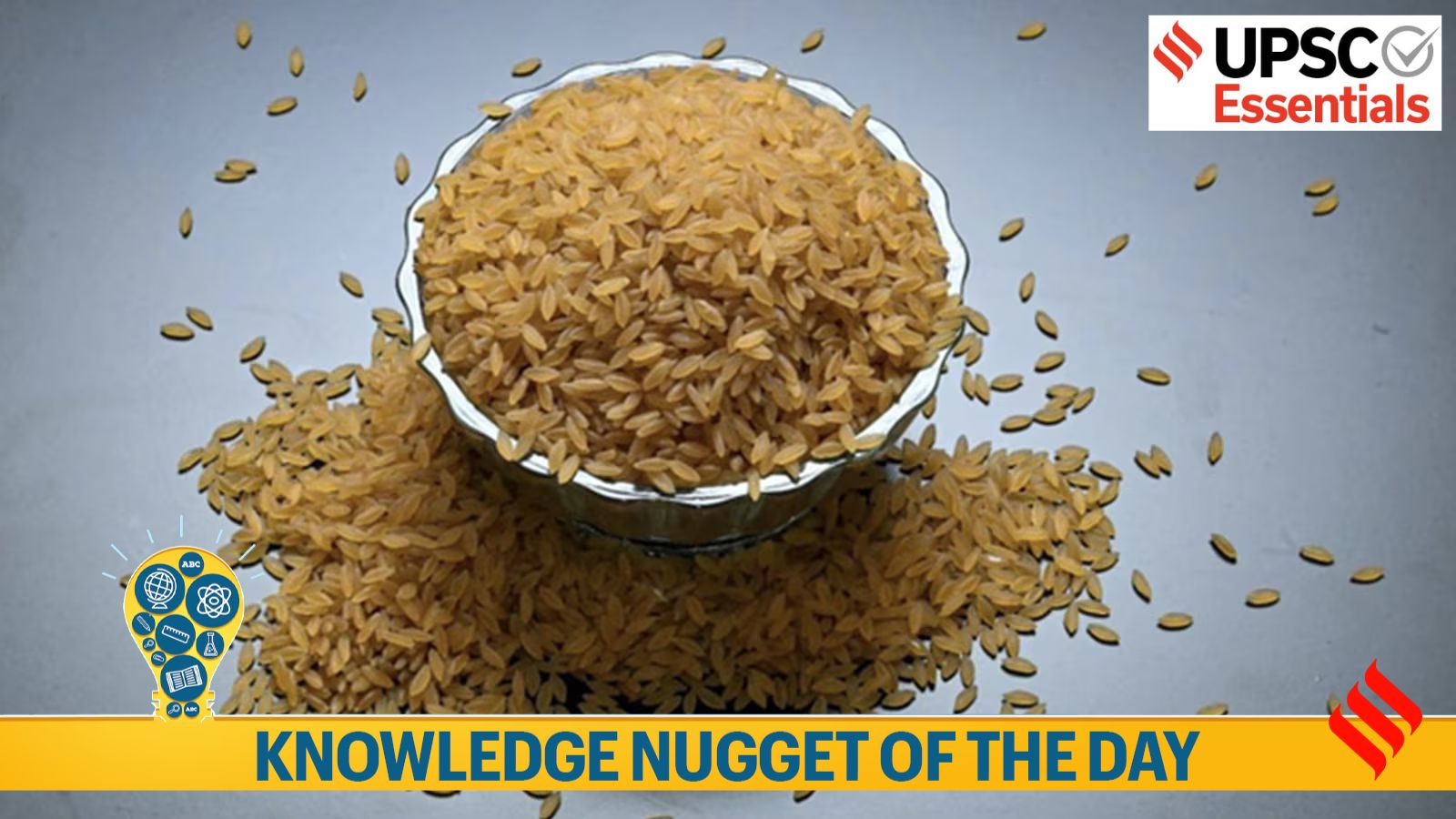
Take a look at the essential concepts, terms, quotes, or phenomena every day and brush up your knowledge. Here’s your knowledge nugget on designer rice for today.
Scientists at CSIR – National Institute for Interdisciplinary Science and Technology (NIIST) in Thiruvananthapuram, Kerala, have developed a “designer rice”. NIIST is a premier interdisciplinary research laboratory under the aegis of the CSIR, Government of India.
Gear up for UPSC Prelims 2026—Practice smarter, revise faster, and succeed with our Special Quiz Magazine. Click Here
During the technology transfer ceremony held on 18th February, 2026, titled “CSIR-NIIST Tech Connect: From Lab to Market”, the rice was officially released. The technology is also officially transferred to TATA Consumer Products Limited and SS Soul Foods, Tamil Nadu.
Key takeaways:
1. The scientists have applied food-processing technology rather than genetic modification to bring this designer rice. It is a “fundamental re-architecture of our most basic staple”.
2. Dr C. Anandharamakrishnan, Director, CSIR-NIIST and the visionary behind the project, noted, “To understand this, imagine a building. If traditional rice is a house made mostly of ‘sugar bricks’ (starch), the CSIR-NIIST team took that house apart. They removed a significant portion of the starch and replaced it with ‘protein beams’.”
3. The team took broken rice ground them into flour, and blended them with protein and micronutrients like iron, folic acid, and Vitamin B12. They then “reformed” this mixture into grains that look, feel, and taste exactly like the rice we know.
Story continues below this ad
Benefits of the Designer rice
* Low GI: According to the scientists, designer rice benefits as it has a low glycemic index(GI) which is below 55. “It releases energy slowly, preventing the sugar spikes that plague diabetics.”
* Protein powerhouse: While normal rice has about 6–8 per cent protein, this version boasts over 20 per cent.
* Fortified defense: It bridges the gap for anaemia by embedding iron, folic acid, and Vitamin B12 directly into the grain’s structure.
4. Highlighting the paradoxical health crisis in India. The scientists see this as one of the solutions to tackle the “Hidden hunger.” Dr. Sudip Karmakar also highlighted this innovation as a champion of a “circular economy.” By using broken rice grains—a byproduct of the milling process—scientists are creating an opportunity for farmers to add value to a resource that was previously underutilized.
Story continues below this ad
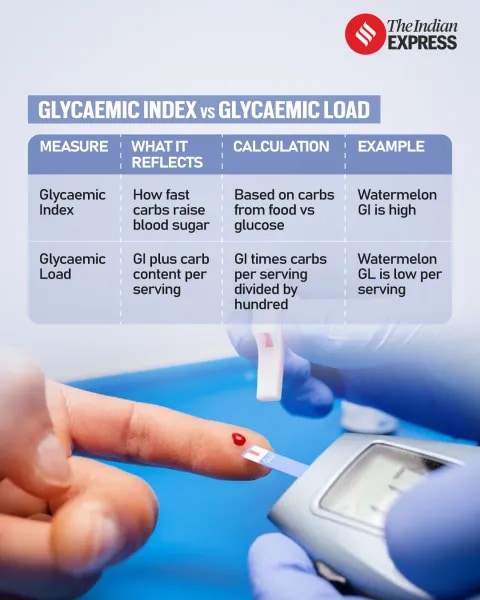
Glycemic index (GI)
5. GI is a measure of how quickly a food can make your blood sugar (glucose) rise. Only foods that contain carbohydrates have a GI. It classifies carbohydrate-containing foods according to their potential to raise the blood sugar levels. It ranks food from 0-100.
6. In general, low GI foods increase glucose slowly in your body. Whole grains, legumes, vegetables, fruit, low-fat dairy products, nuts and seeds raise blood sugar slowly and have a low glycemic index. Low glycemic carbohydrates help in losing weight and keep feeling full longer, improving insulin sensitivity, blood lipids and blood pressure.
Glycaemic Load (GL)
7. Dr Chaturvedi, endocrinologist at Indraprastha Apollo Hospitals, Delhi, GL is a more practical measure because it reflects both the type and amount of carbohydrate consumed. It reflects the actual glycaemic impact of foods as eaten, not just per gram of carbohydrate.
8. GL considers both the GI of the food concerned and the amount of carbohydrates in a typical serving. The formula for GL multiplies the GI by the carbohydrate content per serving and then divides by a hundred. This means that a food with a high GI but low carbohydrate content can have a low GL, and vice versa.
Story continues below this ad
About Rice and its production in India
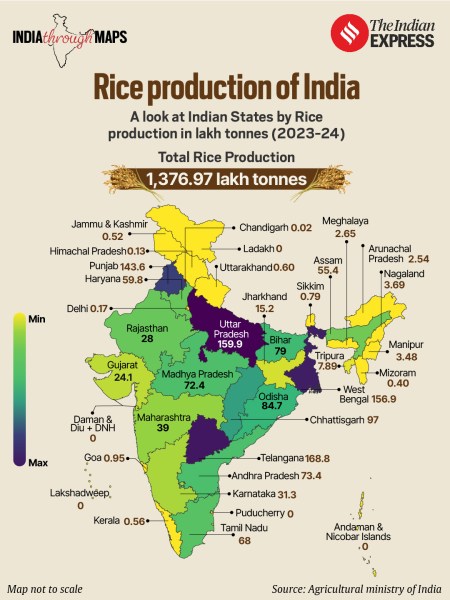
9. In January 2026, the Union Agriculture Minister Shivraj Singh Chouhan said that with the production of around 150 million metric tonnes of rice, India has surpassed China which produces 145.28 million tonnes to become the world’s largest rice producer in 2024-25.
10. Rice crop requires hot and humid conditions, abundant water availability, and alluvial soil (soil formed by the deposition of silt brought by rivers). River flood plains are among the most rice productive regions.
11. A temperature range of 20-37.5 degree celcius is required for its optimum growth. It is grown both during the kharif (southwest monsoon) and rabi (winter-spring) seasons. Moreover, it is cultivated across a wide geography.
Now, let’s understand what fortified rice is and the process of rice fortification.
Story continues below this ad
BEYOND THE NUGGET: Fortified Rice
1. In February 2026, the government decided to temporarily discontinue the process of rice fortification under Pradhan Mantri Garib Kalyan Anna Yojana (PMGKAY) and allied schemes until a more effective mechanism for delivery of nutrients to beneficiaries is identified.
2. The Food Safety and Standards Authority of India (FSSAI) defines fortification as “deliberately increasing the content of essential micronutrients in a food so as to improve the nutritional quality of food and to provide public health benefit with minimal risk to health”.
3. With a high level of malnutrition among women and children; and widespread anaemia among women as per the National Family Health Survey (NFHS-5), fortification of food is considered to be one of the most suitable methods to combat this. Fortifying rice with micronutrients is an option to supplement the diet of the poor.
4. There are various technologies of fortification used to add micronutrients to regular rice, such as coating, dusting, and ‘extrusion’. In India mostly extrusion is used which involves the production of fortified rice kernels (FRKs) from a mixture using an ‘extruder’ machine.
Story continues below this ad
5. Dry rice flour is mixed with a premix of micronutrients, and water is added to this mixture, which is then passed through a twin-screw extruder with heating zones. Kernels similar in shape and size to rice are produced, which, as per Ministry of Consumer Affairs, Food and Public Distribution guidelines, must “resemble the normal milled rice as closely as possible”.
6. The kernels are dried, cooled, and packaged. FRK has a shelf life of at least 12 months. The kernels are blended with regular rice to produce fortified rice. Under the Ministry’s guidelines, 10 g of FRK must be blended with 1 kg of regular rice.
7. According to FSSAI norms, 1 kg of fortified rice will contain the following: iron (28 mg-42.5 mg), folic acid (75-125 microgram), and vitamin B-12 (0.75-1.25 microgram).
8. Rice may also be fortified with zinc (10 mg-15 mg), vitamin A (500-750 microgram RE), vitamin B-1 (1 mg-1.5 mg), vitamin B-2 (1.25 mg-1.75 mg), vitamin B-3 (12.5 mg-20 mg) and vitamin B-6 (1.5 mg-2.5 mg) per kg.
Story continues below this ad
Post Read Question
Consider the following statements about rice fortification:
1. In this, the fundamental building block of rice, starch, is deconstructed and rebuilt with fundamental nutrients.
2. It is provided under the Pradhan Mantri Garib Kalyan Anna Yojana (PMGKAY).
3. It aims to tackle malnutrition and anemia among women and children.
How many of the above statements is/are correct?
(a) Only one
(b) Only two
(c) All three
(d) None
Story continues below this ad
(Sources: Why India’s rice production surge raises concerns over food security, sustainability, What is fortified rice? Why did Centre extend its distribution in schemes?)
Subscribe to our UPSC newsletter. Stay updated with the latest UPSC articles by joining our Telegram channel – IndianExpress UPSC Hub, and follow us on Instagram and X.
🚨 Click Here to read the UPSC Essentials magazine for April 2026. Share your views and suggestions in the comment box or at manas.srivastava@indianexpress.com🚨
Source link
#Knowledge #Nugget #Indias #Designer #Rice #launched #Key #points #UPSC #exam