
What Are Knowledge Pillars?
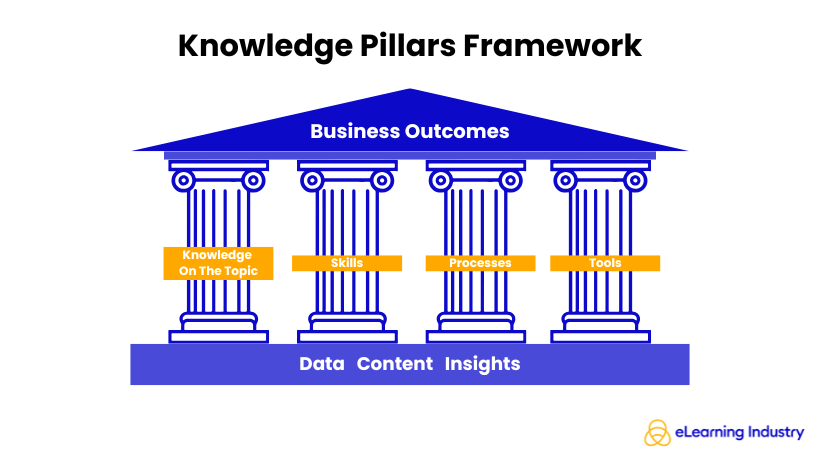
Knowledge pillars are key themes that help organize and deliver information within a learning system or organization. They serve as a framework that ties together content, learning experiences, and performance goals into a unified knowledge structure.
Why are they important, though? Modern L&D has moved from simply creating content to thinking about entire systems. Instead of building separate courses, organizations now create connected learning networks. Knowledge pillars help with this change by organizing content clearly. This makes it easier to understand, remember, and apply skills quickly. These also align with the pillars of knowledge management, ensuring that learning is not only created but also stored, shared, and used effectively.



However, knowledge pillars are not to be confused with topics or skills. They are the main areas that shape a curriculum or learning plan, under which you find specific topics that are focused pieces of content. Now, skills are what learners are expected to do with that knowledge. Together, knowledge pillars, topics, and skills create a system that connects learning with its real-world application.
Table Of Contents
Knowledge Pillars In Instructional Design
Traditional courses often have a straight path: one module follows another, with little connection between them. But modern Instructional Design is changing this. Now, they focus on knowledge pillars, which help connect different topics. This means learning is no longer just a series of isolated facts; instead, everything works together to support a bigger picture.
For Learning Experience Designers (LXDs) and curriculum designers, this approach is crucial. Knowledge pillars help organize content around key topics, making learning clearer and easier to scale. They also fit well with the pillars of knowledge management, ensuring that learning is structured for long-term use and easy access. Let’s see in detail how Instructional Designers use knowledge pillars.
How Instructional Designers Use Knowledge Pillars
Instructional Designers use knowledge pillars to bring clarity and consistency to complex learning environments. Instead of designing standalone courses, they structure entire academies or programs around a defined set of pillars.
These pillars guide:
- Course structure, ensuring all content fits within a clear framework.
- Learning paths, helping learners progress logically across topics.
- Content reuse, enabling scalable ecosystems rather than one-off materials.
When aligned with the four pillars of knowledge management, this approach ensures that knowledge is not only created but also stored, shared, and applied effectively.
For example, in a leadership development program, the curriculum focuses on four pillars: communication, decision-making, emotional intelligence, and strategic thinking. Each one includes a variety of learning materials, practice activities, and assessments. Learners can move between these pillars based on their roles and needs, rather than following a set order. This approach creates a flexible learning experience while still providing a strong structure. It shows how these key areas support both the program’s design and the organization’s overall learning strategy.
Knowledge Pillars Vs. Learning Objectives
Knowledge pillars and learning objectives play different roles in Instructional Design. Knowledge pillars are the main topics that organize content throughout a curriculum or learning system. They provide a framework that helps Instructional Designers create effective learning environments. On the other hand, learning objectives are clear statements about what learners should know or be able to do after a specific learning experience.
Knowledge pillars focus on the big picture, while learning objectives focus on specific outcomes. For example, a pillar like “Data Literacy” may include several courses, each with its own measurable objectives. Understanding this difference is crucial when designing systems that support broader knowledge management goals.
Knowledge Pillars |
Learning Objectives |
| Structural | Outcome-driven |
| Long-term | Session-level |
| Organizing principle | Measurement tool |
When knowledge pillars and learning goals are mixed up, the design of learning can become unclear.
- First, this can lead to a mismatch between the structure and the outcomes. Without clear pillars, the learning goals might not connect to a broader learning strategy.
- Second, it often results in duplicated content. Teams might create similar modules for different goals because there is no shared framework.
- Finally, learners struggle to navigate the material. They struggle to understand how individual courses fit into a larger system, which can lower engagement and reduce knowledge retention.
These problems often highlight gaps in applying the four pillars of knowledge management, especially in how knowledge is organized and shared.
Thus, knowledge pillars and learning objectives are most effective when used together. Pillars define what matters at an organizational level, guiding how knowledge is grouped and prioritized. Objectives, on the other hand, define what success looks like at the learner level by setting clear expectations and measurable outcomes.
The Four Pillars Of Knowledge Management
The four pillars of knowledge management offer a clear, widely accepted framework for organizations to manage knowledge from creation to use. This model sees learning content as part of a system rather than as separate items. It encourages continuous generation, storage, sharing, and application of knowledge. For Instructional Designers, these pillars provide a helpful foundation for creating learning systems that can grow. When these pillars guide the design process, they help turn disconnected content into effective and cohesive learning environments.
1. Knowledge Creation
Knowledge creation is the starting point of any effective knowledge management framework. It involves generating new insights from Subject Matter Experts (SMEs), organizational data, and real-world experience.
In L&D environments, this often includes:
- Capturing expertise from internal leaders.
- Translating tacit knowledge into structured learning content.
- Using performance data to identify emerging skill needs.
Instructional Designers play a critical role here. They do not just document knowledge but shape it into meaningful learning experiences. Without a strong creation process, even the best-designed knowledge pillars will lack depth and relevance.
2. Knowledge Storage
Once knowledge is created, it needs to be organized and stored so it is accessible and usable. This is where systems like LMS platforms, LXPs, and knowledge bases come into play.
Effective storage means:
- Structuring content into clear categories and domains.
- Aligning materials with defined knowledge pillars.
- Ensuring content is searchable and easy to update.
Poor storage leads to duplication, outdated content, and low engagement. For Instructional Designers, this pillar is essential to maintaining a scalable curriculum design framework that supports long-term growth.
3. Knowledge Sharing
Knowledge only creates value when it moves across the organization. Knowledge sharing focuses on distributing insights through formal and informal channels.
This includes:
- Social learning environments
- Peer-to-peer collaboration
- Communities of practice
Modern learning systems rely heavily on this pillar. Instead of top-down delivery, knowledge flows through networks. When aligned with knowledge pillars, sharing becomes more intentional, ensuring that the right information reaches the right audience at the right time.
4. Knowledge Application
The final, and most critical, pillar is knowledge application. This is where learning translates into action and measurable performance outcomes.
Application happens when:
- Employees use knowledge in real work scenarios.
- Learning is embedded into daily workflows.
- Performance improves as a result of learning interventions.
For Instructional Designers, this pillar shifts the focus from content delivery to impact. It ensures that learning is not just consumed but actively used, reinforcing the value of both the knowledge management framework and the underlying knowledge pillars.
Aligning Knowledge Management Pillars With Learning Design
The true value of the pillars of knowledge management emerges when they are integrated into learning design. Together, they create a bridge between knowledge management and L&D strategy.
- Knowledge creation informs content development.
- Knowledge storage supports a structured learning architecture.
- Knowledge sharing enhances engagement and collaboration.
- Knowledge application drives performance and business outcomes.
For mid- to senior-level Instructional Designers, this alignment is critical. It enables the transition from course design to system design, where learning is not just delivered but continuously evolving. By combining the four pillars of knowledge management with well-defined knowledge pillars, organizations can build scalable, measurable, and aligned learning ecosystems.
How To Build Knowledge Pillars For A Curriculum
Designing effective knowledge pillars is not about organizing content, but about structuring how people learn, apply, and retain knowledge over time. For Instructional Designers, this process combines curriculum design, business strategy, and performance outcomes. When done correctly, knowledge pillars provide the foundation for a scalable learning system.
Step 1: Identify Core Knowledge Topics
Start by defining the core topics that matter most to your organization. These will become your knowledge pillars.
This step should be grounded in three inputs:
- Business goals: What capabilities does the organization need to grow or transform?
- Skill gaps: Where are learners currently underperforming?
- Role requirements: What knowledge is essential for success in specific roles?
For example, in a sales organization, your pillars might include product knowledge, negotiation, customer psychology, and pipeline management. These are not random; they reflect critical performance areas. Strong pillars of knowledge management always tie back to business relevance, not just content availability.
Step 2: Cluster Related Topics
Once your topics are defined, the next step is to group related topics under each pillar. This is where structure begins to take shape.
Look for patterns. What topics naturally belong together? What overlaps or repeated ideas exist? This process helps create clarity. For example, under a “Communication” pillar, you might cluster topics like active listening, feedback delivery, and conflict resolution. This approach transforms scattered content into a cohesive knowledge management framework.
For this step, carefully review your existing content and ask for SME input to validate your choices.
Step 3: Align With Competencies And Outcomes
Knowledge pillars alone are not enough; they must connect to measurable performance.
Each pillar should map to:
- Specific competencies
- Clear learning outcomes
- On-the-job behaviors
This ensures that your curriculum is not just informative, but actionable. It also bridges the gap between learning design and business impact. At this stage, think of your pillars as enablers of capability. In the context of the four pillars of knowledge management, this is where knowledge moves from storage to application.
Step 4: Design Learning Pathways Around Pillars
With your structure in place, you can now design learning pathways.
This involves:
- Sequencing content from foundational to advanced.
- Scaffolding learning to build depth over time.
Instead of isolated courses, you create guided journeys within each pillar. For example, a learner might start with basic concepts, progress to applied scenarios, and eventually reach mastery-level practice.
This approach supports personalization and makes your knowledge pillars easier to navigate. It also reflects how modern learners engage with content, which is non-linear, contextual, and goal-oriented.
Step 5: Validate And Iterate
No learning architecture is complete without validation. Use:
- Learner engagement data
- Assessment results
- Feedback from stakeholders
Are learners progressing as expected? Are the pillars clear and useful? Where are drop-offs happening? Continuous iteration ensures that your pillars of knowledge management remain relevant as business needs evolve. Over time, this creates a dynamic system rather than a static curriculum.
Common Mistakes When Defining Knowledge Pillars
Even experienced teams struggle when defining knowledge pillars. The issue is rarely effort; it is structure. Poorly designed pillars weaken both learning design and broader knowledge systems.
Creating Too Many Pillars
When teams break content into too many categories, the structure becomes hard to navigate. Learners cannot see how topics connect, and Instructional Designers lose the ability to build clear learning pathways. Strong knowledge pillars should simplify complexity, not multiply it.
Making Them Too Broad
At the other extreme, overly broad pillars become meaningless. For example, a pillar like “Leadership” without a sub-structure does not guide design decisions. Effective pillars need enough specificity to support curriculum design while still functioning as stable topics within a knowledge management framework.
Ignoring Business Alignment
Knowledge pillars must reflect the organization’s real priorities. When they are defined in isolation from business goals, they fail to support performance. This is where alignment with the pillars of knowledge management becomes critical. If knowledge is not created, shared, and applied in ways that drive outcomes, the structure adds little value.
Treating Them As Static
Many organizations define pillars once and never revisit them. However, knowledge evolves. Skills shift. Markets change. The four pillars of knowledge management highlight the importance of continuous knowledge creation and application, so your structure should evolve accordingly.
How Knowledge Pillars Improve Learning Outcomes
Knowledge Retention
By clearly defining the core themes of a curriculum, Instructional Designers and learning architects can structure content to support better retention. When information is organized around knowledge pillars, learners can chunk related concepts, reducing cognitive overload and making it easier to recall critical information.
Faster Onboarding
When new employees or learners enter an organization, having content structured by knowledge pillars allows them to quickly understand essential domains without being overwhelmed by fragmented or irrelevant materials. This improves ramp-up time and ensures that learning is immediately actionable.
Improved Knowledge Transfer
By connecting learning modules to core pillars, learners can see how skills and information apply across contexts, promoting practical application and long-term retention.
Alignment With Business Goals
Finally, knowledge pillars strengthen alignment with KPIs and business objectives. When learning programs are built around strategic knowledge topics, it becomes easier to measure outcomes, evaluate impact, and ensure that training contributes directly to organizational goals.
Conclusion
By clearly defining and organizing key knowledge areas, organizations can improve learning efficiency, reduce duplication, and support consistent skill development within teams. For Learning and Development leaders, Instructional Designers, and learning architects, these knowledge pillars form the foundation of curriculum design and learning strategy, connecting the content to clear, measurable goals. Looking ahead, organizations that intentionally structure, manage, and leverage knowledge will gain a competitive advantage, driving performance, agility, and long-term workforce success.
Frequently Asked Questions (FAQ) About Knowledge Pillars
The four pillars of knowledge management are Knowledge Creation, Knowledge Storage, Knowledge Sharing, and Knowledge Application. These pillars provide a structured approach to capturing, organizing, and using organizational knowledge, ensuring that learning and insights are accessible, actionable, and aligned with business goals.
Knowledge pillars are core thematic areas that structure information within a learning system or organization. They act as guiding principles for curriculum design, learning paths, and knowledge management, helping Instructional Designers and L&D leaders organize content, reduce redundancy, and improve retention.
Knowledge pillars help scale learning programs, align content with business objectives, and enhance knowledge retention. By creating a structured learning architecture, they make it easier for employees to access relevant information and for leaders to measure learning impact.
Knowledge pillars define the broad structure of what learners need to know, while learning objectives describe specific, measurable outcomes within each pillar. Together, they ensure coherent curriculum design and effective learning measurement.
Effective knowledge pillars start with identifying core knowledge domains, clustering related topics, aligning with competencies, and designing learning pathways. They should be validated with learner feedback and updated to reflect evolving organizational needs.
Yes. Knowledge pillars provide a structured framework for AI systems to map content, recommend learning paths, and generate dynamic learning experiences. They help AI tools organize information semantically, enhancing personalization and knowledge accessibility at scale.
Source link
#Knowledge #Pillars #Strategic #Framework #Instructional #Designers #Learning #Architects