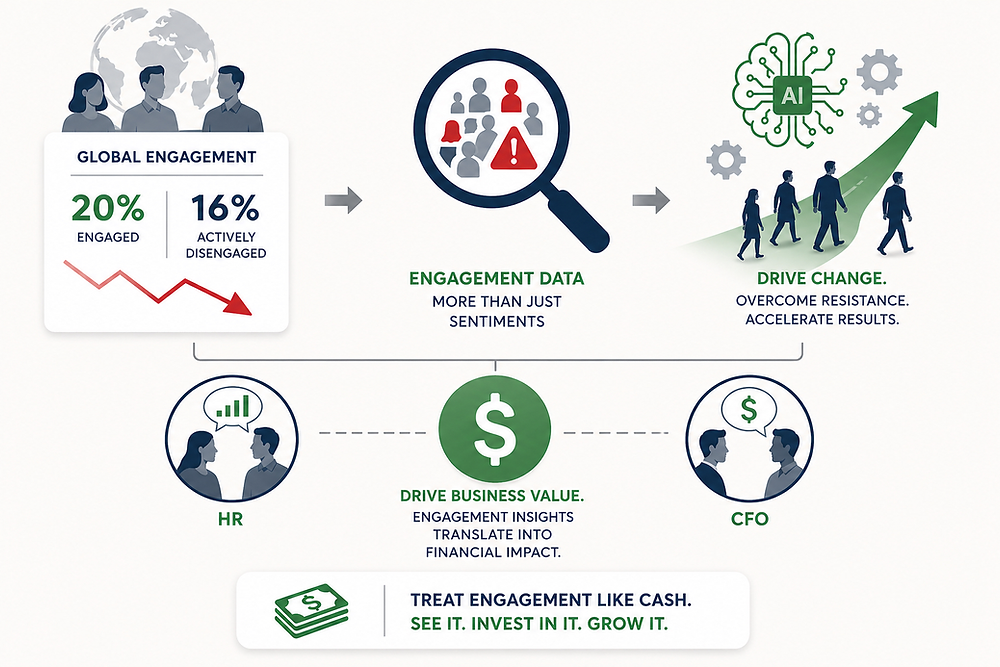
What if your engagement data was treated with the same rigor as your financial data?



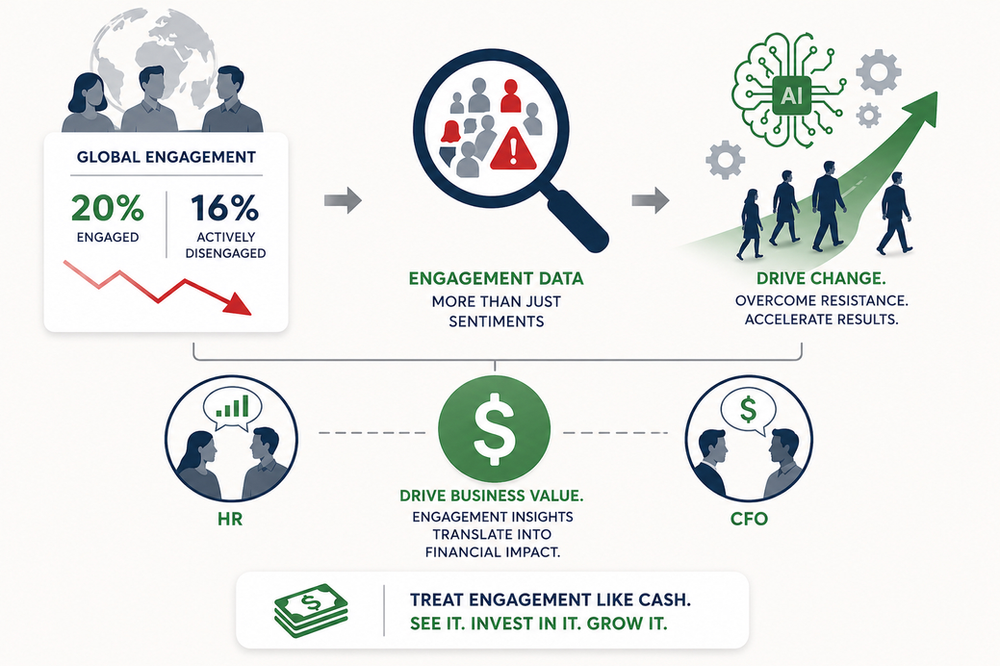
Gallup’s newly released 2026 State of the Global Workplace report reveals that global employee engagement has dropped to 20% and active disengagement now sits at 16%.
These aren’t just HR metrics. They’re business risk indicators.
As AI reshapes the workplace and organizations set clear expectations around adoption, the stakes have never been higher. Employees facing uncertainty (about their roles, their relevance, their future) don’t quietly comply. They disengage. And disengagement has a cost that shows up in productivity losses, missed milestones, troubled post-merger integrations, and failed transformations.
Engagement data is an undervalued enterprise asset, one that signals where value is being created, protected, or quietly eroded. In an environment where AI adoption is accelerating (and in many cases tied to job security), engagement becomes a critical control point:
* It reveals where workforce friction will slow AI ROI
* It surfaces resistance before it shows up in missed targets
* It identifies breakdowns in adoption, trust, and decision velocity
During moments of transformation, such as AI implementation, post-merger integration, operating model shifts, engagement data pinpoints the root causes of execution risk. Engagement data tells you why change is failing before the business results confirm it. In AI rollouts, post-merger integrations, or any large-scale transformation, it can pinpoint the friction (by team, by leader, by function), enabling targeted, timely intervention.
This is the opportunity in front of HR right now:
→ Reframe engagement insights as a strategic business asset, not an annual survey exercise
→ Partner with the CFO to attach financial clarity to people insights
→ Use data to drive decisions, not just diagnose problems
It’s also important to empower and enable managers as intervention vectors. Mangers serve a critical role in employee engagement because they sit between the front line workers and leadership. That gives them first-hand perspective up and down the organization. However, manager engagement has also fallen sharply, down 5% year-over-year and landing at a dismal 22% in 2025. This decline is particularly troubling because manager engagement is a critical success factor in engagement overall and is a leading indicator of team readiness, especially for driving change like AI adoption. Organizations that want to get ahead of this risk will invest in manager capacity to coach, remove friction, and sponsor adoption.
Still, another key to leveraging the value of engagement data as an asset is the relationship between the CHRO and CFO; they should be in the same room, translating engagement insights into financial terms. When paired with CFO-level analysis, engagement data answers the questions that matter:
* Where is productivity leaking?
* Where will timelines slip?
* Where is margin at risk?
Through collaborative leadership efforts, the CHRO and CFO can quantify the cost of disengagement, the ROI of targeted interventions, and the business case for people investment.
People problems are business problems. And engagement data is one of the most direct ways to see them forming in real time. The organizations that win won’t just measure engagement. They’ll treat it like cash and manage it accordingly.
Source link
#Youre #Managing #Employee #Engagement #Youre #Mismanaging