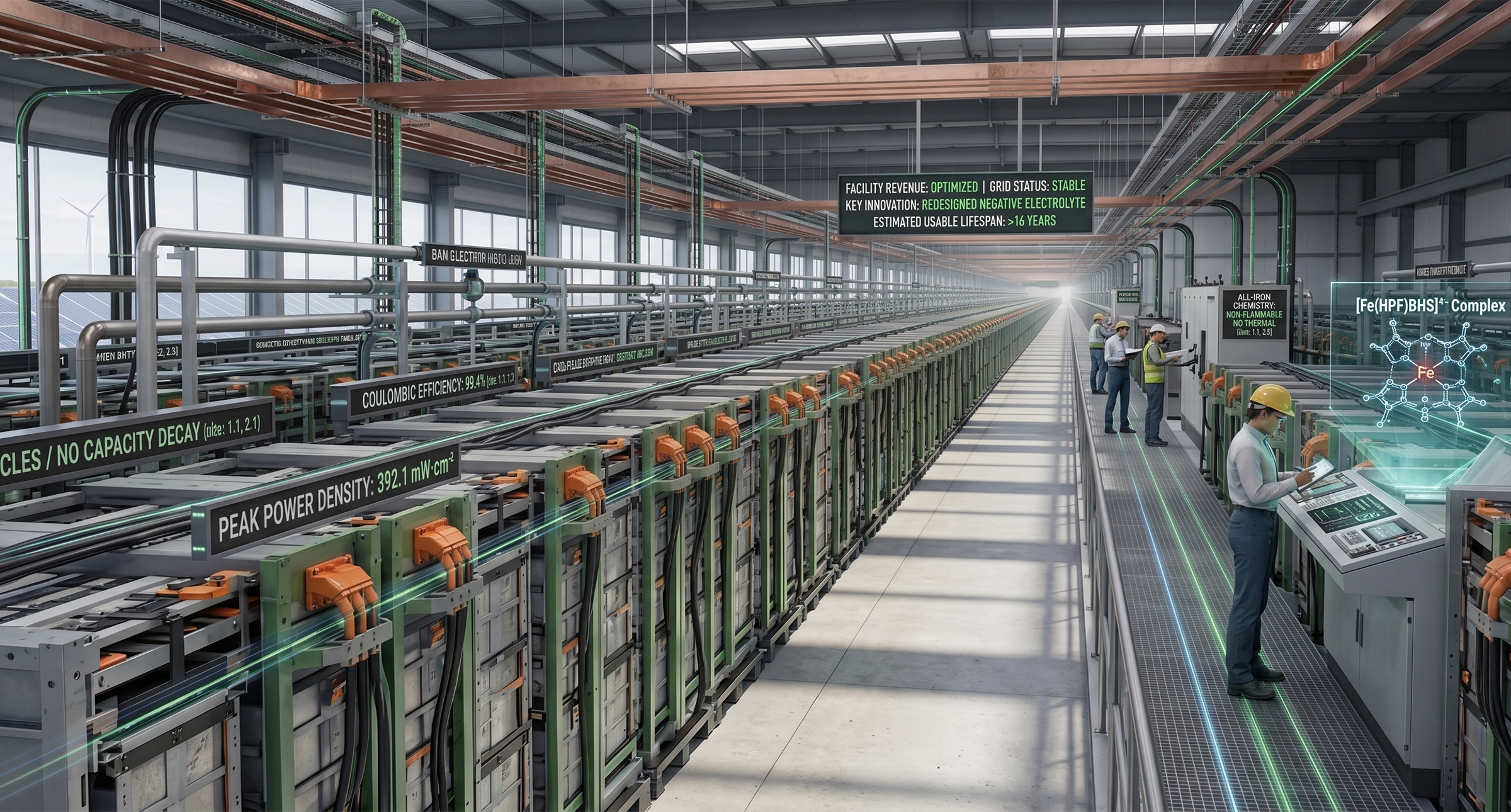
- Iron flow battery runs 6,000 cycles without measurable capacity loss
- New electrolyte chemistry reduces degradation and membrane crossover problems
- Iron materials offer low-cost alternative for large-scale renewable energy storage
Researchers in China say they have made new progress on iron-based flow batteries that could reduce the cost of storing renewable energy while extending usable lifespan.
The team from the Institute of Metal Research under the Chinese Academy of Sciences developed a redesigned electrolyte that allowed an alkaline all-iron flow battery to run through more than 6,000 cycles without measurable capacity decay, according to results published in Advanced Energy Materials.


Iron flow batteries have been studied for years but have struggled with stability problems that limit long-term use. Active materials inside the battery tend to degrade or leak through membranes, reducing efficiency and shortening lifespan.
Article continues below
Iron is 80x cheaper than lithium
The researchers addressed those limits by redesigning the molecular structure of the negative electrolyte used inside the system.
The team synthesized 11 iron complexes built from 12 organic ligands before identifying a compound known as [Fe(HPF)BHS]⁴⁻ as the most stable candidate.
Its bulky structure creates physical protection around the iron center, while negatively charged groups help prevent unwanted reactions and reduce material crossover across the membrane.
Testing showed the battery running at 80 mA·cm⁻² for more than 6,000 cycles with no capacity decay and an average coulombic efficiency of 99.4%, based on performance data released by the research team.
Under higher current conditions, the system reached a peak power density of 392.1mW·cm⁻² while maintaining energy efficiency of 78.5%, indicating stable performance under heavier electrical demand.
Researchers linked the cycle count to long-term use, estimating the performance equals more than 16 years of daily use without measurable degradation.
Iron is more than 80 times cheaper than lithium as a raw material, which could make large-scale energy storage far less expensive, provided the technology scales successfully.
Iron is also widely available, ranking among the most abundant metals on Earth, which reduces concerns about supply shortages compared with lithium.
All-iron flow batteries use water-based electrolytes instead of flammable liquids found in lithium-ion systems. That chemistry removes the conditions needed for thermal runaway, which is the chain reaction that can lead to battery fires or explosions.
Large-scale energy storage remains one of the major technical challenges tied to renewable energy expansion, since electricity generation from solar and wind fluctuates depending on weather conditions.
The research improves stability in iron-based electrolytes, but long-term testing outside controlled environments will determine just how well the chemistry performs in real grid installations.
Via SCMP

Follow TechRadar on Google News and add us as a preferred source to get our expert news, reviews, and opinion in your feeds.
Source link
#times #cheaper #lithium #China #working #ultra #affordable #iron #battery #run #years #degrading #abundant #element #Earth #store #power #waterbased #electrolyte #system #simply #explode