AlphaStreet Newsdesk powered by AlphaStreet Intelligence
NVDA|EPS Est $1.78 (38 analysts)|Rev Est $78.98B|Reports 2026-05-20 None


Wall Street expects Nvidia to report first-quarter fiscal 2027 earnings of $1.78 per share on revenue of $78.98 billion when the semiconductor giant releases results on 2026-05-20. The consensus figures represent the midpoint of 38 analysts covering the company, with earnings estimates ranging from $1.69 to $1.99 per share and revenue projections spanning $77.90 billion to $85.51 billion. The wide range in forecasts underscores both the scale of Nvidia’s business and the uncertainty around demand trends in its core markets.
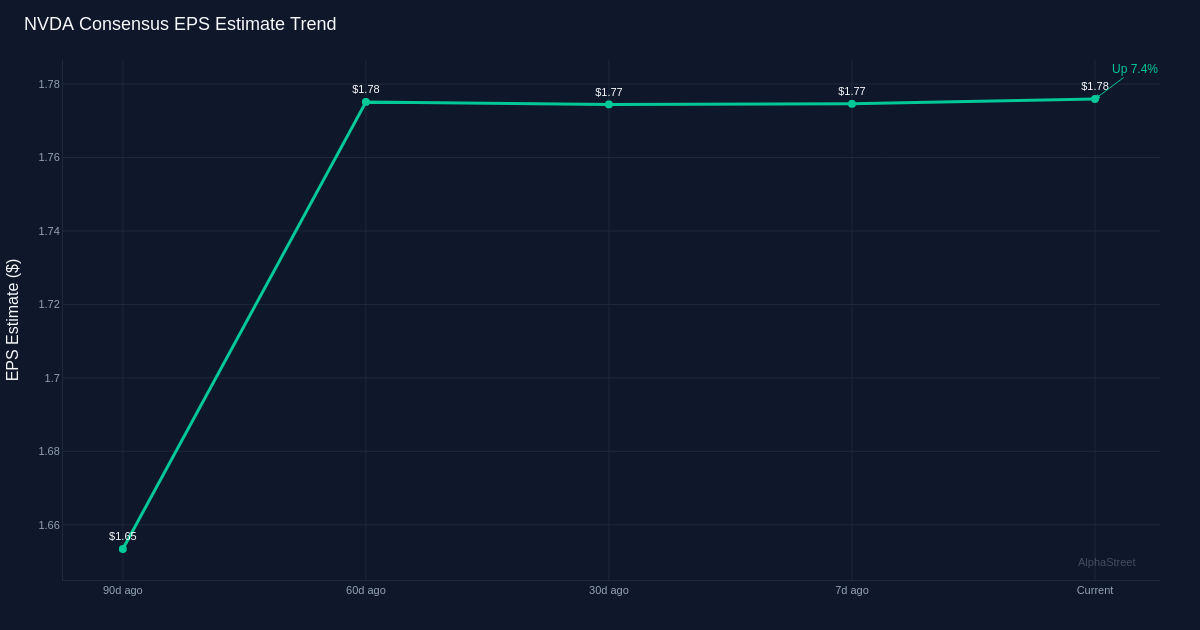
Analyst estimates have moved steadily higher in recent months, signaling growing confidence in the company’s near-term trajectory. The consensus earnings estimate has climbed 7.9% over the past 90 days from $1.65 per share, and has continued to inch upward in the most recent period with a 0.6% increase over the past 30 days from $1.77. This pattern of upward revisions typically reflects improving visibility into order books, stronger-than-expected datacenter demand, or greater confidence in the company’s ability to manage supply constraints and deliver on backlog.
Nvidia operates at the center of multiple transformative technology waves, with its graphics processing units serving as the computational backbone for artificial intelligence workloads, high-performance computing, and accelerated datacenter infrastructure. The semiconductor maker has benefited from an intense capital expenditure cycle among cloud providers and enterprises racing to build AI infrastructure. The consensus revenue estimate of $78.98 billion would represent a massive scale for a quarterly result in the chip sector, reflecting the company’s dominant position in AI accelerators and the premium pricing power that accompanies technological leadership.
The setup heading into this report reflects a company operating in a period of extraordinary demand, though investors will be focused on whether that momentum can be sustained. Nvidia’s fiscal quarters have been characterized by revenue growth that has consistently surprised to the upside, driven primarily by its datacenter segment where demand for AI training and inference chips has far outstripped supply. The company’s Hopper architecture products have commanded premium pricing, while the market eagerly anticipates production ramp of next-generation platforms. Revenue visibility has been complicated by export restrictions to certain markets, supply chain dynamics, and the timing of new product transitions.
For Nvidia, beat-or-miss history is less relevant than the magnitude of outperformance and the forward guidance trajectory. The company has established a pattern of exceeding Wall Street estimates as its AI chip portfolio addressed a market where demand expanded faster than most observers anticipated. More important than the quarterly comparison to consensus will be management’s commentary on sustainability of datacenter demand, customer composition, competitive dynamics, and the production ramp schedule for next-generation products that will determine the company’s ability to maintain its current growth trajectory.
The stock’s position heading into the report will frame investor reaction to both the results and management’s forward outlook. Nvidia shares have been among the most closely watched in the market given the company’s central role in AI infrastructure buildout and the stock’s significant weighting in major indices. The valuation debate has centered on whether current expectations adequately reflect the multi-year nature of datacenter upgrade cycles or whether they’ve priced in an unsustainable pace of growth.
Beyond the headline numbers, the composition of revenue growth and forward guidance will drive the stock’s reaction. Investors should focus on datacenter segment momentum, customer concentration metrics, and whether hyperscale cloud providers continue to represent the dominant source of demand or if enterprise adoption is beginning to contribute meaningfully. Geographic revenue trends matter given export control impacts, while gross margin trajectory will signal pricing power and product mix effects as the company manages the transition between chip generations. Management’s revenue guidance for the following quarter typically moves the stock more than the actual results.
What to Watch: Datacenter revenue growth and customer diversification trends; gross margin performance and pricing power indicators; next-generation product ramp timelines; management guidance for Q2 fiscal 2027 and commentary on full-year demand visibility; supply chain constraints and ability to meet backlog; competitive positioning as alternative AI chip architectures enter production; and any updates on export restrictions or geographic revenue composition.
This content is for informational purposes only and should not be considered investment advice. AlphaStreet Intelligence analyzes financial data using AI to deliver fast and accurate market information. Human editors verify content.
Source link
#Nvidia #Earnings #Preview #Street #Expects #EPS #Alphastreet