

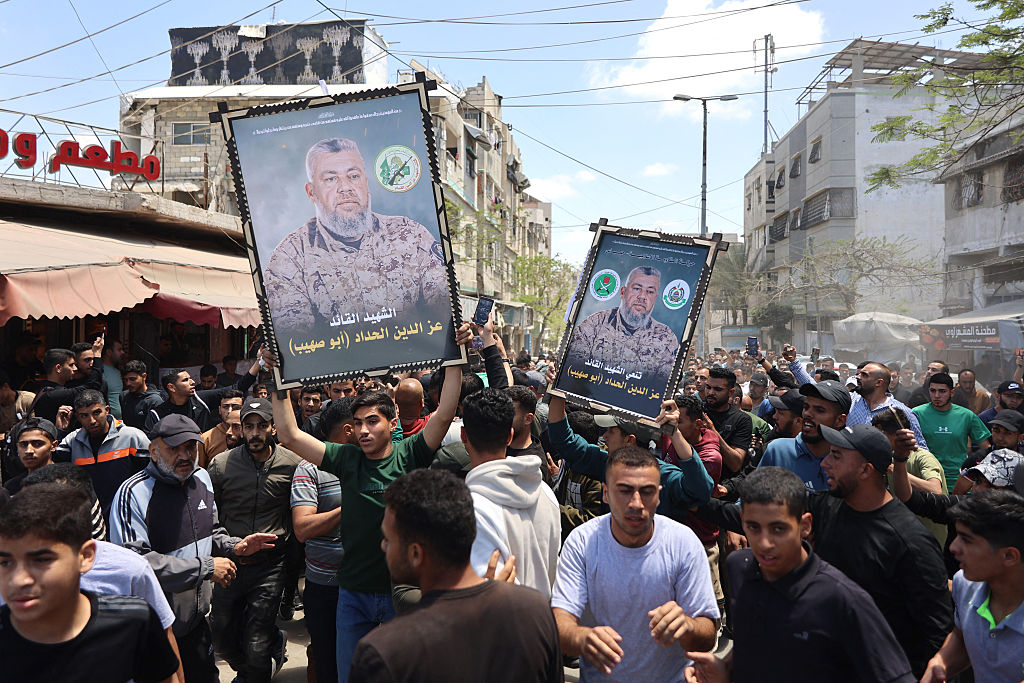
For nearly three years, Izz al-Din al-Haddad had been the most wanted man in Gaza.
He had survived six Israeli assassination attempts. He had moved through tunnels beneath a shattered city while Israeli intelligence hunted him relentlessly. He had earned the name “the Ghost of al-Qassam” — a nod to his ability to vanish before every strike closed in. Israeli hostages who were held near him came home and told their debriefing officers the same thing: that al-Haddad’s name came up in their captivity again and again.



He did not survive Friday.
Israel’s military said Saturday that Izz al-Din al-Haddad — the head of Hamas’ military wing, the Qassam Brigades, and one of the last surviving senior architects of the October 7, 2023 attacks — was killed in a precision airstrike in the Rimal neighborhood of Gaza City on Friday evening. Hamas spokesman Hazem Qassem confirmed the killing on social media Saturday, calling al-Haddad “one of the greatest fighters of our Palestinian people” and the loss “profound.”
The Strike: Three Jets, Thirteen Munitions, a Week of Surveillance
The operation that ended al-Haddad’s life was anything but impulsive.
A senior Israeli security official said the strike was approved by the political echelon approximately a week and a half before it was carried out. During that period, al-Haddad was under continuous surveillance. Intelligence officers at the Southern Command and Military Intelligence Directorate tracked his movements until Friday evening, when an “operational opportunity with a high probability of successful elimination” presented itself.
The strike consisted of three fighter jets and 13 munitions, hitting an apartment building in Rimal where al-Haddad was believed to be hiding, and a vehicle that left the area at the same time. Emergency services in Gaza said at least seven people were killed and more than 50 others injured, with the wounded taken to Al-Shifa Hospital. Among those killed alongside al-Haddad were his wife and daughter. Both of his sons had been killed in earlier Israeli strikes — one in January 2025, another in April 2025.
Prime Minister Benjamin Netanyahu and Defense Minister Israel Katz released a joint statement confirming they had given the order to target al-Haddad, calling him “the commander of Hamas’s military wing and one of the principal architects of the October 7 massacre.”
“Al-Haddad was responsible for the murder, abduction, and harm inflicted upon thousands of Israeli civilians and IDF soldiers,” the statement said. “He held our hostages in brutal captivity, orchestrated terrorist attacks against our forces, and refused to implement the agreement advanced by US President Donald Trump for Hamas’s disarmament and the demilitarisation of the Gaza Strip.”
Who Was Izz al-Din al-Haddad?
Born in Gaza in 1970, al-Haddad joined Hamas when the organization was founded in 1987. He rose through the ranks of the Qassam Brigades — Hamas’ military wing — over three decades, serving as commander of the Gaza City Brigade and commander of additional units before ascending to the top of the organization’s military hierarchy.
After Israel killed Yahya Sinwar in October 2024, al-Haddad took command of two regional commands and 14 battalions, practically sharing control of Hamas with Mohammed Sinwar. When Mohammed Sinwar was killed by Israel in May 2025, al-Haddad assumed sole command of the Qassam Brigades — making him, in the IDF’s assessment, the last remaining senior commander directly involved in planning the October 7 attacks.
He was also a member of Hamas’ Military Council, the highest command body that played a central role in the October 7 operation. Israel accused him of being one of the primary architects of the attack that killed approximately 1,200 people and took more than 250 hostage into Gaza.

Ahmed Al Arini/AFP via Getty Images
The Hostage Connection: Human Shields and a Promise to Romi Gonen
Perhaps the most chilling dimension of al-Haddad’s profile was his direct, personal involvement with Israeli hostages held in Gaza — including his alleged use of them as human shields.
Israeli intelligence assessed that al-Haddad personally held hostages to deter attacks against himself, including female soldiers Liri Albag, Daniella Gilboa, Karina Ariev, Naama Levy, and Agam Berger from the Nahal Oz base. The IDF said al-Haddad “surrounded himself with hostages to prevent his elimination.”
Freed hostages have since described disturbing personal encounters with him. In a January 2026 interview with Channel 12, Romi Gonen recounted speaking to al-Haddad over a phone during the end of the November 2023 ceasefire. Al-Haddad told her that her attacker would be found, and that she would be prioritized for release — as long as she did not tell anyone that her captors had sexually assaulted her. Later, she and fellow hostage Emily Damari were taken to al-Haddad’s tunnel in eastern Gaza City. During her release in January 2025, al-Haddad reportedly approached the vehicle she was in and asked her: “Do you remember our promise?”
Former hostage Eitan Mor told an Israeli newspaper that shortly after he was taken hostage during the Nova music festival massacre, al-Haddad met him and told him in Hebrew that he would be released within two weeks. Al-Haddad met with Mor several more times before his release in October 2025.
IDF Chief of Staff Lt. Gen. Eyal Zamir said after the confirmation of al-Haddad’s death: “In every conversation I held with the hostages who returned, the name of the arch-terrorist Izz al-Din al-Haddad, one of the chief perpetrators of the October 7 massacre and the head of Hamas’ military wing, came up again and again.” Zamir vowed to “continue to pursue our enemies, strike them and hold accountable everyone who took part in the October 7th massacre.”
The Ceasefire Question: Does the Strike Change Everything?
Al-Haddad’s killing did not happen in a vacuum — it happened inside a fragile, seven-month-old ceasefire that was already struggling to survive.
The Gaza ceasefire went into effect in October 2025, signed by Israel and Hamas in Sharm el-Sheikh, Egypt. Since then, Israel has carried out near-daily strikes in Gaza — citing imminent threats to its forces — and more than 850 Palestinians have been killed since the truce began, according to the Palestinian Ministry of Health.
Just one day before the strike, Nikolay Mladenov — the official overseeing implementation of the ceasefire as director-general of the Gaza Board of Peace — acknowledged at a Jerusalem press briefing that the truce was “far from perfect” but said it had brought “relative stability.” He warned that a prolonged stalemate risked cementing Gaza’s permanent division and leaving two million Palestinians without a viable future.
The core obstacle to progress is Hamas’ refusal to disarm. The ceasefire plan requires Hamas to demilitarize as a condition of moving forward. A senior Israeli official said after Friday’s strike that al-Haddad had been “undermining Trump’s Gaza plan” — and that Hamas’ ongoing non-compliance “will continue to have consequences.”
An Israeli security source told KAN News that if Hamas continues to refuse disarmament, the IDF is prepared to restart full-scale fighting in Gaza to “complete their mission.” Israel has reportedly told Mladenov it will not withdraw from the so-called “yellow line” — a demarcation encompassing roughly 53% of Gaza — so long as Hamas remains armed.
Hamas Responds: “We Will Continue the Struggle”
Hamas spokesman Hazem Qassem confirmed the death on social media, calling al-Haddad “a central figure in directing combat operations” and a “great fighter.” Social media footage appeared to show al-Haddad’s coffin being carried through the streets of Gaza on Saturday as large crowds gathered. One individual could be heard saying: “Rest in peace Abu Suhaib, and we will continue the struggle” — using al-Haddad’s nom de guerre.
Iran’s government also released a statement praising al-Haddad and framing his death as part of the Palestinian “resistance.” The comments came as tensions remain high across the Middle East amid the ongoing conflict involving Iran, Israel, and the United States under Operation Epic Fury.
With the ceasefire hanging by a thread, Hamas leaderless at the top of its military chain for the first time since the war began, and the Gaza Board of Peace warning of permanent partition, the next move — by Hamas, by Israel, and by the Trump administration’s mediators — may determine whether a seven-month truce survives or collapses entirely into a third Gaza war.
Source link
#Israel #Kills #Hamas #Military #Chief #Izz #alDin #alHaddad #Architect #October #Gaza #Strike





