



Over the last three years, headlines have been dominated by excited coverage of the potential of artificial intelligence – but in spite of this, public support is far from unanimous. A new study from Teneo has found that a third of UK residents are pessimistic, optimistic, or undecided on the technology’s impact – unless asked about its possible impact on public services, which firms could use as a selling point in the future.



Teneo’s research draws on four complementary workstreams to provide a combined view across public, political, professional, and expert perspectives. Among the UK general public, a nationally representative sample of over 2,000 adults was polled by FocalData, while more than 100 members of parliament were surveyed by Yonder – and some 500 technology professionals were questioned by FocalData.
The results show that consensus is yet to develop around AI – in spite of huge campaigns from governments and businesses to assert the technology as an essential part of Britain’s future. When asked how they felt about the technology relating to their own prospects, 37% were optimistic and 35% optimistic – but when asked about their wider community, this flipped to 33% pessimistic, and 32% optimistic; suggesting that people foster most concerns about AI’s societal impact.
Source: Teneo
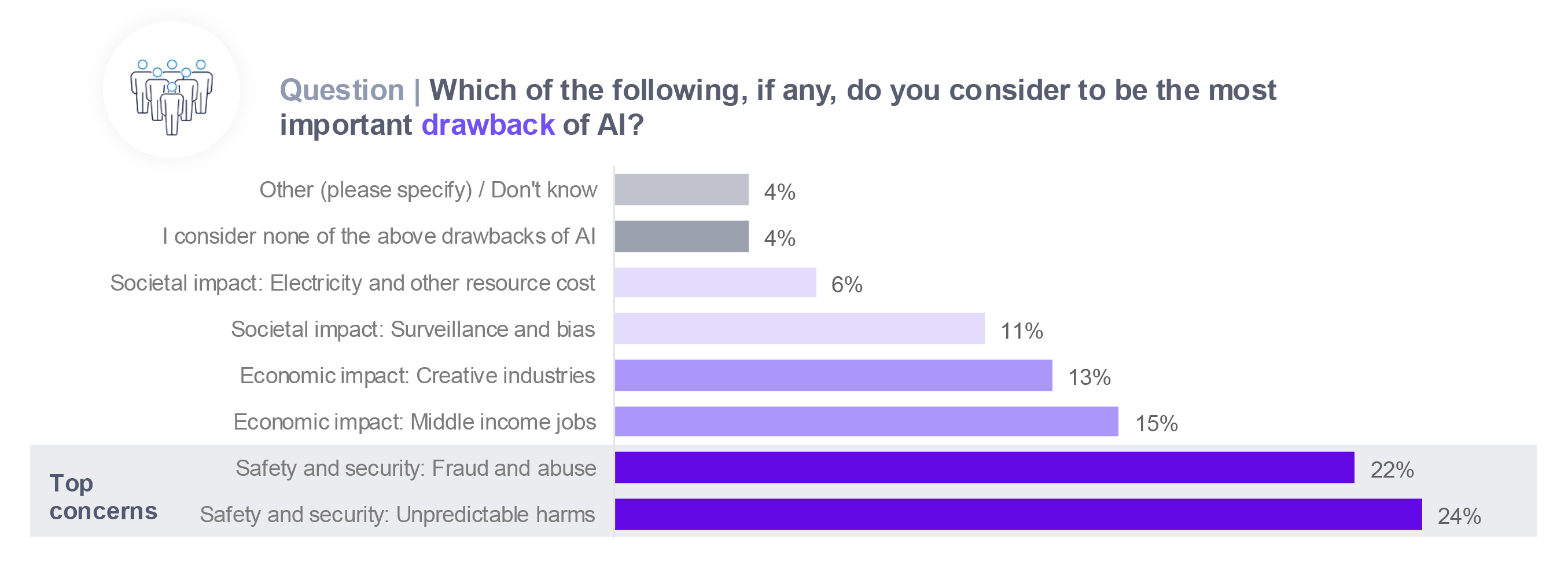
Indeed, Teneo found that when asked to name the most important drawback to AI, 24% of respondents picked “unpredictable harms” related to safety and security. Meanwhile, 22% pointed to the prospect of fraud and abuse relating to the technology – and double-digit responses were also seen around employment, the arts, and mass surveillance.
Overall, the data suggests that there is still no majority support for the expansion of AI in the UK – even as multiple programmes to embed the technology at every level of life forge ahead. While only 11% “strongly support” such an idea, there is a mounting risk that this change will lead to widespread distrust and disengagement with public and private services – which the technology’s proponents will need to counter if they are to avoid a notable backlash.
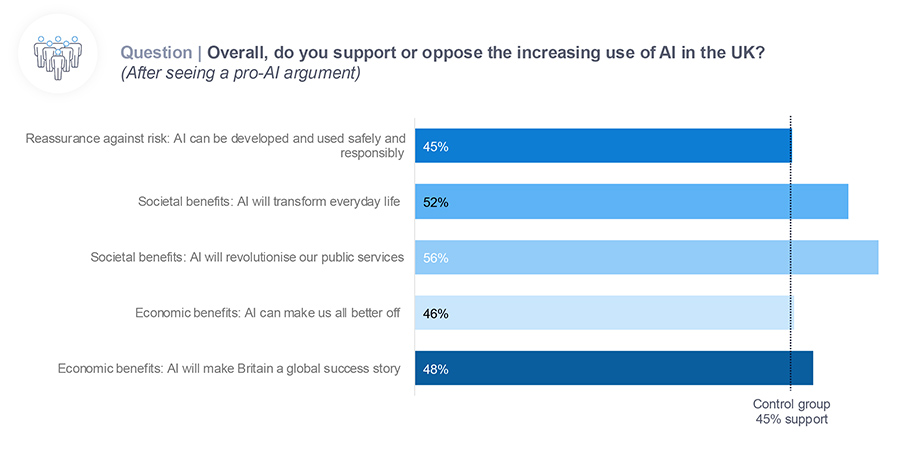
To that end, the researchers found that only one argument made to those polled sufficiently moved the needle in favour of a pro-AI majority. Balanced against a control group, when a portion of respondents received a pitch on the potential social benefits of AI, support broke the 50% threshold – 52% said they would support the roll out of the technology after hearing it could “transform everyday life”, and 56% said the same when it was suggested to them “AI will revolutionise our public services”.
Source: Teneo
Andrew Feldman, CEO of UK strategy and communications, Teneo, said, “Our research shows that what resonates most is not abstract claims about Britain winning the ‘AI race’ or broad promises of prosperity, but a more practical argument centred on the NHS and public service delivery. The next few months and years will be pivotal in shaping Britain’s AI future, whether we are on the leading edge, or trying to catch up with the big players in the US or beyond. Our findings show if the most persuasive arguments can be identified, there is a meaningful group of ‘swing voters’ who would be supportive.”
Matters of trust
As is often the case around the role AI may actually play in business and life, however, much of the potential remains speculative, the “coulds” and “mays” loadbearing. The speed of AI for delivering answers is often highlighted as a panacea for backlogs in public services, helping to clear demand rapidly with ‘serviceable’ answers. A previous pilot by the UK government found a ChatGPT-based chatbot called GOV.UK Chat answered citizens’ questions on a range of issues concerning government services to a degree that almost 70% of those involved in the trial found the responses useful. But while in the private sector, that might pass muster, services upon which lives may depend can hardly afford to deliver inaccurate or useless output in ‘just’ 30% of cases.
So-called ‘hallucinations’ are among a number of concerns public sector trade union Unison has already cited as reasons why using this argument to push the UK headlong into an ‘AI future’ might well backfire. But beyond this, there is also the concern as to who might gain access to important public data, when plumbing technology into sensitive state infrastructure.
Recent reports from the Financial Times confirmed that Britain’s state-run National Health Service is granting staff from companies including Palantir “unlimited access” to identifiable patient data while working on its flagship National Data Integration Tenant (NDIT). Palantir is a large American technology company, specialising in storing large data collections and providing tools to manage the data, and feeding it to AI to analyse and categorise it. The firm’s founder has previously claimed the NHS “makes people sick” and called for its privatisation at an Oxford Union address in 2023, while the firm as a whole has drawn criticism for its close ties to the US security state. In the publicly available version of its latest contract relating to the NHS, nearly all the data protection text – which runs to three pages – is redacted.
Simply alluding to more technology in the public sector may not be the silver bullet for public buy in it seems, then. Teneo pointed out that the technology sector – 73% of which believes most people are already persuaded of the benefits of AI – is behind on the apparent salience of the public sector argument. According to the study, only 21% of technology professionals correctly identified the this argument as “the most persuasive” – while . But deeds not words matter most. If the future of Britain’s status in the ‘AI race’ really does hinge on public perception, trust and transparency around such weighty decisions are surely important, if arguments of what might be are really to click.
Source link
#roll #stall #public #opinion #remains #divided





