
Homeowners insurance can help pay to repair or rebuild your home and replace its contents if they’re damaged by specific perils such as fire, theft, or weather events like wind or lightning.
What to know about homeowners’ insurance
- Most standard homeowners insurance policies cover the structure of your primary residence, personal property, personal liability, and additional living expenses.
- Though your state government doesn’t require it, your mortgage lender will require that the property is insured.
- Before buying a policy, assess your home insurance needs. The age of your home, the value of your belongings, and the risk of natural disasters should all be considered.
- Shop around. We focused on companies with a national presence, but regional carriers may offer the best rate and a more personalized service.
How we chose our top picks
Money vetted 15+ top homeowners’ insurance companies after conducting 1,000+ hours of research based on more than 20 data points. We reviewed the insurers’ availability, financial strength, and customer satisfaction ratings to determine which were the best providers nationwide.



Read the full methodology to learn more.
Our top picks for the best homeowners’ insurance
- Offers database listing vetted and licensed contractors
- Discounts for claims-free customers
- Ranks highly in JD Power’s studies
- Superior financial strength ratings
- Not available in Hawaii
- Premium rates are generally more expensive
HIGHLIGHTS
- Financial rating:
- A+ (Superior) on AM Best
- Discounts:
- Bundling, loyalty, claim-free, autopay, electronic bill, alarm system, detection devices
- Bundling options:
- Auto, renters, life, umbrella
Why we chose Amica Mutual: Amica is our top choice for homeowners insurance because it checks all of the boxes: comprehensive coverage, very positive customer satisfaction ratings, and nationwide availability.
Amica, though not the cheapest insurer, has a great customer service track record, with top marks in what’s arguably the most important factor for customers: the claims process. It earned the top spot in J.D. Power’s 2025 U.S. Property Claims Satisfaction Study and, in 2026, ranked highest with a score of 773.
Another standout aspect of the company is its Contractor Connection database, which lists thousands of vetted, licensed, and insured contractors and guarantees their work with a five-year warranty.
Read our full review of Amica Homeowners Insurance.
- Coverage for homes up to $100 million
- Robust cybersecurity coverage
- Coverage for properties outside the United States
- High rating in J.D. Power’s Home Insurance Study
- Customers have to buy more than one policy with the company
- No homeowners insurance coverage in California
HIGHLIGHTS
- Financial rating:
- A (Excellent) on AM Best
- Discounts:
- Undisclosed
- Bundling options:
- Undisclosed
Why we chose AIG: AIG is known as a luxury insurer that provides comprehensive coverage, from dwelling to cybersecurity insurance, for high-value properties worth up to $100 million.
AIG offers homeowners guaranteed unlimited replacement-cost coverage for homes valued from $750,000 to $100 million on an “all-risk” basis, meaning the policy covers all perils except those specifically excluded.
It also offers the option of ultra-high deductibles (up to $100,000). This could help significantly lower your premium, but you’ll also pay much more out of pocket.
In addition to standard coverage, AIG offers kidnap, ransom, and extortion coverage, landscaping coverage, multinational property coverage, and business property coverage.
Read our full review of AIG Homeowners Insurance.
- Robust mobile apps and an online policy management platform
- Claim RateGuard helps prevent premium increases after qualifying claims in eligible states
- Broad selection of optional coverages, such as scheduled personal property, yard and garden protection, and water backup coverage
- Large nationwide agent network combined with strong digital self-service capabilities
- Customer satisfaction and claims experience generally trail top-ranked carriers
- Premiums can be higher than some regional competitors
- Certain coverages and discounts are not available in all states
HIGHLIGHTS
- Financial Rating
- Superior (A+) from AM Best
- Discounts
- Multi-policy, claim-free, protective device, responsible payment, early signing, automatic payment, welcome and homebuyer discounts and others.
- Bundling Options
- Auto, renters, condo, life, motorcycle, landlord and umbrella insurance.
Why we chose Allstate: Allstate stands out as one of the best homeowners’ insurers for digital tools and policy management. This provider offers one of the industry’s strongest mobile app experiences, allowing customers to manage policies, file and track claims, access digital ID cards, make payments, and communicate with agents through a single platform.
In addition to an extensive nationwide agent network, Allstate offers flexibility for homeowners seeking both self-service convenience and in-person support.
Beyond its digital capabilities, Allstate’s wide range of coverage options and endorsements allows homeowners to customize protection based on their needs. Claim RateGuard, scheduled personal property coverage, yard and garden protection, and identity restoration services help distinguish its policies from more basic offerings.
As one of the nation’s largest homeowners’ insurers, Allstate also benefits from significant claims resources and a broad geographic footprint. While customer satisfaction scores typically do not match those of industry leaders like Amica or Chubb, its combination of digital innovation, coverage flexibility, and nationwide availability makes it an excellent choice for homeowners who value online tools and policy customization.
- Masterpiece homeowners policy covers properties valued at over $1M
- Covers the cost to rebuild or repair even if it exceeds the policy’s limit
- Offers a cash payout settlement if you don’t rebuild or repair the property
- Coverage for traumatic experiences such as child abduction and home invasions
- More expensive than average, focuses most on high-end customers
- No online quotes and only sells through local insurance agents
HIGHLIGHTS
- Financial rating:
- Superior (A++) on AM Best
- Discounts:
- Security and safety systems, new or renovated home, gated community, loyalty, claim-free, autopay, electronic bill, alarm system and more.
- Bundling options:
- Auto, renters, life, and umbrella
Why we chose Chubb: Chubb’s Masterpiece policy offers unique benefits beyond standard homeowners insurance, including risk consulting services, coverage for hijacking, home invasions, and more.
A standout benefit is that policyholders can receive a cash settlement up to the policy’s limit if, after the damage, they choose not to rebuild the property or rebuild elsewhere. Chubb’s private flood insurance also exceeds the industry standard. Homes are covered up to $15 million against flood damage, compared to the NFIP’s $250,000 maximum.
However, these rare benefits come at a cost. Chubb is widely regarded as one of the most expensive home insurers on the market, but if its rates fit your budget, it’s an excellent choice. The insurer consistently ranks in the top three in J.D. Power Customer Satisfaction Surveys year over year and has one of the lowest NAIC complaint indices among all the insurers we reviewed.
- Available in 47 states and Washington, D.C.
- Ranks above average in J.D. Power’s Property Claims Satisfaction Study
- Partnered with Wildfire Defense Systems to provide free fire prevention and risk management
- Large variety of coverage types, great for bundling discounts
- Fewer discounts than other large insurers
- Only accessible through State Farm agents
- No longer accepting applications from California residents
HIGHLIGHTS
- Financial rating:
- A++ (Superior) on A.M. Best
- Discounts:
- Bundling, home security systems, resistant roofing
- Bundling options:
- Auto, renters, life
Why we chose State Farm: State Farm is the largest home insurance company in the United States and offers a wide variety of policies, from life to car to condo. Customers can bundle in various ways, not only getting discounts but also enjoying a more streamlined experience overall.
One drawback to State Farm, though, is that the company only works through captive agents. However, its agent network is extensive, at close to 19,000 by some estimates, covering almost every state. Prospective customers should have no trouble finding assistance with their applications.
A guide to homeowners insurance
Homeowners insurance coverage is a type of property insurance that provides financial compensation if your home is damaged by certain natural disasters, theft and/or accidents. This type of insurance does not cover flooding or earthquakes, which require different coverage.
How much does home insurance cost?
Home insurance premiums vary by company and depend on your home’s location, style, square footage, and age. Personal factors such as your credit score and claims history will also affect your rates.
According to a report by the Consumer Federation of America (CFA), typical homeowners paid over $3,000 to insure their property. This figure represents an alarming average increase of 24% since 2021. Overall, the report finds that Florida, Louisiana, Oklahoma, Kentucky, and Nebraska are the most expensive states to insure a home. But Utah saw the sharpest jump in premiums at 59%.
Home insurance discounts
One of the most common homeowners insurance discounts is the multi-policy, or bundling, discount. In some cases, this could save you over $1,000 a year.
Insurers may also reduce your rate for automatic payments, electronic statements, paying the annual policy cost upfront, insuring a brand new home, and even for installing protective devices like burglar and smoke alarms.
What does homeowners’ insurance cover?
Most standard home insurance policies include the following types of coverage:
- Dwelling coverage: This covers the main structure of the property, namely the actual house, against 10 basic perils: fire, lightning, hail, windstorms, explosions, civil unrest, aircraft damage, vehicle damage, smoke damage, vandalism, theft, and volcanic eruptions.
- Personal property coverage: Standard insurance will typically cover personal belongings up to a certain percentage of your overall home insurance coverage. This percentage varies by policy. Consider an add-on to cover valuable items like jewelry, art collections, and other precious possessions.
- Personal liability coverage: Liability protection covers injuries suffered by non-residents of your household while on your property. It could cover medical payments and legal costs, depending on the policy.
- Other structures: This covers detached structures, such as fences, gazebos, or tool sheds, that are affected by covered perils.
- Additional living expenses (ALE) or loss of use coverage: When a covered loss makes your home unlivable, most homeowners insurance policies will reimburse you for temporary housing, like hotels or rentals, up to your coverage limits.
What is excluded from homeowners’ insurance?
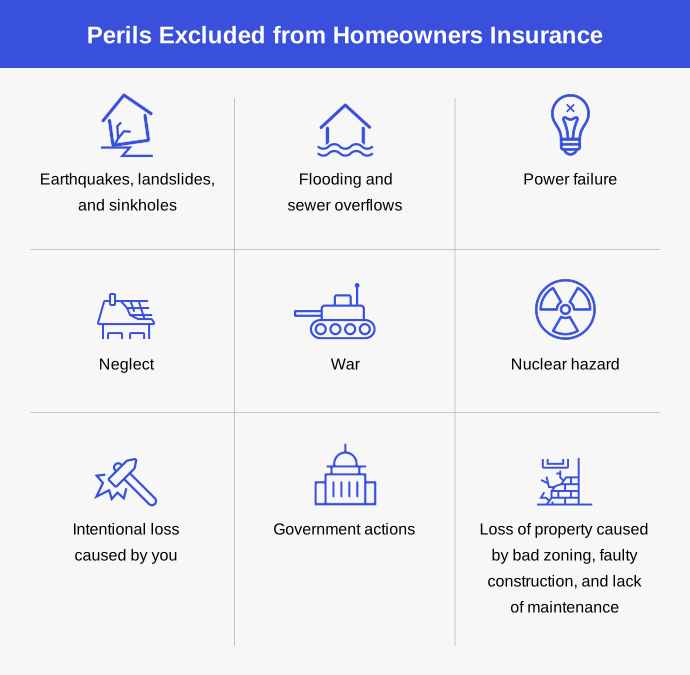
The perils listed in the table below are typically excluded from standard homeowners insurance policies.
Other weather-related exclusions
Though floods are excluded from standard home insurance policies, you’ll be required to purchase flood insurance if the Federal Emergency Management Agency (FEMA) determines that your property is in a flood zone.
The National Flood Insurance Program (NFIP) provides flood insurance for property owners, renters, and businesses in 23,000 participating NFIP communities. Visit FloodSmart.gov for more information.
Most homeowners insurance policies cover water damage caused by a covered peril (for example, a vehicular accident breaking a pipe). However, if the cause is something not listed in the policy, such as a hurricane, water backup, or a DIY home renovation accident, it will not be covered.
Depending on where you live, there may be additional weather-related exclusions. For example, homeowners’ insurance policies issued for coastal homes in Texas don’t cover wind or hail damage.
In Eastern coastal states, hurricanes and windstorms have a special type of deductible based on a percentage of your chosen coverage amount. This is mostly regulated by state laws. For more on your specific state, visit the Insurance Information Institute.
Earthquake damage is typically excluded from home insurance policies. You can get coverage for this peril through a rider or by buying a separate policy. Checking with the largest earthquake insurer in the state, the California Earthquake Authority, is a good start.
Most home insurance policies cover wildfire damage. However, some companies have stopped offering this coverage or have made adjustments in areas at high risk of wildfires. Check locally available insurance companies to see if they still offer wildfire coverage in your area or explore alternatives like your state’s FAIR Plan (e.g., California FAIR Plan).
For additional information, read our in-depth guide on how homeowners’ insurance works.
How to choose the best homeowners’ insurance
To choose the best homeowners’ insurance company, keep a few factors in mind. These include the policy price and coverage, as well as the value of your home and personal belongings.
Assess your home insurance needs
Before you can choose the right type and level of coverage, you have to assess your home insurance needs. When doing so, take into account the following:
- Your area: If you live in a flood zone or a state like Florida or California, where natural disasters are a frequent concern, you may need additional coverage.
- Home features: If you live in a historical building or have made recent, expensive renovations, you might need a policy that offers guaranteed replacement cost to rebuild your home as close to its previous state as possible.
- Belongings: Create an inventory of your belongings and consider purchasing additional coverage for precious items such as jewelry or collectibles. While most policies cover personal belongings, there’s generally a limit, and high-value items won’t be covered in full.
Consider the extras
Depending on your living situation, standard insurance products might not be enough.
Check the types of endorsements, also known as insurance riders or add-ons, that each company offers. These will increase your annual premium, but it might be worth it to protect valuable assets such as jewelry or collectibles.
Some companies provide protection for more specific issues, such as water damage, identity theft, cybersecurity threats, and even kidnapping.
Find the best homeowners’ insurance companies in your state
The next step should be to find insurers, both national and local, that work in your state. Then get multiple quotes and review their coverage, financial strength ratings, customer satisfaction scores, complaints, etc.
Though national carriers have name-brand recognition and larger market share, small, regional providers may offer better customer service, personalized coverage, and competitive rates.
You can find insurers in your state or county through your local government’s insurance department. Their contacts are available on the pages of the National Association of Insurance Commissioners (NAIC) or the Insurance Information Institute.
How we chose the best homeowners insurance companies
To select the best homeowners’ insurance companies, we reviewed the following factors.
- Customer satisfaction: We reviewed J.D. Power’s 2026 U.S. Property Claims Satisfaction Study and the 2025 U.S. Home Insurance Study to gauge customer satisfaction with the insurers on our list. We also looked at the NAIC Complaint Index of select subsidiaries with the largest homeowners insurance market share. With few exceptions, we may select companies with above-average J.D. Power ratings and a low NAIC complaint index.
- Financial strength: We reviewed financial ratings from agencies such as AM Best and Demotech to ensure each company is financially sound and able to meet its insurance obligations.
- Coverage options: Coverage options vary little among insurers. We took special note of companies that offered flood insurance and other riders, such as extended replacement cost coverage and the option to get a cash settlement.
- Market share: Our top picks prioritized carriers that were available nationwide and had a sizable market share. For this, we referenced the NAIC’s 2025 Property/Casualty Market Share report.
Homeowners Insurance FAQs
Is homeowners insurance required?
Homeowners insurance is not required by state or federal law. However, practically all lenders will require homeowners insurance as part of your mortgage agreement.
Does home insurance cover mold?
As with many issues, mold is covered by homeowners insurance if the cause is a covered peril. If the mold is caused by a peril that’s not listed in your policy (such as flooding) or negligence by the homeowner, it will not be covered.
What is the 80% rule in homeowners insurance?
However, even a policy that covers 100% of your home’s value won’t guarantee the insurer will pay the full amount needed to repair your home. Read your policy carefully and consult with an agent if you have questions.
Latest news in homeowners insurance
Money reports the results of the latest J.D. Power Property Claims Satisfaction Study: While home insurance premiums are on the rise and the industry is raking in profits, customer satisfaction is taking a nosedive. Many customers are frustrated by slow service, particularly with claims and repairs that drag on for more than a month. Clients who didn’t file a claim are also seeing premium increases, further aggravating frustration with carriers.
A.M. Best, the insurance industry’s benchmark for financial stability, reports that the National Oceanic and Atmospheric Administration (NOAA) plans to sunset a database crucial to insurers’ pricing and risk assessment. This database has tracked climate disasters that caused damage of at least $1 billion for over 40 years.
It’s an irreplaceable tool, particularly as the frequency and intensity of extreme weather events increase. Finding an alternative won’t be that easy, either — the NOAA’s database was created in 1980, and building something comparable to the original will take years.
Summary of Money’s best homeowners insurance companies of 2026
Source link
#Homeowners #Insurance #Companies