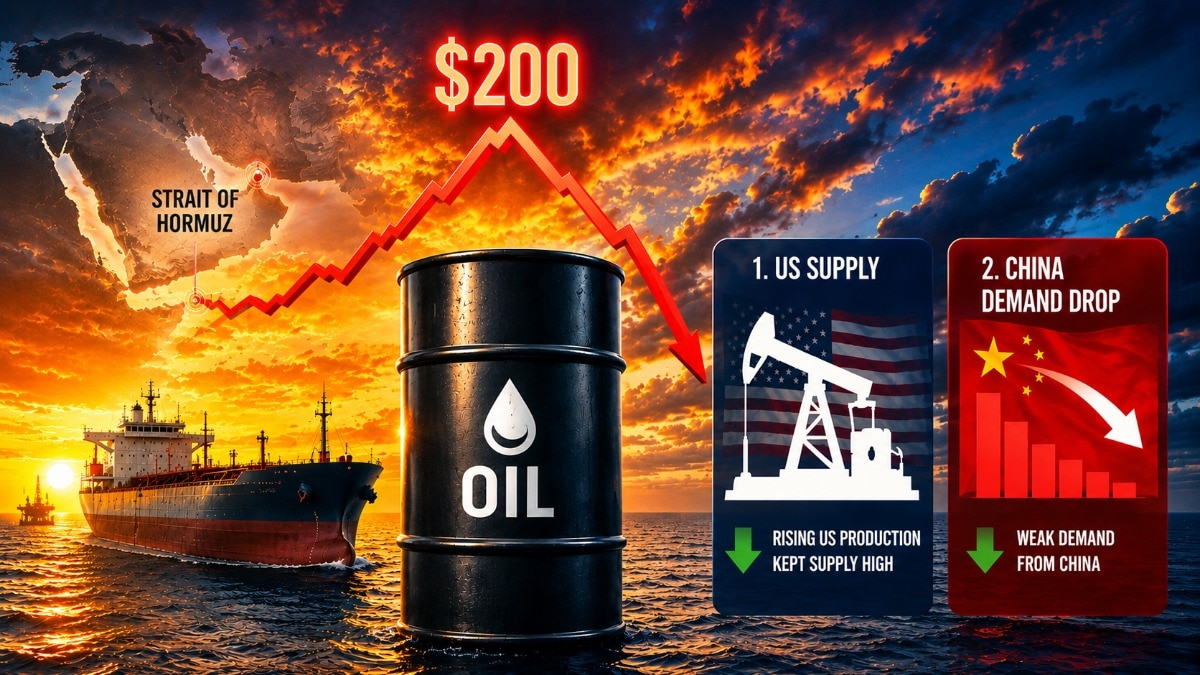
When war disrupted the Strait of Hormuz, many analysts predicted oil could soar to $200 a barrel.
More than three months later, those forecasts have not materialised. Despite the loss of over 10 million barrels a day of West Asia supply, crude remains below $100, thanks to a mix of record US exports, falling Chinese demand and emergency interventions, according to a Bloomberg report.


The Strait of Hormuz is one of the world’s most important energy chokepoints, carrying a significant share of global crude shipments. The disruption removed more than 10 million barrels a day of West Asian supply from the market. Yet oil has failed to sustain the dramatic rally many feared.
“People thought it was going to be a lot worse,” US President Donald Trump said Friday. “Today I looked at $96 a barrel, people thought that was going to be $300 a barrel.”
Don’t Miss: Oil at $200? Macquarie flags 40% risk probability as Iran war chokes Strait of Hormuz
China emerged as the biggest surprise
One of the most important reasons oil prices did not spiral higher was a sharp drop in Chinese imports.
China, the world’s largest crude importer, cut inbound shipments by almost 40% in May compared with last year’s average, according to Vortexa.
The reduction alone offsets between a fifth and a third of the barrels lost because of the conflict, depending on the estimates used.
Analysts cited several reasons behind the decline.
China has slowed additions to its strategic petroleum reserves, expanded the use of coal-based feedstocks for chemicals, and continued to see rising electric vehicle adoption, reducing petrol demand.
Refinery throughput in China during May and June is estimated at around 13 million barrels a day, significantly below last year’s average of 14.8 million barrels.
“China’s backing off from the crude market has played a crucial role in attempting to rebalance the global market, which has helped cap oil prices,” Warren Patterson, head of commodities strategy at ING Groep NV, told Bloomberg. “The extent of which has taken most of the market by surprise.”
Must Read: ‘What happens in Asia doesn’t stay in Asia’: Raghuram Rajan warns Hormuz shock will hurt US
America became the world’s swing supplier
The US has played a central role in stabilising markets since launching strikes on Iran earlier this year, the report said.
American crude and fuel exports in May were more than 2 million barrels a day higher than the average for all of last year.
The Trump administration also authorised the release of 172 million barrels from the Strategic Petroleum Reserve. At one point last month, the reserve was being drawn down at a pace of 1.4 million barrels per day.
Nearly half of the barrels released have been shipped overseas, helping ease supply shortages in Europe and elsewhere.
US production, boosted by the shale revolution, has reached record highs, allowing Washington to emerge as the world’s most important swing supplier during the crisis.
Gulf producers found alternative routes
Another factor limiting the price spike was the ability of Gulf producers to reroute exports.
Saudi Arabia increased the use of its East-West pipeline to transport crude to the Red Sea, while the UAE relied on pipelines leading to Fujairah outside the Gulf.
Bloomberg also reported that some vessels continued moving through the Strait of Hormuz despite the risks, while others used alternative arrangements and routes.
“Over three months into this conflict, the world has proven surprisingly resilient,” Maria Angelicoussis, chief executive of shipping giant Angelicoussis Group, was quoted as saying. “Commodity prices are up by 50% or 60%, Asian LNG prices by 90%, but they’re not at the sky-high levels that at least I would have personally expected.”
Russian oil helped fill part of the gap
The Trump administration also eased restrictions on some Russian oil flows, helping major buyers such as India secure additional supplies.
Russian crude exports to India averaged about 1.76 million barrels a day in May, up 63% from February levels. The additional barrels helped cushion the impact of disrupted West Asian supplies on global markets.
Source link
#Crude #oil #supposed #hit #Hormuz #shock #Heres #didnt #BusinessToday