

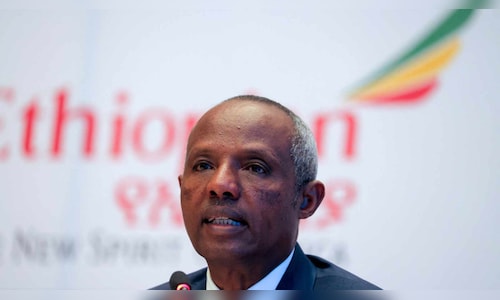
The West Asia conflict has significantly increased fuel costs for Ethiopian Airlines, with fuel now accounting for 54% of the carrier’s operating costs, up from 40% before the crisis, according to Group CEO Mesfin Tasew.
Speaking to CNBC-TV18 on the sidelines of the IATA Annual General Meeting in Rio de Janeiro, Tasew said the airline has also seen weaker demand on West Asian routes, forcing it to reduce frequencies to Dubai.


“It used to be 40%. Now it has reached 54%,” Tasew said, referring to fuel’s share in the airline’s operating costs.
According to him, jet fuel prices in Addis Ababa have nearly doubled since the crisis began. Across Ethiopian Airlines’ global network, the average fuel price increase is around 60%.
Despite the sharp increase in costs, the airline expects to remain profitable, although margins are likely to be halved.
“Even with this price, we will still be profitable, but the margin will reduce,” he said, adding that the impact could potentially reduce margins by about half.
The airline has largely maintained its network outside the West Asia and continues to expand despite the challenging environment.
“Some routes are losing a lot of money. But we maintain our flights because we have to take care of our customers,” Tasew said.
On India, Tasew said Ethiopian Airlines remains optimistic about growth prospects. The carrier currently serves multiple Indian destinations and plans to increase frequencies on those routes before adding new cities.
Traffic on Indian routes remains strong, with load factors of around 75-80%, he said.
Separately, Ethiopian Airlines is evaluating an order for approximately 25 regional aircraft as it looks to modernise and expand its fleet. The airline is considering the Airbus A220, Embraer E2 family and Boeing 737 MAX 7, with a final decision expected within the next three months.
“For both. Enhancing our fleet plus replacing a few aged airplanes,” Tasew said, adding that the aircraft would primarily be deployed on domestic routes and services to neighbouring countries.
The airline currently operates a fleet of 147 aircraft, including Boeing 777s, 787s and 737s, Airbus A350s along with some small jets.
Source link
#Ethiopian #Airlines #CEO #Fuel #operating #cost #West #Asia #conflict #CNBC #TV18





