

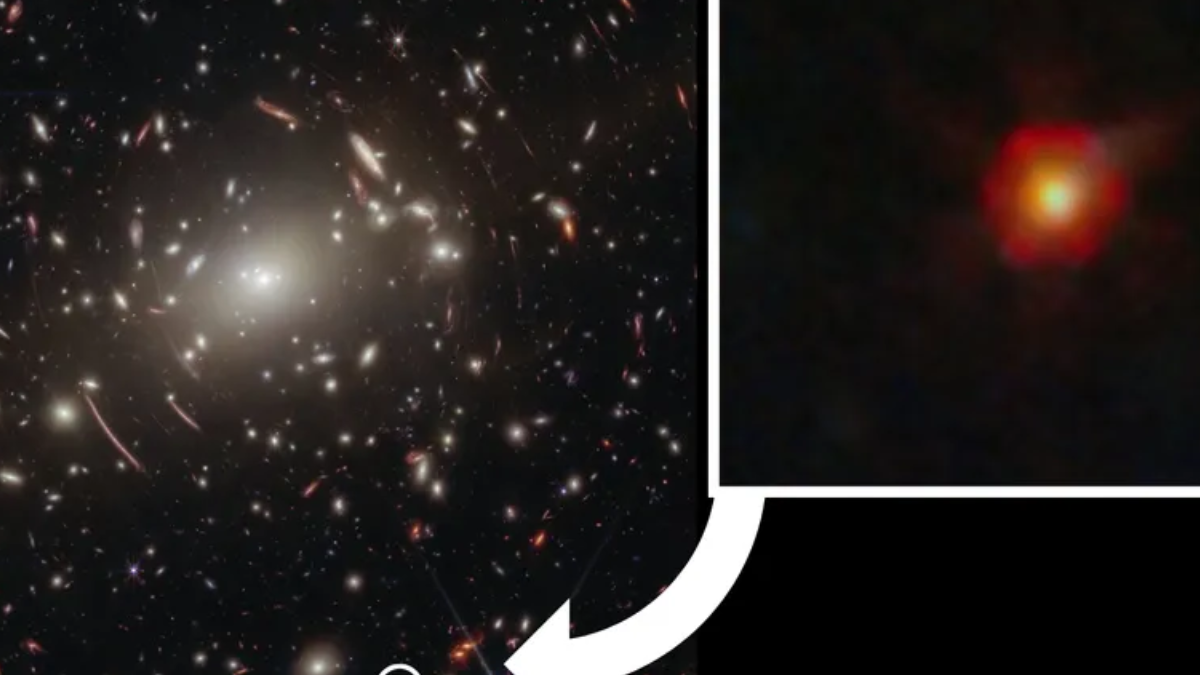
These little red spots have been detected by the James Webb Space Telescope since 2022. These are plentiful within 600 million years of the Big Bang but go away when the universe is less than two billion years old. These red dots, which astronomers from the University of Texas at Austin, led by Vasily Kokorev, have recently confirmed to be, are actually “black hole stars,” or black holes feeding at extremely fast rates inside clouds of dense gas.
Decoding GLIMPSE-17775’s Record-Breaking Spectrum
Published June 10 in The Astrophysical Journal, Kokorev’s study centered on GLIMPSE-17775, seen 1.8 billion years after the Big Bang. Discovered incidentally while JWST observed galaxy cluster Abell S1063, it benefited from the cluster’s gravitational lensing — stretching 30 observing hours to an effective 80. This yielded over 40 spectral lines, the most detailed little red dot spectrum ever. Hydrogen, oxygen, and helium signatures indicated electron scattering by a dense gas cocoon, while 16 iron emission lines — an “iron forest” — and helium absorption features pointed to a rapidly accreting black hole.



How Black Hole Stars Solve the Disappearing Act
The “black hole star” model also nicely accounts for why the red dots ultimately vanish. Through their voracious appetites, they strip away the gas cocoons surrounding them, leaving behind nothing to give them a red and tight appearance. Once stripped of their cocoons, they become regular active galactic nuclei and give up on their masquerade. Furthermore, it accounts for why they are X-ray faint – dense cocoons would absorb most high-energy photons. Finally, the black hole masses in question are not huge; little red dots do not have to “break cosmology.”
Source link
#Astronomers #Solved #Red #Dot #Mystery





