The 2026 FIFA World Cup kicked off this month, and while global attention mostly focuses on the matches, ticket prices and travel bans, questions remain about whether some host communities are ready to handle the demands of a tournament expected to draw such large crowds.
For communities already contending with water access challenges, the World Cup threatens to further strain systems already under pressure.



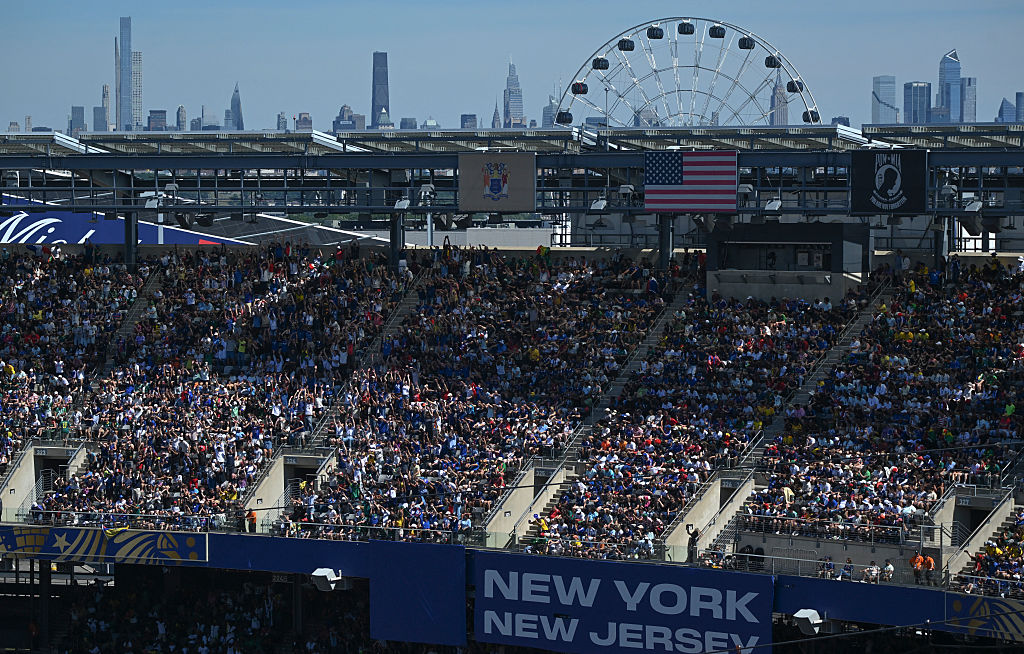
New Jersey’s MetLife Stadium will be the venue for soccer’s biggest game, the World Cup Final. It has also attracted the most scrutiny over its water footprint. MetLife received the highest water stress score of all 2026 host venues, a designation that reflects the area’s low elevation and exposure to storm surges and saltwater intrusion.
An example of a potentially strenuous situation for local infrastructure comes during the breaks within games. With the blowing of a half-time whistle, there will inevitably be thousands of fans moving to use stadium restrooms at once.
FIFA’s stadium guidelines note that water demand can fluctuate dramatically during major events, with fully occupied stadiums generating large peaks in consumption during short periods such as half-time. FIFA warns that the impact of these demand spikes on water supply and wastewater networks “should not be underestimated.”
This situation is only amplified by the grand scale of the World Cup, which adds to this pressure in ways that a standard sporting event does not. A total of 8 sold-out matches are set to be played at MetLife across two months, with fan numbers far exceeding those of most domestic fixtures.
New Jersey’s water supply was already under significant stress before the arrival of a single fan for the World Cup. James Shope, assistant extension specialist at Rutgers University, pointed International Business Times to this immediate pressure: “We have been in some sort of drought warning statewide for the better part of two years. This can be very rough in the more highly populated regions.” Official statistics back this up, with the U.S. Drought Monitor recording 100% of New Jersey as suffering from moderate to severe drought as of May 2026.
Shope also referenced the stadium’s physical setting as a potential issue, stating that “the meadowlands is very vulnerable to flooding, economic disruption from flooding, and the potential mobilization of pollutants if there is substantial flooding.”
While the tournament would not increase flood risk itself, any major such event occurring during the World Cup could affect far larger numbers of visitors, workers, and transport networks than during a typical period. He added that he anticipates “multiple differing levels of planning by local entities”, though what those plans contain remains unclear.
Expert opinion on the actual risk, as opposed to simply a perception of risk, is divided. Upmanu Lall, director of the Columbia Water Center at Columbia University, told International Business Times that water shortage itself is not a primary concern for the region: “NYC does not have any notable water stress in the sense of water shortage.”
However, he acknowledged vulnerabilities within their water infrastructure, which could be put under further stress by the increasing demands across the World Cup: “The NJ area is flood prone, so there is indeed vulnerability to those factors in that specific locale.” On the question of contingency planning, Lall stated, “I am not aware of their contingency plans.”
Multiple organizations responsible for ensuring that water supplies throughout the New York-New Jersey region remain healthy and fruitful did not respond to a request for comment by International Business Times.
With the public being left without a clear picture of how regions with already insecure water supplies will cope with one of sport’s biggest stages, others point to possible private sector solutions.
U.S.-based water technology provider Xylem has developed the Flygt Concertor, a product which it describes as “the world’s first fully integrated, intelligent wastewater pumping system,” using smart sensors to detect clogging and prevent wastewater overflows.
Already used in places like London’s Heathrow Airport, the technology could have major applications for managing wastewater spikes from sporting events like the World Cup.
In Mexico, also a host country, years of water scarcity have fostered innovative environmental solutions, too.
Hydrosafe, part of Tec de Monterrey’s accelerator program, uses AI, satellites, and drones to detect underground water leaks, reducing water waste and preempting flood risks.
Technologies like this could be key to ensuring more sustainable practices in future sporting events.
But with the 2026 World Cup kicking off on June 11, lessons about responsible water management may have to be learned the hard way, with the people of New Jersey and New York most at risk.
Source link
#World #Cup #Crowds #Threaten #Water #Infrastructure #York #Jersey