

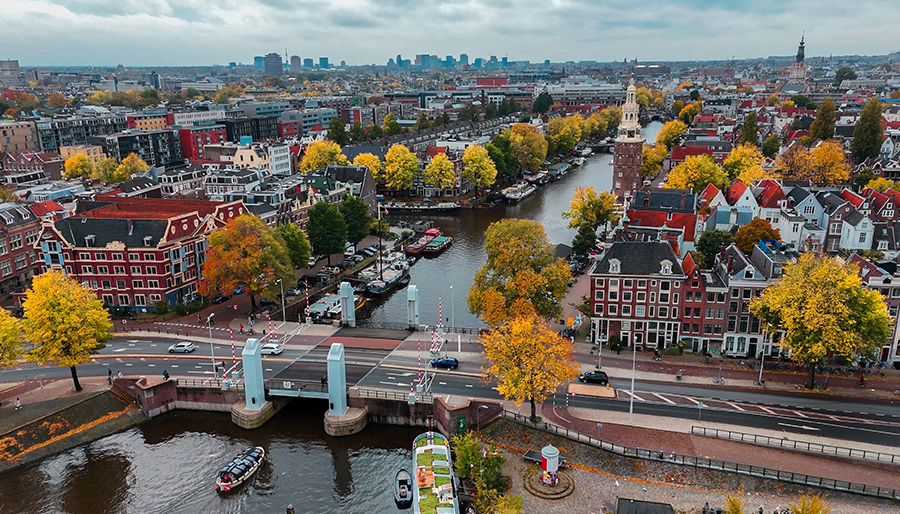
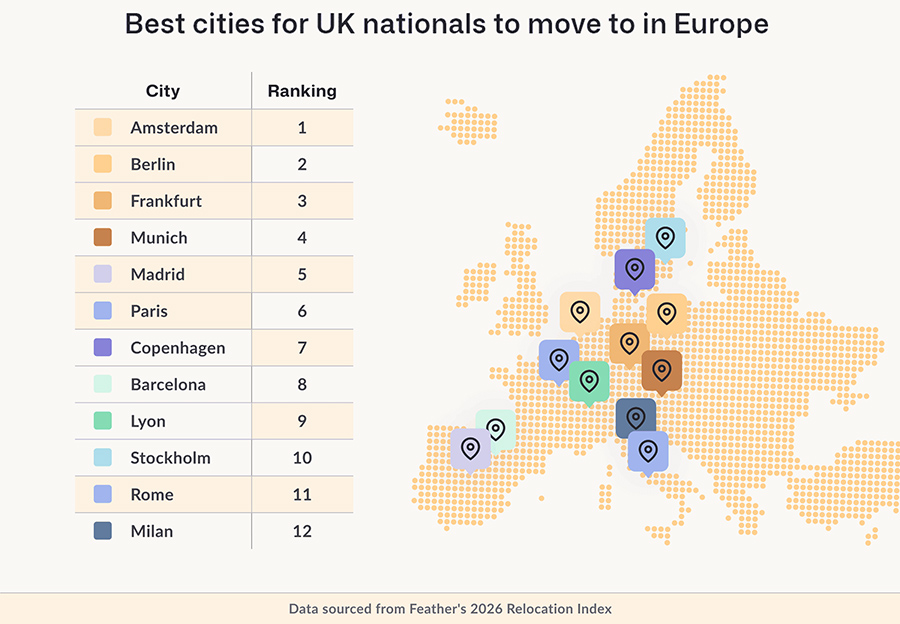
Despite visa-free relocation to the continent coming to an end following Brexit, the UK is seeing an exodus of skilled labour, as workers search for improved wages, access to public services, and the realistic prospect of affordable housing. According to a new study from Feather Insurance, Amsterdam is now the easiest city for UK nationals to relocate to in Europe, thanks to its higher level of available work, and its high-proficiency in English as a second-language.



There is a continued rise in people seeking to move abroad in the UK. Total UK emigration numbers jumped by over 6% in 2025 according to the Office for National Statistics, with 252,000 citizens leaving the UK, while only 143,000 people returned.
Of those who departed, 76% of them were under the age of 35 – reflecting the desire to build a better life elsewhere, as wages continue to stagnate in Britain, under-funded public services are reduced or dismantled, and the cost of owning a home becomes unobtainable for younger professionals or families without inherited wealth. Meanwhile, lower relative costs of living, efficient public transport, a stronger emphasis on work-life balance and a cleaner living environment are also attractive factors for life on the mainland.
Source: Feather
The move is no longer as simple as it used to be, though. For the first time in generations, workers moving to the European Union need to contend with visas, and a costly settlement process following Brexit. Meanwhile, with foreign languages having never been prioritised by British education, only one-in-five UK citizens can speak another language fluently – making navigating this new level of bureaucracy a genuine obstacle.
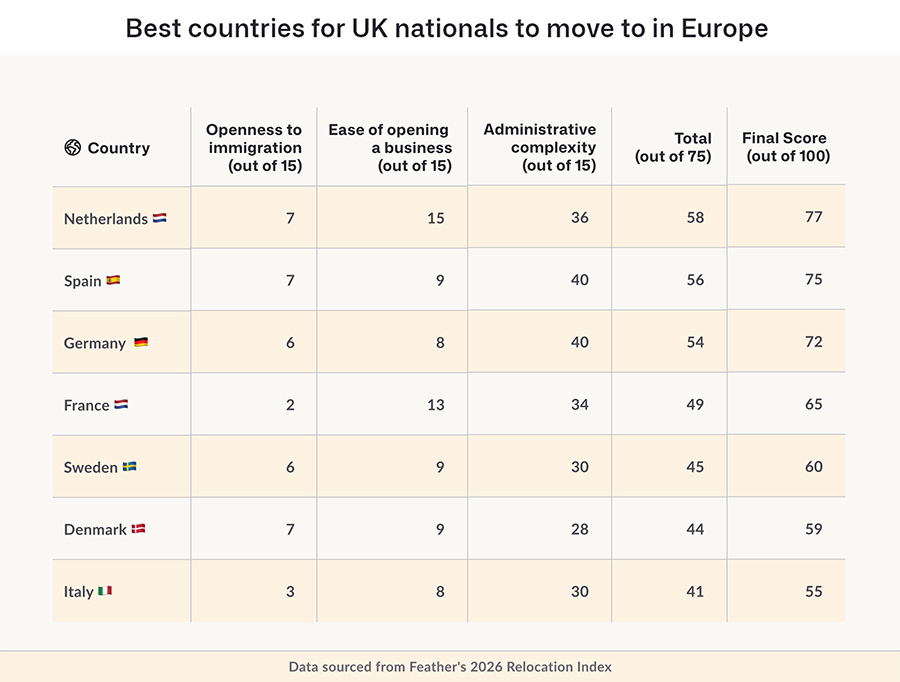
To help navigate this, Feather Insurance has drawn up its 2026 Relocation Index. Looking to shift the discussion from the question of “Where can I afford to live?” to a “more useful” “Where can I realistically relocate?”, the researchers sought to clarify which countries and cities make a move abroad easiest for UK citizens, by assessing factors including openness to immigration to administrative complexity.
Vincent Audoire, seasoned expat and co-founder at Feather Insurance, commented, “More people are looking to leave the UK in search of warmer climates, a new lifestyle, or a lower cost of living. But too often the challenges an expat faces and the processes involved when moving abroad are ignored and underestimated. From finding a place to rent and sorting visas and insurance, to settling into a new environment, relocating can be complex. That’s why we created the Relocation Index, to highlight the easiest places to move to and help people understand the benefits and challenges of each destination.”
The result of the data sourced by the company suggests that Western Europe dominates the ideal destinations for British workers. But while three of the top five locations were based in Germany, the Netherlands’ capital city finds itself at the peak of the ranking.
Source: Feather
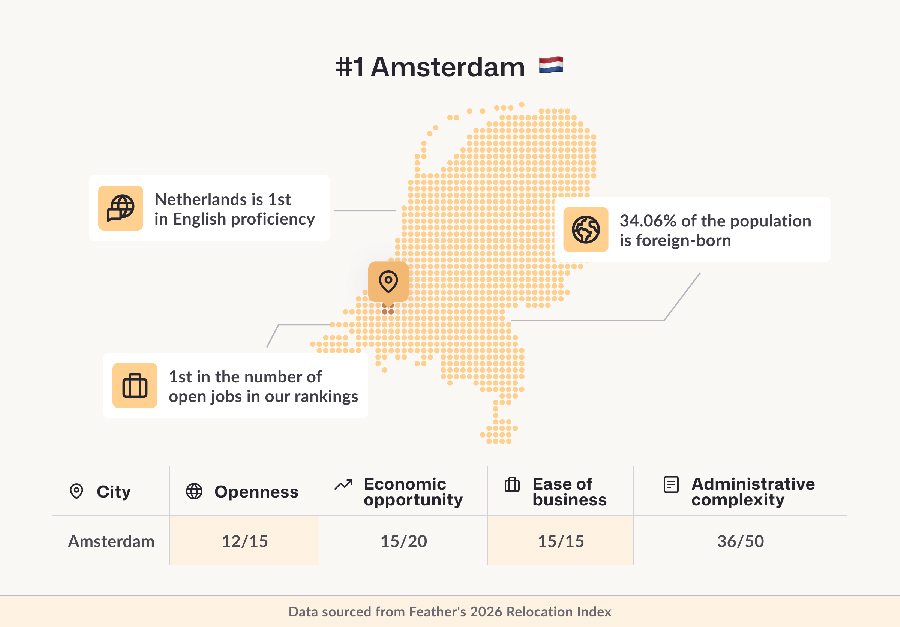
While learning Dutch is a difficult process, the Netherlands has been recognised by various research as the leading nation when it comes to English proficiency as a second language – since it is taught in state schools from an early age. This is partly because of the nation’s position as a European trade hub – with English serving as a useful common language to talk business around the world.
This is emphasised in Amsterdam – the top city for UK emigrants – which is the country’s financial centre. That means it ranks first in the number of job openings across the analysis – at 42 vacant positions per 1,000 residents. But the city is also particularly English-language-friendly, due to its reputation as a multicultural metropolis. With more than a third of Amsterdam’s population was born in other nations, English is also adopted as a useful second language to speak across its many national communities.
Taken together, these factors make Amsterdam a great choice whether you’re an entrepreneur or an employee. Nowhere comes without risk, though. The city does have a higher cost of living than most of the other cities in the list. In Amsterdam, renting an average one-bedroom apartment takes up nearly half of your salary. This can make it a less desirable option if cost of living concerns are your primary reason for relocating – while the nation’s continued housing crisis means that even finding that level of accommodation can take a nerve-shredding degree of luck – let alone hard work.
Source: Feather
Net migration
The findings come at a pivotal moment for the topic of migration in the UK. Immigration has been welded to the front-pages of mainstream news sources over the last decade. One of the major campaign issues during the UK’s pivotal Brexit vote was ‘border-control’, something which Reform UK – the opposition party led by Nigel Farage – has made hay with since 2024, currently leading in the polls amid regular discussion of mass deportations, should the party form the next government.
The UK’s incumbent Labour government has also taken aim at migration, in a bid to target Farage’s support-base. In 2025, Home Secretary Yvette Cooper promised to overhaul the UK’s family reunion policy, which allows people to bring their partners and children to the country once they are granted refugee status.
Meanwhile, the administration has been preparing new rules aimed at an overall reduction in immigration of all kinds. Changes include: an increase in the time it takes to reach permanent settled status, from five years to ten years; increased English language requirements for many types of visas, including family visas; and a tightening of criteria for skilled worker visas, leading to a surge in businesses and individuals seeking legal advice to settle in the UK.
And with a steady stream of British citizens also exiting the country, Warwick University recently published a study which suggested the UK could see negative net migration, where more people leave than arrive, as soon as the end of the year. With businesses continuing to complain of a skills shortage in the country, while vital sectors including health and social care are already short-staffed when it comes to catering to the needs of an ageing population, negative impacts of negative migration have long been speculated. But with skilled labour entering the country shrinking, while domestic workers continue their exodus, the actual outcomes may become visible sooner, rather than later.
Source link
#Amsterdam #top #destination #emigrants #Europe





