

Disengagement in UK workplaces is mounting and it’s impacting employee’s performance; a new study finds. But offering time to volunteer for community causes could rectify that, with more than 60% of staff saying it could boost their motivation, and engagement with an employer.



Corporate social responsibility (CSR) is a form of international private business self-regulation. By undertaking CSR projects, private companies look to make themselves socially accountable to their staff, stakeholders, and the public – contributing to the goals of a philanthropic, activist, or charitable nature by engaging in pro bono programs, community development, raising funds, or administering monetary grants to non-profit organisations for the society or the planet’s benefit.
It can also give businesses a major boost in terms of their own performance, though. Not just in terms of the reputational shot-in-the-arm volunteering for a good cause provides, but in re-energising and motivating a firm’s workforce – leading to boosted productivity.
Source: Royal Voluntary Service
In 2025, analysis from the Royal Voluntary Service estimated that employee volunteering could unlock £32.5 billion in productivity gains for the UK economy annually. The majority of firms which adequately engaged in volunteering schemes reported that their workforce was more motivated, healthier and better engaged in their usual work too.
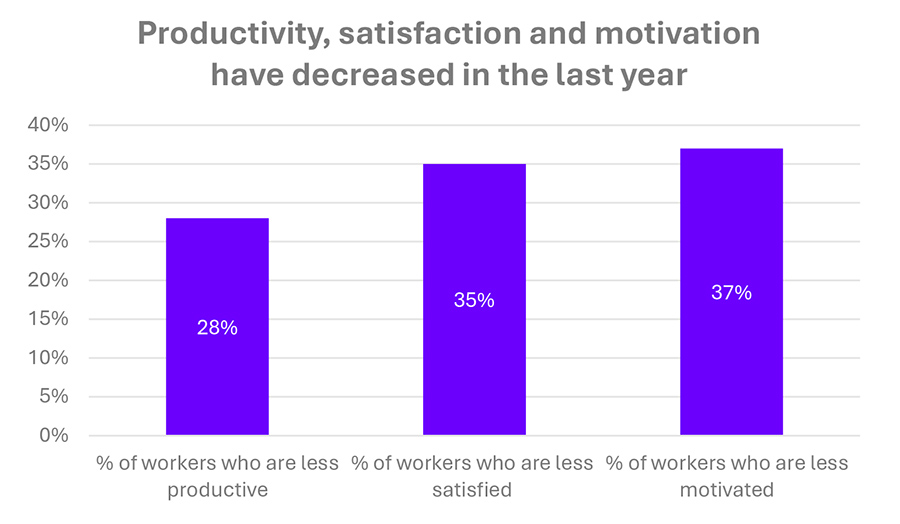
New research a year on shows how badly this is currently needed at many firms. A poll of more than 1,000 employees across the UK finds one-in-three are disengaged, while productivity and job satisfaction has waned for 28% of respondents. Coinciding with a time in which many employers have repeatedly reminded their staff they could soon be ‘replaced’ with AI, while the economic picture and a threat of global war also hang over the workforce, anxiety, insomnia and a loss of identity are just some of the mental health disorders currently facing employees.
It might not be surprising to learn that 34% of workers told the RVS that they felt burnt out at present, then. This rose to its highest among young workers – where 43% said they were impacted in this way – and women, 39% of whom said they were affected by burnouts and stress.
Source: Royal Voluntary Service
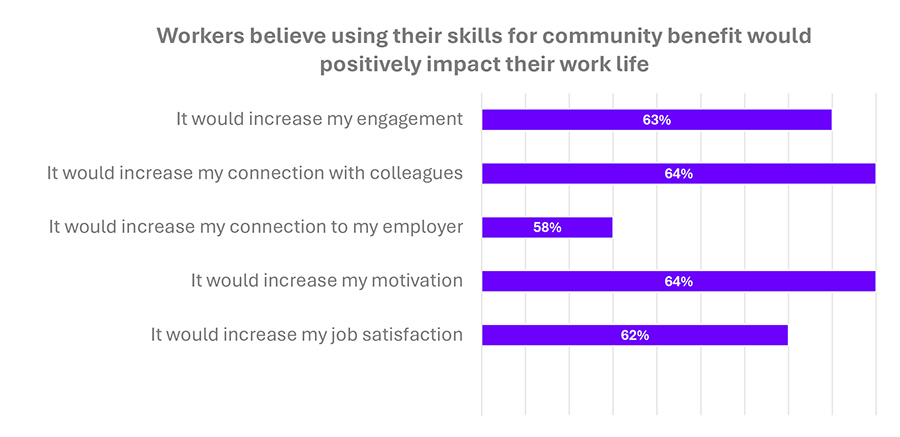
But with just 29% of workers currently feeling their work is meaningful – with 22% saying their workloads make work feel purely task-orientated – there is an opportunity for volunteering to make a difference to a large number of workplaces. When asked what impacts using their skills for the community would have on their working life, close to six-in-ten said that it would increase their connection to their employer, while 62% added it would boost their job satisfaction.
The knock-on effect of this would see 63% feel more engaged at work, and 64% more connected to colleagues. In turn, this would see 64% improve in motivation, potentially offering firms an antidote to their current productivity lapse.
Carole Urey, chief revenue officer for the Royal Voluntary Service, said, “For businesses, the findings send a clear signal – millions of employees are unsatisfied, burnout is rising and productivity is declining. There’s also growing desire for greater meaning and connection in our working lives. Volunteering is a practical and effective way to address these challenges. And the poll shows high demand from employees to contribute, with the majority saying having opportunities to use their skills to benefit the community would boost job satisfaction, motivation and engagement. This makes for a compelling case to embed volunteering more deeply into workforce strategy and to make it a core part of company culture.”
Source link
#Volunteering #reengage #workforce #boost #productivity