As AI mints new millionaires, billionaires, and even trillionaires, it’s also threatening to replace entry-level workers and sparking fearful chatter of the “permanent underclass.” There’s no place that’s more evident than in the Bay Area, at the heart of Silicon Valley, where technology is wedging a deeper divide in the K-shaped economy, especially in the housing market.
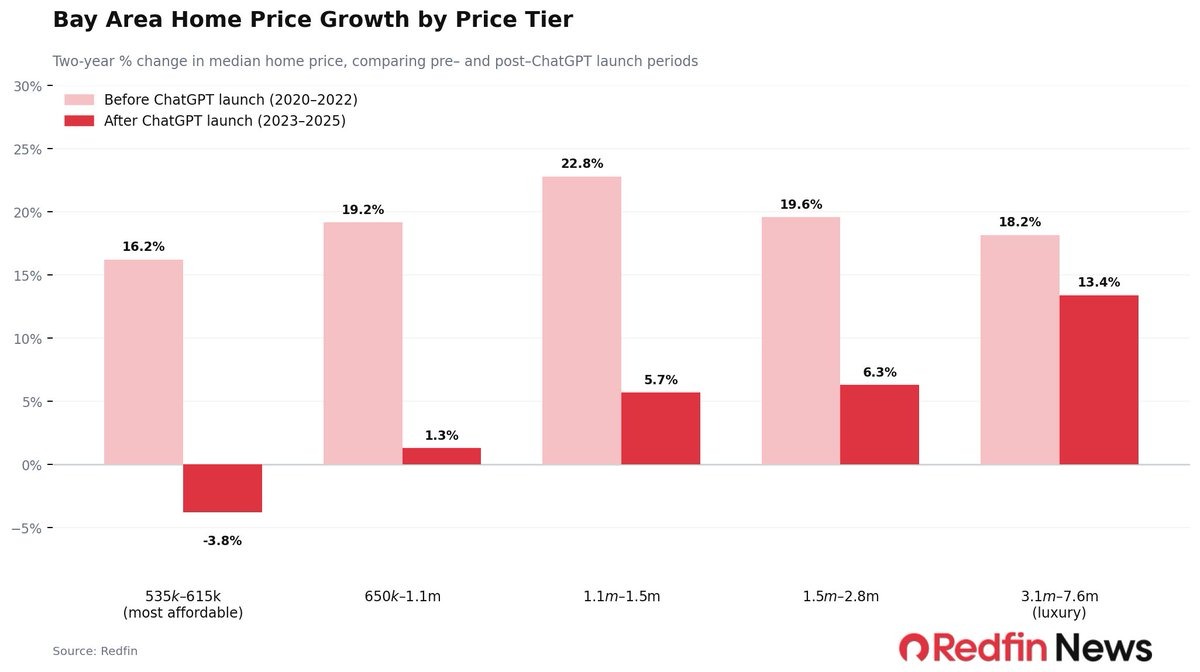
A new Redfin report found that since the launch of ChatGPT’s first model in Nov. 2022, luxury home prices in the region—classified as those selling between $3.1 and $7.6 million—have jumped 13.4%. At the same time, home values for lower-end properties in the Bay Area—those $535,000 to $615,000—have fallen by 3.8%.



“Some owners of lower-end properties have missed out on the AI boom, with home prices in the most affordable Bay Area zip codes declining over the past two years,” Yingqi Xu, Redfin senior economist, said in a statement. “It’s another sign of the K-shaped economy taking shape in the Bay Area, with AI lifting the fortunes of some households and neighborhoods much more than others.”
Many Americans today are grappling with the sobering reality of high mortgage rates, inflated home prices, and a housing stock shortage. Many are delaying homebuying by a near decade from just a few years ago, as the median age of the first-time homebuyer hit 40 in 2025, up from just 33 in 2021.
How the AI boom is splitting the Bay Area housing market in two
Overwhelmingly it seems that AI’s biggest winners are thriving and buying up multi-million-dollar properties.
The median home sale price in the San Francisco metro area—where companies like Meta, Alphabet, Uber, and Salesforce are based—rose 14.4% year over year in March to a record $1.7 million, according to Redfin. The firm’s chief economist Daryl Fairweather told Fortune that the market reflects an increasingly familiar pattern playing out across Silicon Valley today.
“There are lots of people who have gotten very rich off of AI,” she said. However, the opposite also holds true. “At the same time, salaried white-collar workers are feeling the strain of the economy, worry[ing] that AI is going to replace them.”
This trend also marks a sharp break from Bay Area housing patterns before ChatGPT’s release. Between 2020 and 2022, home-price growth was roughly equal at about 20% across all price segments, from luxury to the cheapest homes. This was largely driven by low mortgage rates and pandemic-era demand.
The decline in prices at the lower end of the market may seem like an opening for buyers who have been waiting on the sidelines. But Fairweather noted that homes in that range often need significant repairs, and many are condos burdened by high HOA fees, charges that cover shared amenities like pools and gyms and can substantially offset any potential savings from a lower asking price. It’s not so much that these homes are becoming more affordable, but rather that they’re being devalued by homebuyers.
“This has more to do with the very big winners of AI, those executives and those venture capitalists that are making a lot of money off of the hype and the value of AI,” Fairweather said.
While this trend of inflated home prices may seem familiar to those in the Bay Area, it hasn’t quite reached other parts of the country yet.
According to Redfin, New York’s luxury zip codes saw the slowest growth in the two years after the launch of ChatGPT in November 2022. In Los Angeles, too, luxury zip codes struggled, though they still outperformed other zip codes, but not meaningfully.
The report notes that the link between AI and the luxury housing market isn’t strictly causal. But because it’s unique to the Bay Area
“The fact that this trend is absent in areas with less AI wealth suggests that the AI boom is what is fueling divergence in the Bay Area,” the report reads.
Source link
#quietly #splitting #housing #market #Bay #Area #luxury #homes #affordable #collapsing #Fortune