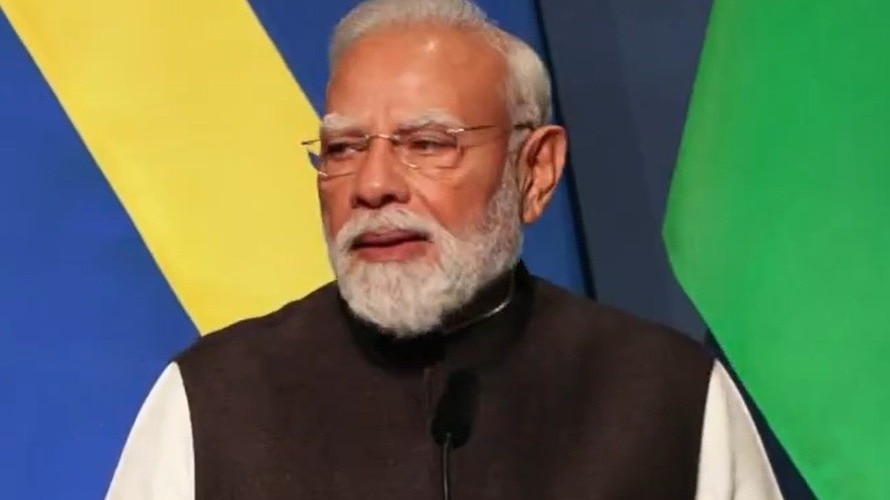
On the evening of May 17, 2026, in Gothenburg, Sweden’s industrial heartland, India’s Prime Minister Narendra Modi walked into a room filled with the chairmen and CEOs of Europe’s most powerful corporations and issued a direct challenge: make one new, bold commitment to India within the next five years.
The occasion was the European Round Table for Industry, one of Europe’s most influential business forums, co-hosted with Swedish Prime Minister Ulf Kristersson and European Commission President Ursula von der Leyen. It marked one of the most significant diplomatic-business engagements between India and Europe in recent years, and Modi used every minute of it.


Who was in the room
The ERT session drew an elite cross-section of European industry across sectors. Telecom and digital was represented by Vodafone, Ericsson, Nokia, and Orange. Technology and semiconductors brought in ASML, NXP, SAP, and Capgemini. Energy and clean tech saw ENGIE, TotalEnergies, Shell, and Umicore at the table. Infrastructure, mobility, and manufacturing included Volvo Group, Maersk, Airbus, Saab, ArcelorMittal, and Heidelberg. Healthcare and life sciences was represented by AstraZeneca, Roche, Merck, Philips, Nestlé, and Unilever.
The five-sector framework
PM Modi laid out a crisp framework for deeper India-Europe industrial collaboration, built around five priority sectors where he called on the assembled companies to make specific, concrete commitments:
- Telecom and Digital Infrastructure — covering the 5G to 6G transition, AI-enabled networks, and digital inclusion
- AI, Semiconductors and Deep-Tech Manufacturing — positioning India as a global end-to-end technology hub
- Green Transition and Clean Energy — spanning hydrogen, electric vehicles, energy storage, and decarbonisation
- Infrastructure, Mobility and Urban Transformation — including aerospace, green steel, logistics, and defence
- Healthcare and Life Sciences — covering vaccines, cancer care, digital health, and medical devices
The ask
PM Modi’s pitch was direct. “Can every company here make one new, bold commitment to India? Can we identify flagship projects that will launch in the next five years? The Indian government will back every single one of them.”
He spoke candidly about India’s reform journey over the past 12 years, GST, the Insolvency and Bankruptcy Code, corporate tax cuts, Production-Linked Incentive schemes, FDI liberalisation, and a significant reduction in the regulatory compliance burden. He also pointed to India’s structural credentials: the world’s fastest-growing major economy, a population of 1.4 billion, and the third-largest startup ecosystem globally.
Structural proposals on the table
Beyond the pitch, PM Modi put forward a set of institutional proposals to formalise the India-Europe business relationship on a sustained basis. These included an annual India-Europe CEO Roundtable involving industry bodies from both sides, sector-specific working groups to fast-track collaboration in priority areas, an ERT India Desk or India Action Group to support companies already operating in India and facilitate new entrants, and government-backed institutional reviews of flagship projects to ensure time-bound delivery.
Source link
#Modi #pitches #sector #India #vision #Europes #biggest #boardrooms #Airbus #Shell #Roche #present #BusinessToday