

Having been swept up in the AI-ferver of the last three years, the majority of companies have sought to mainline the technology into their communication functions. However, two-thirds have no formal change strategy for communication – neglecting the human aspects of business needed to make the most of the technology – meaning a similar number find themselves trapped in the experimentation stage.


Around the world and across all industries, executives remain excited around AI. Publicly, at least, they issue statements declaring they hope to realise huge productivity boosts and efficiency savings by plumbing the technology into every facet of their operations. But more than three years since ChatGPT and generative AI entered the public conscious, material impacts seem thin on the ground.
Late in 2025, for example, IBM has polled an international cohort of CEOs, and found that even as talk of the technology’s untapped possibilities remains rife, progress in the adoption of AI remains slow. In 2024, two-thirds of leaders said they expected to move beyond the piloting phase of AI changes, but a year later, 60% were still stuck in the nascent period of experimenting. And as companies continue to burn through funds, investors are beginning to participate in a growing amount of wheel-kicking – testing to see which areas they are actually seeing value for money in. If leaders expect to continue on this track, then, they will need to put more extensive plans in place than they have managed to date.
Source: Gallagher
The communications function is no exception to this. According to a new survey from Gallagher, drawing on insights from more than 1,300 communications and HR professionals, while many firms have adopted AI tools to boost their communications output, very few have implemented a holistic strategy around it, leading to low levels of meaningful integration.
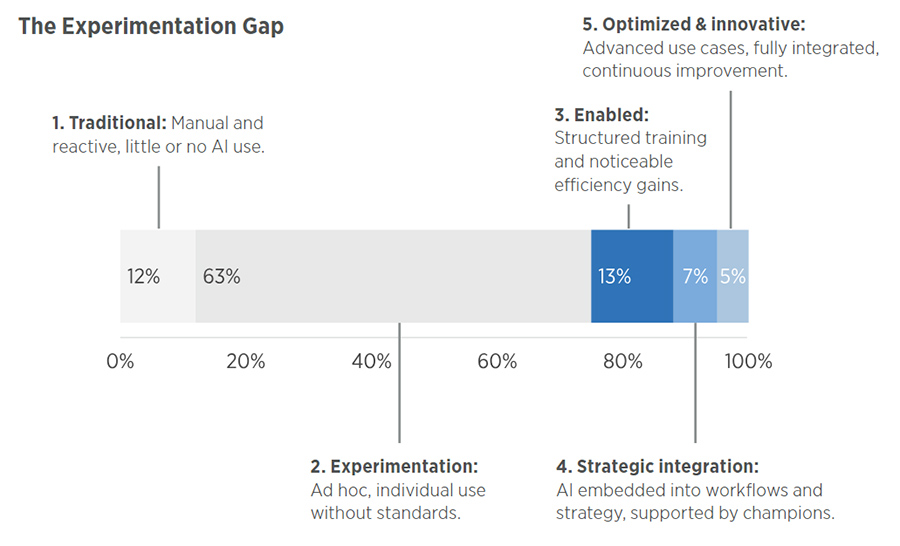
While ‘change management’ is recognised by 57% of companies as their organisation’s most valuable skill – in a time of perpetual digital transformation – Gallagher found that 61% had no formal change communication strategy in place. And as a result, many are lagging behind when it comes to scaling the technology’s use – with 63% still in an “experimentation phase”, while 75% describe their AI maturity as ad hoc or “discussion only.”
In stark contrast, just 5% report optimised integration. As AI readiness becomes a key point of interest, the lack of a clear implementation programme and a defined governance code will present an administrative challenge for communication teams.
Source: Gallagher
The common approach here is to blame the companies for not understanding the technology they are deploying. But in this case, it seems just as likely that the leaders have little understanding of the work they are trying to either optimise or replace with AI. Gallagher found that 69% of firms had fewer than six people in a comms role – and that number persisted regardless of whether the company has 500 employees or 50,000.
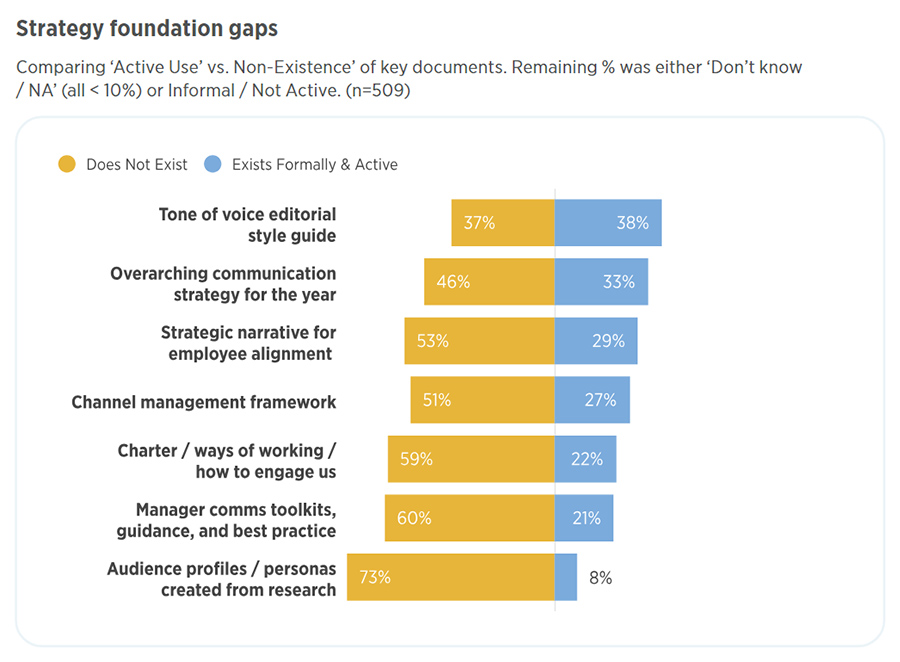
This resourcing pressure – compounded by budget constraints – means internal communications departments are overstretched when it comes to their normal jobs, let alone having to re-imagine their working day around the particularities of an AI tool which may or may not be suited to their role. A 73% majority had no access to audience profiles, and 37% did not even have the time to strategise around a tone of voice or editorial style guide. At the same time, only 21% of companies said their comms team had toolkits, guidance and best practices in place to help plan for the future. Getting the most out of AI here clearly will not boil down to simply ‘plug in and go’, then.
William F. Ziebell, global chief executive officer of Gallagher’s benefits and HR consulting division, said, “In a fluid business and technological environment, change communication, EVPs and AI tools are high on organisations’ agendas. However, many companies do not have a clear plan for how to deliver on these priorities across the workforce. Ultimately, effective communication relies on giving teams the resources to deliver the right message at the right time. The value of the human insights cannot be underestimated when seeking to improve engagement. Employees want to know their feedback is being heard and in-person events and townhalls are the best venue for this.”
Source link
#communications #transformations #trapped #experimental #phase