
The global sports industry faces the mounting threat of disruption, if it cannot modernise its broadcasting commitments for the modern era, according to a new study. The research from Altman Solon shows that rising prices are pushing a quarter of younger viewers to tune into pirated ‘alternative’ streams of events – threatening the economic model underwriting many of the world’s leading sporting institutions.



For years now, sports promoters and broadcasters have grappled with something of an emerging existential crisis. While older fans remain willing to engage in their products, younger and less affluent consumers are drifting away from the sport. Attempts to appeal to ‘young people’ so far have included the supremely unpopular Super League project, as well as patronising suggestions that they could be lured back to sport via ‘AR and VR experiences’, bundles with streaming providers, and smartphone-based statistical experiences.
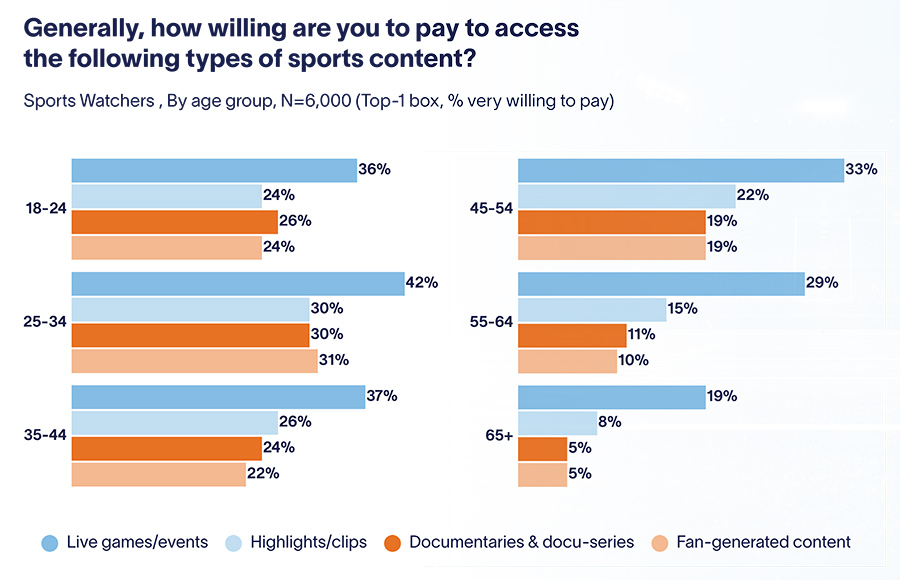
However, a new study from Altman Solon shows that far from disengaging with sporting products, younger viewers have become the leading consumers of subscription content. When the consultancy asked 6,000 consumers about their willingness to pay for access to sports content, the highest portions of 42% among those aged 25-34, and 36% among those aged 18-24, said they would pay to watch live games and events. Neither cohort saw fewer than 24% being willing to pay for other content – including highlight clips, documentary series, or fan-generated content.
Source: Altman Solon
This stands in stark contrast to those aged 65 and over. Possibly because many of them remember a time they could watch sport on television without spending big on a monthly subscription, or attend an event in person, just 19% would pay to watch live events. And just 8% said they would pay for highlights, while 5% saw the other options as worth paying for.
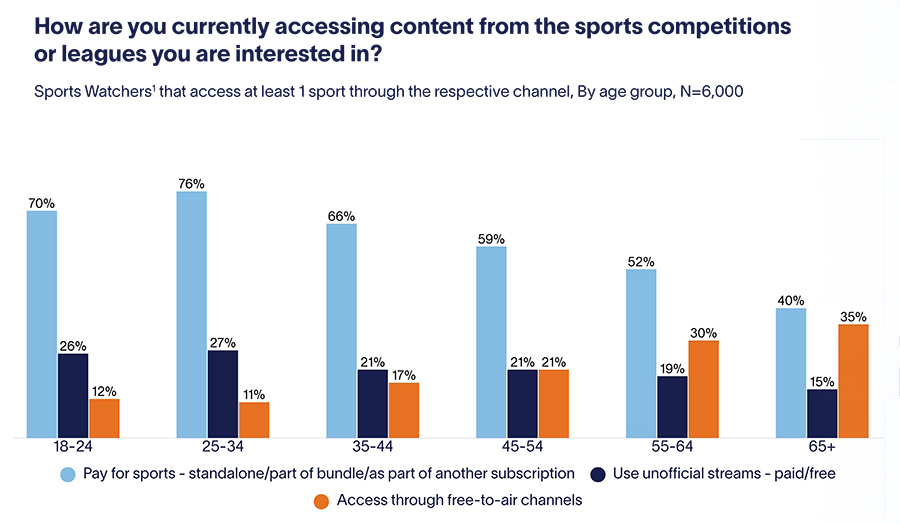
When asked how people currently accessed sport content, this played out in a similar way. While 40% of consumers aged over 65 watched pay-per-view or subscription services, this was much lower than among the youngest people Altman Solon polled. A 76% majority of 25-35 and 70% majority of 18-24 year-olds fell into this category.
The thing is, with an economic environment which has left these consumers with significantly less spending power than their parents or grandparents – with little access to affordable housing, or the public services those generations took for granted – the largest portion of these consumers are also looking to ‘unofficial’ sources for content. Having been priced out of conventional sports viewing, 27% of 25-34 and 26% of 18-24 year-olds are viewing pirated footage instead.
Source: Altman Solon
This mirrors the surge of illegal streaming beyond sports. As the likes of Netflix and Disney+ hike prices, and foist new advertising tiers to users who can’t keep up with the inflated cost, visits to bootleg streaming websites have boomed since the pandemic – and as many of those streamers head into sports broadcasting, with a similar view to pricing, the trend may well extend there.
While double-digit numbers of consumers in other demographics also seek out these sporting streams, this may particularly concern broadcasters, and the sporting institutions which depend on their funding, regarding the younger cohorts of the survey. After all, they are the future – the long-term customers they will need to cater to. As to how they do that, Altman Solon took a number of views from experts in the field.
Andreas Kaeshammer, head of football at Infront Sports & Media, argued that Gen Alpha would “rather pay 50 cents for a 15-minute reel of their favourite strikers’ touches than a $30 monthly subscription”, and that “rights holders need models for this.” But a more radical suggestion came from Fabien Robineau, CCO of Eurovision – who argued making sport easier to access legally – including lower-friction entry points such as “freemium” offerings should be considered.
He warned, “We’re in the “Napster” era — sports needs a “Spotify” model.”
Source link
#Piracy #disrupt #broadcast #revenues #Spotify #sport