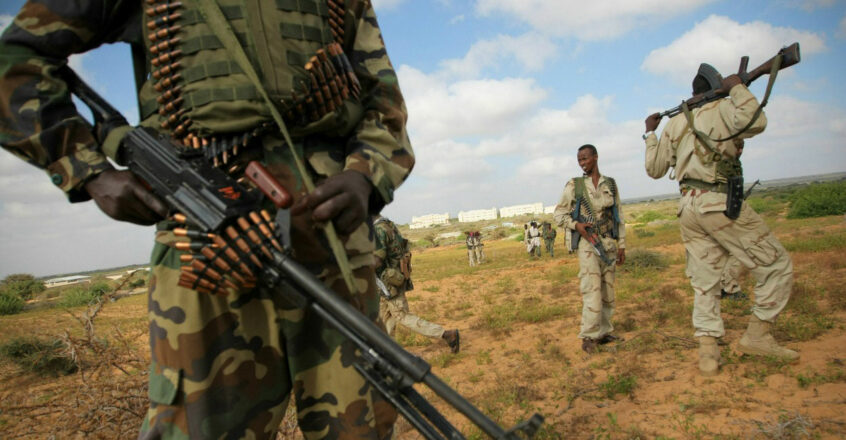
The prevailing consensus in Western media portrays Sudan as mired in a brutal civil war between two local rival factions, the Sudanese Armed Forces (SAF) and the Rapid Support Forces (RSF). This narrative, however, overlooks a reality well understood by many Sudanese: the SAF—ostensibly the national army—has increasingly subordinated itself to non-Sudanese interests, particularly those aligned with the Muslim Brotherhood. Led by General Abdel Fattah al-Burhan, the SAF has consistently advanced Brotherhood interests, ensuring the failure of both democratic reform and peace negotiations. The U.S. has recognized the threat posed by Muslim Brotherhood chapters in Egypt, Jordan, and Lebanon, designating them as terrorist organizations. This precedent creates an uncomfortable policy contradiction if a military institution increasingly shaped by the same ideological networks continues to be treated internationally as a conventional national army.
Sudan’s Long Islamist Entrenchment
To grasp why the Brotherhood’s control of the SAF and state institutions matters, it is necessary to understand that Sudan’s Muslim Brotherhood—like its branches around the world—systematically embeds itself within state institutions, turning the state apparatus into a vehicle for both ideological and criminal objectives. The Sudanese Brotherhood movement entered state power through the NIF-led coup of June 1989 that brought Omar al-Bashir to power and sidelined pluralist politics. For at least a decade after the coup, the Islamist ideologue Hassan al-Turabi and his cadres were the de facto leadership, embedding Brotherhood-style networks inside the army, security services, civil service, and economy. These Brotherhood networks exacerbated ethnic and religious tensions, leaving Sudan’s diverse communities—ranging from Arab Sudanese to marginalized African minorities such as the Fur, Nuba, and Zaghawa—victims of systematic violence and exclusion.



The military overthrow of Bashir in 2019 sidelined his National Congress Party (NCP), but it is a mistake to assume that the Muslim Brotherhood was dismantled along with the party. Functioning as a parasitic network, the Brotherhood migrated much of its political and financial infrastructure into the SAF’s command structure. Guided by Brotherhood ideology, the SAF remains obdurate in the face of peace negotiations.
One need only examine the Islamists who have embedded themselves within Sudan’s military and governing elite to understand the continuity of Islamist power. Ali Karti, the secretary-general of the Sudanese Islamic Movement (SIM) and Bashir’s former foreign minister, commands the El Baraa Ibn Malik Brigade (BBMB), a hardline Islamist militia that supports the SAF and maintains ties with Iran; the U.S. Department of State has sanctioned him for obstructing peace in Sudan. Ali Osman Taha, a former vice president and longtime SIM hardliner, remains a senior Islamist figure and has openly called to revolt against any erosion of Islamist authority. Ahmed Haroun, an ICC-indicted war criminal and former chairman of the National Congress Party, escaped from Kober Prison in 2023 and has since mobilized Islamist militias to fight alongside the SAF. Meanwhile, Osama Abdallah, another key operative from the Bashir era, oversees the integration of Islamist “shadow brigades“ into the military structure; he ensures that the SAF functions as a cohesive Islamist fighting force.
Taken together, the four men’s deep entrenchment within the SAF grants them effective control over both military and state institutions, relegating General Burhan to a veneer, while real power lies with Muslim Brotherhood power brokers.
The Human Cost of Islamist Militarization
The international community saw the results of an Islamist army in the 2023 outbreak of large-scale violence. An Islamist-controlled military led to egregious violations of international humanitarian law. In late 2025, CNN reported on the SAF’s atrocities against non-Arab ethnicities, including the dumping of “bodies into the water” and “throwing others in while they were still alive.” Additionally, the SAF has blocked humanitarian aid, choosing to use starvation as a weapon. The U.S. Treasury has already taken action against the BBMB due to its use of “arbitrary arrests, torture, and summary executions.” These measures highlight a broader dilemma for governments that continue to treat the SAF as a conventional national army despite its growing reliance on Islamist militias and political networks.
Reuters’ Arabic-language reporting indicates that thousands of Islamists from the former regime have joined forces with the SAF, further complicating efforts to end the bloodshed. As the SAF becomes more deeply intertwined with these networks, international partners face an increasingly difficult question: whether continued engagement with SAF leadership risks reinforcing the very actors that have repeatedly obstructed peace negotiations and democratic reform.
Democratic Alternatives to Islamist Militarism
One such force is the pluralistic Civil Democratic Alliance for Revolutionary Forces (Somoud), which has called on the international community to support a democratic civilian transition while blaming the military and its Islamist allies for obstructing peace efforts. On X, Somoud has outright called to criminalize Brotherhood and SAF-aligned Islamist brigades due to its anti-democratic ideology.
Another auspicious movement is the Sudan Founding Alliance (Tasis). Unlike the warring parties that are prolonging Sudan’s bloodshed, Tasis commits to “building an inclusive homeland, and a new secular, democratic, decentralized, and voluntarily unified Sudan, founded on the principles of freedom, justice and equality.”
For movements such as Somoud and Tasis to compete on a fair political playing field, Sudan’s international partners will need to reconsider how engagement with Islamist networks embedded within the SAF shapes Sudan’s political landscape.
Figures such as Burhan, Karti, Haroun, Taha, and Abdallah remain central nodes in those networks, raising a fundamental policy question: whether continued international legitimacy for these actors ultimately undermines the democratic transition that Washington and its partners claim to support.
Resolving this contradiction will be a critical step toward ending Sudan’s civil war and creating the conditions under which Sudan’s democratic political forces can emerge.
Source link
#Sudans #Muslim #Brotherhood #Army #Washingtons #Sudan #Policy #Faces #Growing #Contradiction