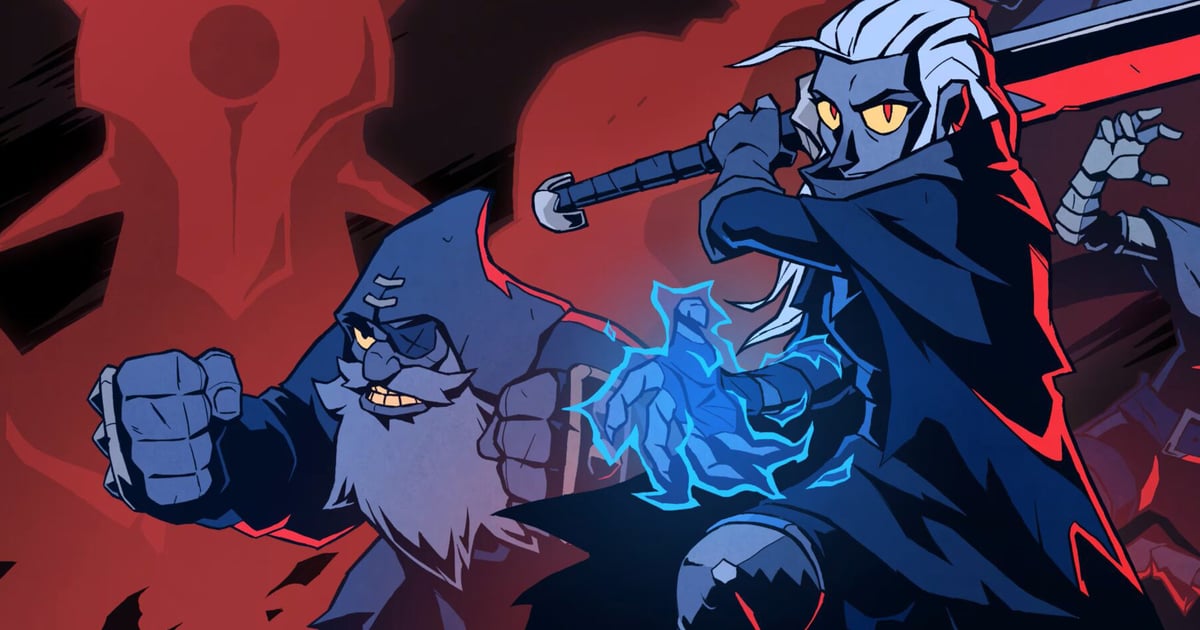
Gorgeous art direction often serves a game’s narrative. But what happens when narrative serves the art?
I caught myself asking this question while playing Absolum, from developers Dotemu, Guard Crush Games and Supamonks. I picked the game for my Nintendo Switch 2 on a lark, looking for an action roguelike to satisfy my brain while my spouse binges Letterkenney. I’d heard good things about the side-scrolling combat and the art direction was immaculate. I was disappointed that the game’s story is a somewhat thin affair, but the gorgeous and imaginative fantasy world was enough to keep me going.


But while the story itself didn’t satisfy, one storytelling technique surprised me with its specialness. While Absolum’s narrative moments are few and far between (though it’s clear its creators are deeply invested in its backstory), the ones that do surface serve a gameplay purpose I haven’t seen often: directing players to pay close attention to the visuals.
This largely comes in the form of characters and quests that instruct the player to visit specific locations in the game world without providing any UI-based navigation tools. A pirate queen told me to look behind the bushes in a glen near the starting point of each run. A goblin asked if I would help them navigate to a swamp without telling me how to approach it. And a mysterious narrator-type character urged me to pay attention to the background of levels—if a certain small fantasy creature appeared, it indicated the presence of a hidden area.
This was in striking contrast to Supergiant Games’ Hades II, the most recent action roguelike I’d played before Absolum. Both games have an amazing visual style that support their core gameplay. Hades II‘s lush environments play well with its isometric view, and the comic book-inspired art of Absolum serves its beat-em-up and fighting game influences. But the story Hades II rarely asked me to pay close attention to the environment itself.
So why does Absolum? That’s what we’re talking about on this week’s Narrative Notebook.
Absolum‘s combat design is all about the frames
Let’s go back to Hades II for a moment. Combat in Hades II, like Absolum, demands precise timing and creative combinations of weapons, abilities, and god-given powers.
But the timing’s not that precise. After all, unlike the heroes of Absolum, Melione isn’t trying to parry her way to victory. Hades II‘s combat difficulty largely scales on the types of enemies in a given zone and how many of them show up. It doesn’t go full-on Vampire Survivors—where the enemy attack animations barely matter and their proximity is all that counts—but the lack of a parrying mechanic makes it easier for players to prioritize attacking foes instead of waiting for them to strike.
Absolum, by contrast, is a beat-em-up all about parrying. In this game, parrying doesn’t occur with a properly timed “block” action, it occurs with a properly-timed dodge action. There is no damage reduction if you miss your window, either you get out of the way, you get smacked, or you parry the blow.
Between this and a “clash” system (where players interrupt enemy attacks with their “Skill” or “Arcanum” attacks), players are tasked with paying extremely close attention to enemy animations. And those animations are complex. A brief shining light will signal that a parryable attack is incoming, but the timing of when that attack hits varies from foe to foe.
Unlike recent parry-heavy hits like Clair Obscur: Expedition 33, where players stand still while watching an individual enemy’s windup and attack, Absolum players must prepare their defenses while fending off enemies on all sides. The gap between “telegraph” and “impact” comes much faster and in a more chaotic environment.
Here is my theory: you can tell players all you want to pay attention to enemy movements but many of them will lose patience and just try and brute force their way through combat (it’s me, I’m one of those players). But if you want players to stare at your luscious art intensely, teaching them to pay attention to nooks, crannies, and sudden unexpected movements sure feels like a good way to go about it.

Image via Dotemu/Gamirror Games
One later quest sends the character down into a dwarven mine, and the player learns they need to reignite a furnace in order to unlock another area. The player is given no instruction on how to do so. When they find the furnace, a giant temperature gauge looms in the background of the environment—but that’s it.
Does the player need to find a hidden switch? Will the temperature go up automatically? The player only finds the answer by fighting the enemies that spawn and attempt to hit or throw them into the furnace’s side. This exposes the flames within—flames that will only rise when the player casts more enemies into the fire.
These moments feel strangely similar to hidden object games, which present players with detail-rich 2D environments, and players search for…well, the designated hidden objects. The “ah-ha!” moment of surprise and delight that follows overlaps intensely with Absolum‘s environmental secrets. The repeated task of having players focus on the environment overlaps with the task of paying attention to animations.
It’s a common design feature in other parry-heavy games—but Absolum is the first one I’ve encountered where the characters explicitly tell you to watch your surroundings with strong narrative justification. It’s that relationship among visuals, story, and combat that makes me argue the game’s narrative serves the art direction, not the other way around.
Storytelling secrets help retain player interest
So what were the creators of Absolum intending with this kind of storytelling? It’s not a topic I’ve seen them discuss anywhere, so I shot a few questions over via email to Dotemu head of game design Jordi Asensio. “Absolum is an action game, so we wanted to interrupt the player as little as possible,” he explained. “That’s why we kept the dialogue relatively short and relied on a lot of environmental storytelling to convey the world and the atmosphere.”
Gautier Knittel, the game’s writer and narrative designer, said the goal was for the game to expose players to the story through “layers and hints,” and to trust the player’s “intuition and intelligence” to piece the puzzles together.
So why the environment-driven quests? “We’re just huge fans of secrets in games,” Arsenio said. “Some of our best gaming memories come from discovering hidden paths or unexpected things, so naturally we wanted Absolum to be full of them.” He noted that some of those secrets were “too hidden,” so art director Maxime Mary came up with the idea of placing the small one-eyed rabbit in the environment as a hint.
These methods, he added “fit with our broader goal of fighting the monotony sometimes associated with beat-em-ups and the repetition that can happen and roguelites.”
“Secrets and alternate paths help keep players curious and constantly exploring.”
March inspirations: Pitter patter and ancient telephones
I’m squeezing this column out just before March wraps up but I’m pleased to say I found plenty of delightful inspiration between the madness of GDC and the trials and tribulations of a family wedding.
-
Letterkenney
-
I simply couldn’t resist the siren song of Canadian comedy. Plenty of comedies and dramadies have spun gold out of the notion that small-town folks are smarter and more clever than they seem at first glance—Letterkenny takes it a step further by having everyone have a gimmick and/or tight-five comedy set ready to go at the drop of a hat. Someone needs to try to capture the flow and feel of this show’s dialogue in a text-based game tool. Pitter patter, get on with it!
-
-
Classic telephone design
-
I was walking through San Francisco Airport leaving GDC when I stumbled on a whole museum exhibit displaying telephones from across the twentieth century. The more esoteric designs immediately drew my eye, and I thought how they could be used in a game not necessarily as phones, but other strange technological marvels. Take the failures of the past and turn them into fodder for your games!
-

Image via the author
-
Hivespark LLC’s Mailville
-
I stumbled on Mailville while visiting PAX East and not only was charmed by the conceit of “a twin stick shooter where you’re delivering the mail,” but also something that lead developer Ariel Wexler said while I was praising the game’s art style. He explained that he uses MS Paint to sketch out ideas of what he wants various assets to look like—so he used that as a foundation for his art direction.
-
Signing off—and remember, great games writing is everywhere.
Game Developer and GDC Festival of Gaming are sibling organizations under Informa Festivals.
Source link
#story #serves #art #direction #Absolum