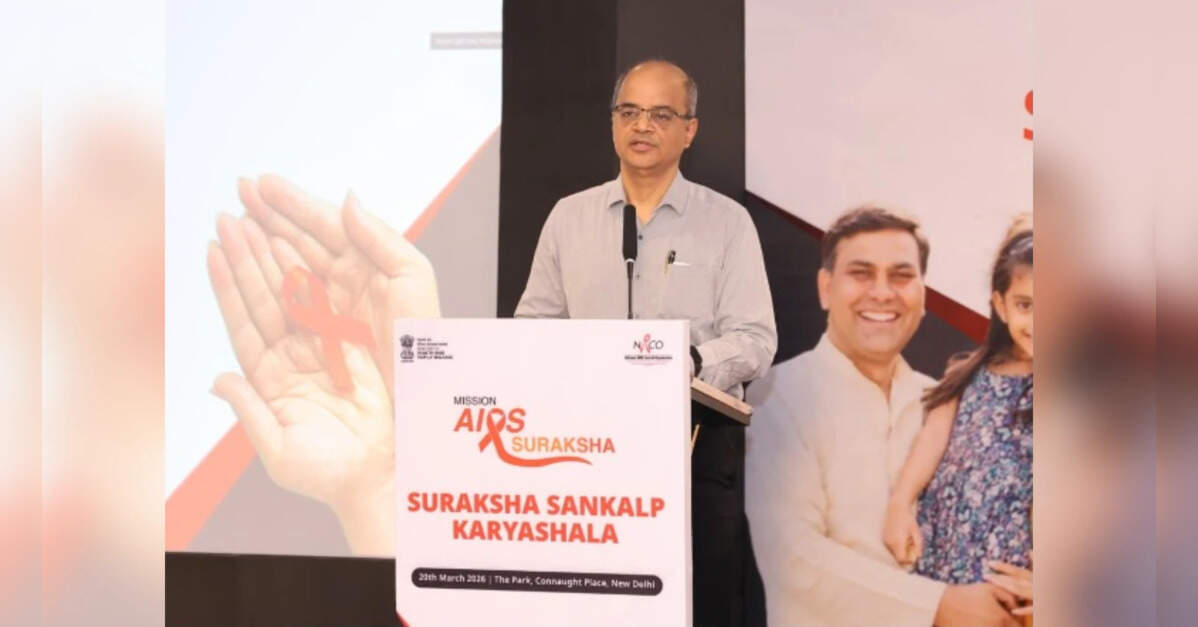


New Delhi: The need of the hour is granular, district-led strategies backed by robust data analytics and improved service delivery frameworks to address evolving HIV trends in India, said Rakesh Gupta, Additional Secretary and Director General of the National AIDS Control Organisation.
He was speaking at the ‘Suraksha Sankalp Karyashala’ convened in Delhi by the Ministry of Health and Family Welfare as part of a nationwide strategy to strengthen district-level HIV/AIDS response, with a focused engagement on Haryana and Delhi.
In his keynote address, Gupta emphasised that HIV/AIDS continues to pose a significant public health challenge, requiring sustained vigilance, innovation, and coordinated action across all levels of governance. He reiterated the importance of achieving the globally endorsed 95:95:95 targets—ensuring that 95 per cent of people living with HIV are aware of their status, 95 per cent of those diagnosed receive sustained antiretroviral therapy (ART), and 95 per cent of those on treatment achieve viral suppression.
Highlighting regional disparities, he noted that Delhi faces critical gaps, with only around 70 per cent of identified individuals currently linked to treatment. In contrast, Haryana has achieved a cascade of approximately 81:83:95, indicating progress while underscoring the need to improve diagnosis and treatment linkage.
Gupta also stressed the urgent need to eliminate mother-to-child transmission of HIV, which remains preventable through timely testing, counselling, and treatment. He called for strengthened antenatal screening and universal access to prevention services.
At the national level, 219 districts have been identified as priority areas for intensified HIV/AIDS interventions, including 11 in Haryana and 7 in Delhi. Delhi currently has an adult HIV prevalence of 0.33 per cent, with an estimated 59,079 people living with HIV, while Haryana reports a prevalence of 0.24 per cent, with around 59,642 cases.
Priority districts in Delhi include North, New Delhi, Shahdara, Central, South East, South, and North West, while in Haryana, key districts include Gurugram, Faridabad, Panipat, Rohtak, and Hisar, among others.
District programme teams from these regions are participating in the workshop to present progress, identify operational challenges, and develop targeted, outcome-oriented action plans to strengthen grassroots-level implementation.
Calling for a “whole-of-system” approach, Gupta urged closer coordination across national, state, and district stakeholders to bridge gaps in awareness, testing, treatment, and adherence.
He outlined a time-bound roadmap, reaffirming India’s commitment to bringing HIV/AIDS under control by World AIDS Day 2027, with an accelerated push towards achieving enhanced 95:95:99 targets.
The Karyashala is designed as a collaborative platform to strengthen programme implementation through inter-sectoral convergence, capacity building, and robust monitoring mechanisms, with a focus on early diagnosis, prompt treatment initiation, sustained adherence, and stigma reduction.
The initiative aligns with India’s broader goal of ending AIDS as a public health threat by 2030, reinforcing a coordinated, inclusive, and data-driven national response.

Source link
#Centre #Pushes #DistrictLevel #HIV #Action #Targets #Epidemic #Control