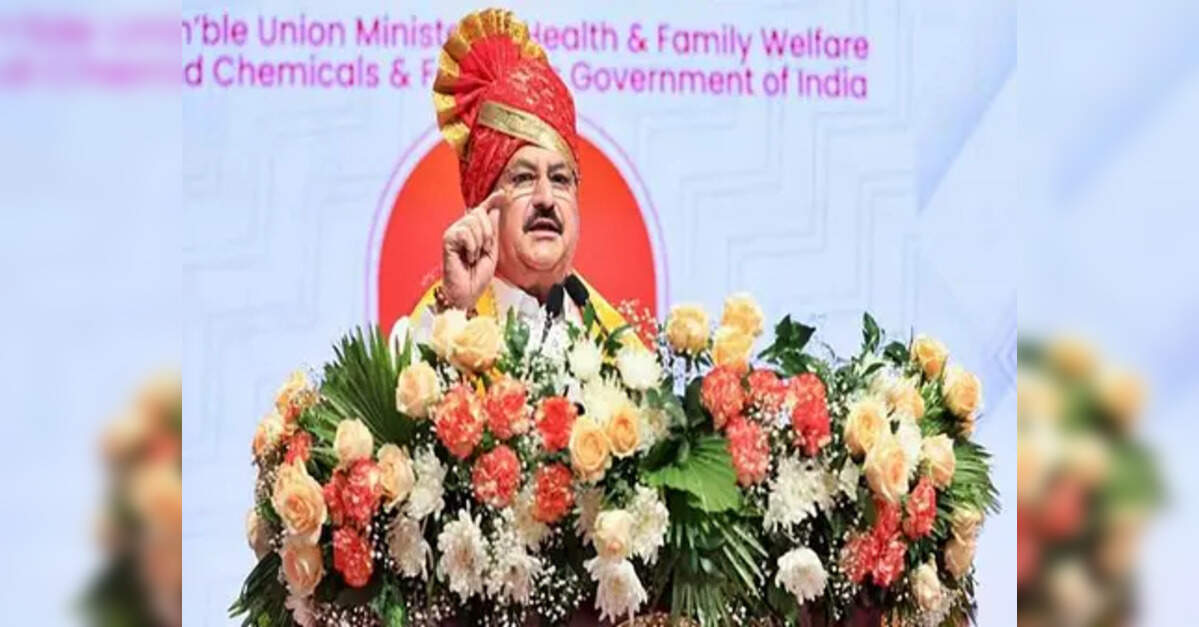



Moradabad: Union Minister for Health and Family Welfare J. P. Nadda called on graduating students to serve society with commitment as India moves through the second phase of Amrit Kaal, while highlighting the country’s progress in strengthening healthcare systems.
Speaking at the convocation ceremony of Teerthanker Mahaveer University in Moradabad, Nadda said the graduating class is entering the professional world at a time when India is working toward the vision of Viksit Bharat by 2047.
Describing convocation as a defining milestone, Nadda said it represents years of dedication and discipline, while also marking the beginning of a new phase of responsibility and service.
“A convocation is not merely the end of an academic journey but the beginning of a new chapter of responsibility and service to society,” he said.
“You are privileged to be entering the professional world during the second phase of India’s Amrit Kaal, as the country moves towards the vision of Viksit Bharat by 2047. This period presents both opportunity and responsibility for young professionals to shape the future of the nation,” Nadda added.
Highlighting developments in the healthcare sector under the leadership of Narendra Modi, the minister said the past decade has seen significant expansion in healthcare infrastructure and medical education.
“In the last eleven years, India has witnessed a significant expansion of premier medical institutions. The number of All India Institute of Medical Sciences (AIIMS) has increased from 6 earlier to 23 today, strengthening tertiary healthcare services and creating new opportunities for high-quality medical education and research across the country,” he stated.
Nadda also pointed to improvements in key public health indicators, particularly in maternal and child health.
“India’s Maternal Mortality Ratio has declined by about 86 per cent, compared to a global reduction of around 48 per cent, reflecting the impact of sustained public health interventions,” he noted.
Speaking about efforts to eliminate tuberculosis, he said India’s progress has outpaced the global average.
“India has achieved a 21 percent decline in TB incidence, which is significantly higher than the global decline of 12 percent,” he said, citing estimates reported by the World Health Organisation (WHO).
During the ceremony, 6,041 students received degrees across undergraduate, postgraduate, doctoral and diploma programmes.

Source link
#Healthcare #infrastructure #medical #education #expanded #significantly #decade #Nadda