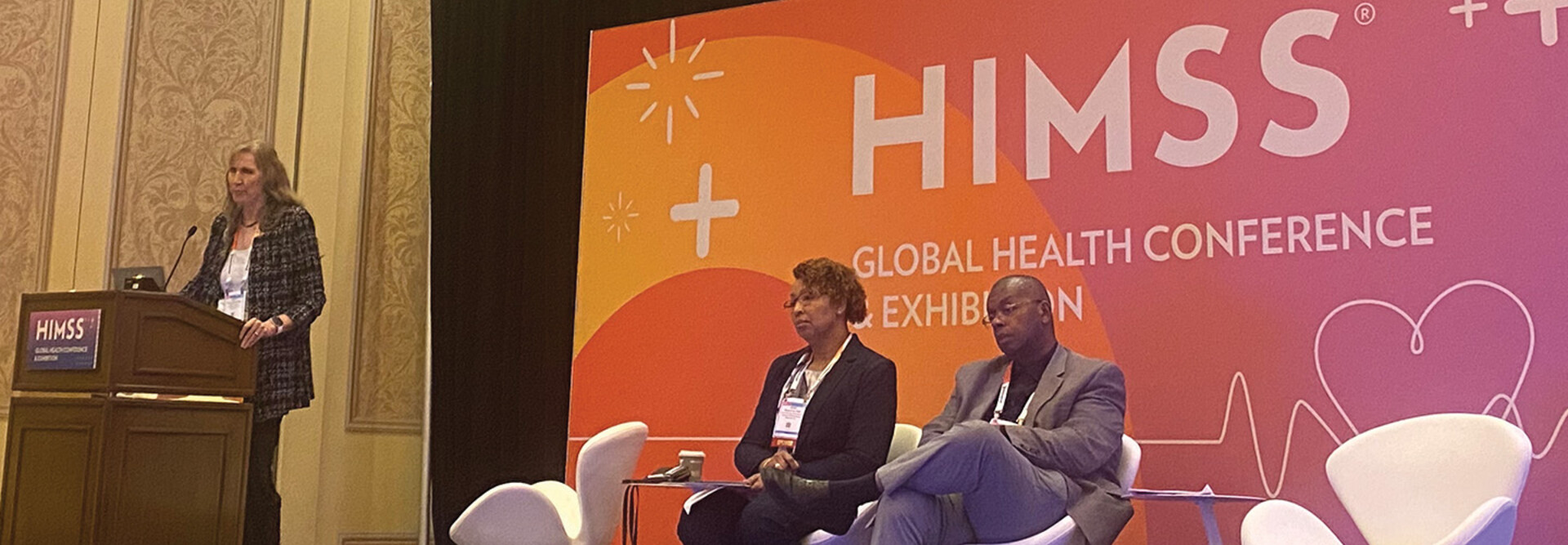
Charles, Renée Pratt, past president of the Association for Information Systems’ Special Interest Group on Information Technology in Healthcare, and Jack Crumbly, Management Department head and faculty of the Andrew F. Brimmer College of Business and Information Science at Tuskegee University, led the session for clinicians and healthcare IT stakeholders. They encouraged attendees to think more deeply about the risks and rewards connected to ambient clinical documentation tools.



Growing Scrutiny for Ambient Intelligence Tools
Clinicians are becoming more enthusiastic about adopting artificial intelligence in their practices, especially if it can help reduce administrative burdens, such as documentation. In recent years, a number of health systems have noted that using ambient listening tools helps save time on charting, improve clinician satisfaction and create more focus on patients.
On the patient side, some may feel that their clinicians are able to pay more attention to them instead of a computer screen, as one UW Health video depicts. But others may still have concerns about the unintended consequences of using AI in healthcare, especially misdiagnosis, privacy breaches, less time with clinicians and higher care costs.
READ MORE: How to strengthen the muscle of AI strategy with clinical insight.
Ambivalence about ambient intelligence tools has even been represented in widely watched TV medical dramas: A recent episode of HBO’s The Pitt captures the excitement and caution with which these tools have been received by doctors.
During the HIMSS session, Charles also highlighted emerging legal concerns about holding provider organizations accountable for negative outcomes tied to the use of AI in healthcare applications. Last month, the American Bar Association published an article outlining the privacy and security issues with ambient listening tools, including recent lawsuits in California and Illinois about the use of such technology without patient consent.
When should clinicians tell patients that their interactions are being transcribed by an ambient listening tool? Should the disclosure be made at the start of every encounter? What if it’s an inpatient setting that requires clinicians to see a patient multiple times a day? Is it enough to include it in writing among paperwork to be signed that patients mostly skim through? These are all questions that, for now, are being answered by individual healthcare organizations, as federal guidance has not yet caught up.
DISCOVER: Clinical workflow optimization creates better patient outcomes.
Pratt noted that other operational concerns include device management and network security. If organizations have a BYOD policy, is the ambient listening tool compliant on a clinician’s personal smartphone? How are devices kept clean? She also mentioned concerns around using “wake words” that could unintentionally activate not just the clinician’s device featuring the tool but also any patient devices.
“When we think about AI governance, you want to ask yourselves some questions. Who is accountable? Who is allowed? Whose data can be used? How will you catch any problems? Being able to manage those questions is going to be extremely critical,” Pratt said.
Source link
#HIMSS26 #Clarifying #Governance #Ambient #Clinical #Documentation #Tools