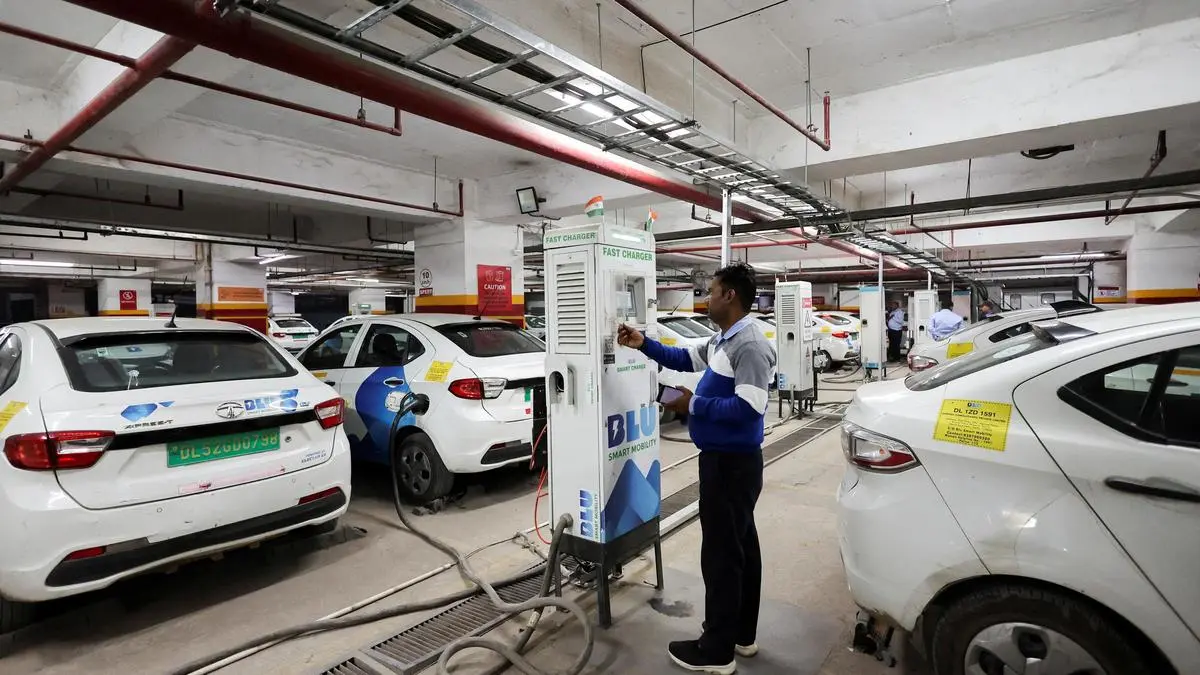
FILE PHOTO: A man charges an electric vehicle (EV) at the charging hub of Indian ride-hailing BluSmart Electric Mobility in Gurugram, India, December 9, 2022. REUTERS/Anushree Fadnavis/File Photo
| Photo Credit:
ANUSHREE FADNAVIS
India’s EV makers are caught in a tug-of-war between improving financials and persistent cost pressures, as a turbulent macro environment — ranging from chip shortages and rare earth disruptions to ongoing geopolitical tensions — keeps input costs elevated.



Companies like Ather Energy have made visible progress, narrowing losses and moving closer to breakeven in FY26. However, rising prices of key inputs such as rare earth magnets, lithium-ion batteries, and memory chips continue to weigh on margins.
Industry stakeholders point to structural challenges underpinning these pressures. An industry spokesperson, Dhivik Ashok, told businessline that nearly 60 per cent of EV components in India are imported, either as raw materials or finished goods, making the sector highly vulnerable to currency movements. The sharp depreciation of the rupee, from around ₹36–40 per dollar in 2009 to nearly ₹95 now, has significantly inflated input costs. Even in the recent past, the currency has seen a sharp uptick, further exacerbating import bills.
This is being compounded by ongoing supply chain disruptions driven by global uncertainties, including geopolitical tensions and shifting trade dynamics across regions such as South America, key to raw material supply chains.
Tarun Mehta, co-founder and CEO of Ather Energy, acknowledged these pressures in a post-quarter investor call, noting that supply chain challenges have intensified through the year. “What hit us were three big things, rare earth magnet prices, the spike in memory costs globally, and the surge in lithium-ion battery prices due to commodity inflation,” he said during a post-earnings call.
At the same time, companies are attempting to cushion the impact through engineering innovation. Mehta highlighted that Ather’s new platform aims to reduce dependence on expensive materials like aluminium and copper, while improving cost efficiency. Peers are seeing similar trends. Euler Motors Founder and CEO Saurav Kumar told businessline, “We’ve seen around 4-5 per cent cost pressure from commodities like battery cells, plastics, and electronics. We’ve passed on about 1-1.5 per cent of this increase to customers, while absorbing the rest. Overall, including batteries, cost pressures are in the 4-6 per cent range. That said, margins have still improved significantly — from around -119 per cent earlier to about -63 per cent — as scale and operating leverage kick in.”
Despite the near-term strain, the industry remains cautiously optimistic. Mehta noted that while inflationary pressures will persist in the short term, commodity cycles are unlikely to remain elevated indefinitely. Efforts to mitigate costs, through selective price hikes, higher-margin software and accessories, and a shift to alternative battery chemistries such as LFP, are underway, though unlikely to fully offset the impact.
(Additional inputs from BL intern Vasundhara Prakash)
Published on May 6, 2026
Source link
#industry #crossroads #Financial #gains #meet #cost #headwinds