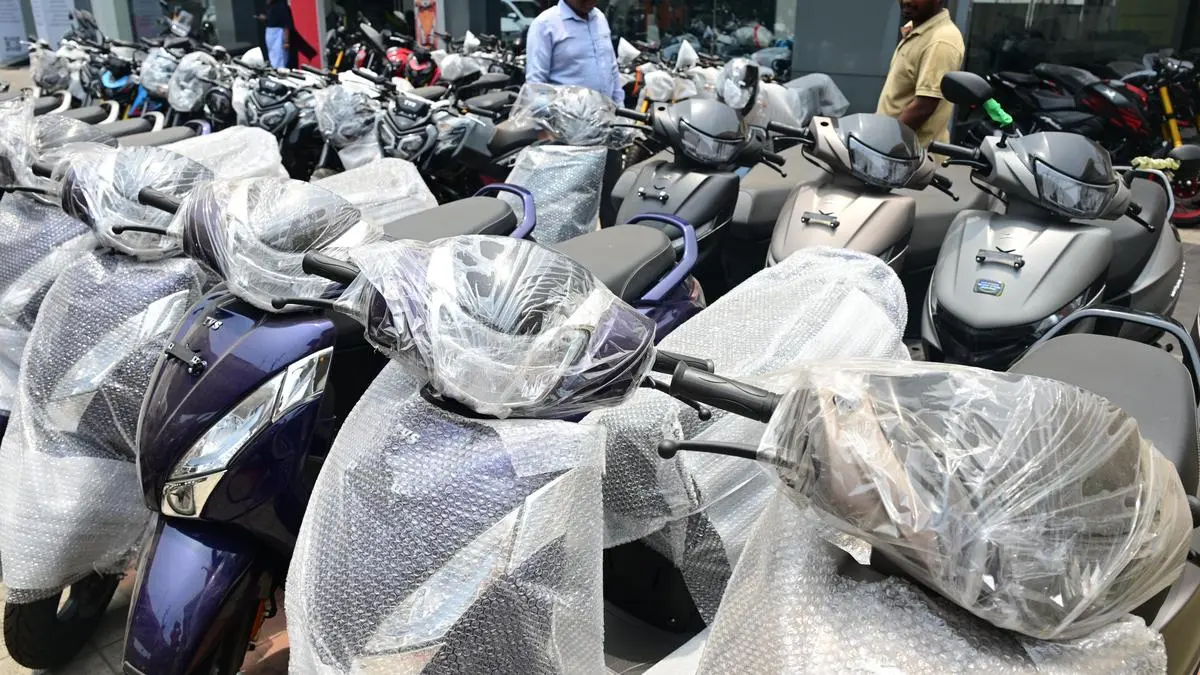
Accelerating consumer adoption of electric mobility, aided by expanding product portfolios, improving charging infrastructure and rising participation from both legacy automakers and dedicated EV manufacturers along with a larger push towards energy security post the West Asia war led to the surge.
| Photo Credit:
RAO GN
India’s electric two-wheeler (E2W) market maintained its strong growth trajectory in May 2026, with total registrations rising 58 per cent year-on-year to 1.64 lakh units from 1.04 lakh units in the same month last year, according to Vahan portal registrations data as of 8.30 am on Sunday.

Accelerating consumer adoption of electric mobility, aided by expanding product portfolios, improving charging infrastructure and rising participation from both legacy automakers and dedicated EV manufacturers along with a larger push towards energy security post the West Asia war led to the surge.
On a sequential basis too, EV two-wheeler sales grew 18 per cent compared to April 2026’s total registrations at 1.39 lakh units, indicating sustained demand for electric scooters and motorcycles across the country.
Poonam Upadhyay , Director, Crisil Ratings, said that the average monthly run rate through the first half of FY26 was around 1.05 lakh units. The segment is now running at a materially higher base, and consistency across two consecutive months points to a structural step-up.
“Three factors are driving the growth. Fuel supply concerns stemming from the West Asia conflict has added to consumer anxiety around petrol dependence, nudging more buyers toward electric. The running cost advantage remains a compelling pull – operating costs significantly lower than comparable ICE options, a gap that only widens as fuel price uncertainty persists. Legacy manufacturers with established distribution and service networks continue to gain ground, giving buyers confidence that after-sales support is no longer a concern,” she said.
The underlying demand drivers – improving cost economics, fleet adoption, and wider OEM participation – continue to be drivers, she added.
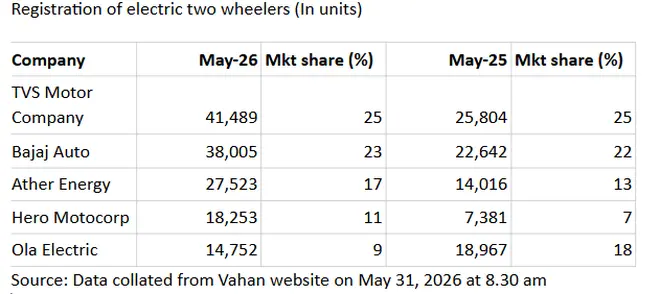
TVS Motor Company retained its leadership position in the segment, registering 41,489 units during May and holding on to a 25 per cent market share. The company recorded a 61 per cent increase over the 25,804 units sold in May 2025.
Bajaj Auto consolidated its second position with registrations rising 68 per cent to 38,005 units from 22,642 units a year ago. Its market share edged up to 23 per cent from 22 per cent, reflecting increasing acceptance of its electric scooter range.
Among the new-age players, Ather Energy had a standout month, nearly doubling its registrations to 27,523 units from 14,016 units in May 2025, a 96 per cent YoY growth. The Bengaluru-based EV maker expanded its market share to 17 per cent from 13 per cent, emerging as one of the biggest gainers.
Hero MotoCorp also delivered a strong performance, with registrations more than doubling to 18,253 units from 7,381 units a year earlier. Its market share climbed to 11 per cent from 7 per cent, highlighting the company’s growing presence in the electric mobility space.
However, Ola Electric continued to face pressure amid intensifying competition and its own execution challenges. Registrations fell to 14,752 units in May 2026 from 18,967 units in the corresponding month last year. Its market share nearly halved to 9 per cent from 18 per cent.
Published on May 31, 2026
Source link
#twowheeler #registrations #surge #yoy #fuel #supply #anxiety #surge #analysts