

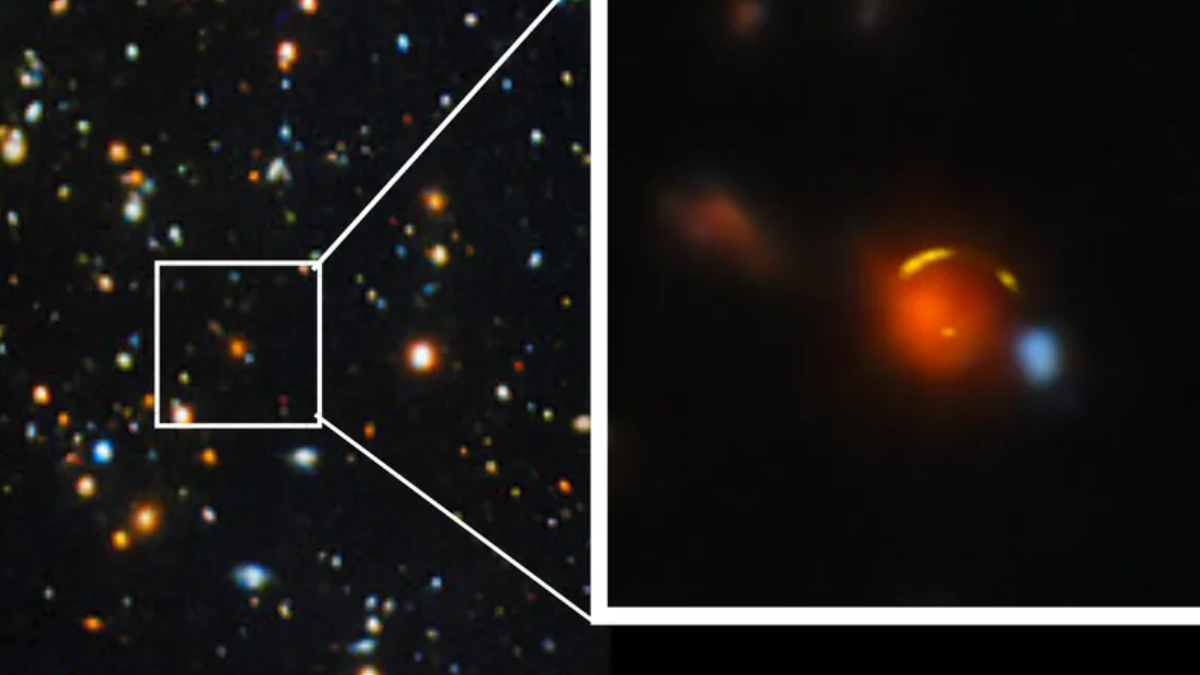
The IceCube Neutrino Observatory in Antarctica detected a brief high-energy particle streaking through Earth in 2021, but the source was unknown until now. Scientists have managed to find that the neutrino, called IC 210922A, came from a bright and dusty galaxy called “Shadow Blaster”, which is about 11 billion light-years away from us. These are the first clues that galaxies that have been rapidly forming stars over their distant past produce neutrinos.
What the New Study Found
In a paper published June 17 in Nature Astronomy, lead author Yuji Urata and colleagues describe how they tracked down Shadow Blaster, officially known as JCMT0402−0424, with the James Clerk Maxwell Telescope, the Submillimeter Array, and ALMA. The light from Shadow Blaster was split into four images by gravitational lensing of a foreground elliptical galaxy. This allowed us to zoom in on a galaxy at redshift 2.988 and examine its inner workings. We found an unexpectedly compact core, around 1,500 light-years in size, full of material for making stars but lacking any signs of a central supermassive black hole that was feeding.



Why It Matters for Cosmic Neutrinos
Although neutrinos are plentiful throughout the universe, they have very few known sources. This means that starburst galaxies lacking any kind of black hole activity can act as natural cosmic-ray accelerators for high-energy neutrinos. According to Urata, these galaxies can contribute around 20 percent of the diffuse neutrino background detected by IceCube. Starburst galaxies were abundant about 10 billion years ago, which is one of the reasons why neutrinos are so abundant, although most starburst galaxies do not have gravitational magnification as Shadow Blaster does.
Get your daily dose of tech news, reviews, and insights, in under 80 characters on Gadgets 360 Turbo. Connect with fellow tech lovers on our Forum. Follow us on X, Facebook, WhatsApp, Threads and Google News for instant updates. Catch all the action on our YouTube channel.
IceCube Neutrino Observatory, Neutrinos, Astronomy, Astrophysics, Starburst Galaxies, Shadow Blaster, JCMT0402−0424, Nature Astronomy, ALMA, James Clerk Maxwell Telescope, Submillimeter Array, Gravitational Lensing

RIL AGM 2026: Jio Showcases AI Voice Agent for Calls, Jio TeleFrame AI Agents and JioBharat IQ Apps
Tecno Camon Slim Confirmed to Launch Soon; Design, Colour Options Teased

Source link
#IceCube #Links #Powerful #Neutrino #Ancient #Starburst #Galaxy





