Spending a premium on more sustainable products remains a bone of contention for UK consumers. With a quarter unwilling to do so, many are turning to second-hand products for their needs – something which may cause retailers a headache if they are unwilling to become more sustainable, without passing the buck to their customers.


The problem with placing responsibility for sustainability on individual consumers has been writ large in recent years. While a number of celebratory reports since just after the pandemic had contended that consumers in markets like the UK, US and Australia had finally reached a ‘tipping point’ – where the majority would no longer be willing to engage with products that had negative impacts on the world – the lingering cost-of-living crisis which commenced in 2022 has up-ended the received wisdom that shoppers could change the world through their purchasing power alone.
Contrary to the overriding sentiment of these studies – that consumers would increasingly opt to pay more for companies they purchased from not to damage the planet, and it would now be a matter of time before all companies had to change their ways to adapt – that is probably due some revision. With multiple studies already showing that ultimately, when their spending power is restricted, consumers will shop according to their budgetary needs rather than their environmental convictions, another from BearingPoint has found British shoppers are holding fast with that sentiment.
Source; BearingPoint
The BearingPoint researchers surveyed 4,000 participants from five European countries – France, Germany, UK, Italy and The Netherlands – including 500 participants from the UK on their consumer sustainability behaviours. And they found that UK consumers are highly aware of their environmental impact. A 78% majority – rising by 6% from 2024 to the end of 2025, and 4% higher than the EU average – were aware of their consumption choices’ impact. Two-in-three consumers in Britain also take sustainability into account in their purchase decision – while 72% also trust corporations to commit to sustainability promises – compared to 66% in the EU.
Even so, however, economic base factors mean that 23% of UK consumers are not willing to pay extra on a product, regarding its sustainability credentials. And while 44% said they would be willing to pay a premium of more than 10% in this regard, the number of refuseniks is holding steady – while 33% also said they were unwilling to go higher than 10%.
This might still sound like companies getting ready to position their sustainable products for a premium price are positioned to do well. But they will need to factor in the fact that a growing portion of the consumers they are hedging their bets with are also shifting their focus away from new products entirely – making the amount they would hypothetically spend on something new something of a moot point.
Source; BearingPoint
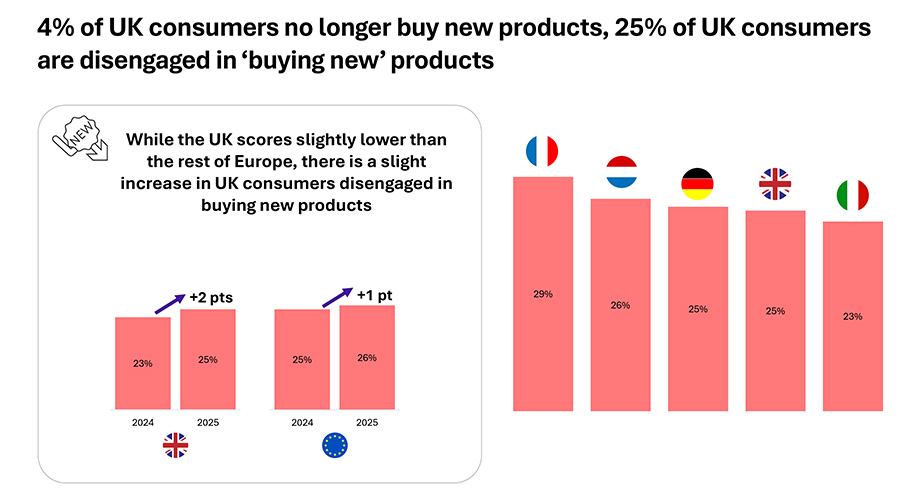
Rising by 2% since 2024, BearingPoint found that a quarter of UK consumers said they were disengaged in buying new products. And while the UK scores slightly lower than the rest of Europe when it comes to buying second-hand goods, a majority of 61% said they were more consistently engaged in buying from professional re-sellers and charity shops in 2025 – up from 59% in 2024.
Richard Walters, sustainability lead at BearingPoint, commented, “At a time when sustainability ambitions face scrutiny and cost pressures challenge household choices, UK consumers continue to engage with sustainable behaviours, however their actions reveal a widening gap between intention and the practical realities of price and convenience. Sustainability messaging has landed. The challenge now is operational execution that removes the cost and convenience penalty for doing the right thing.”
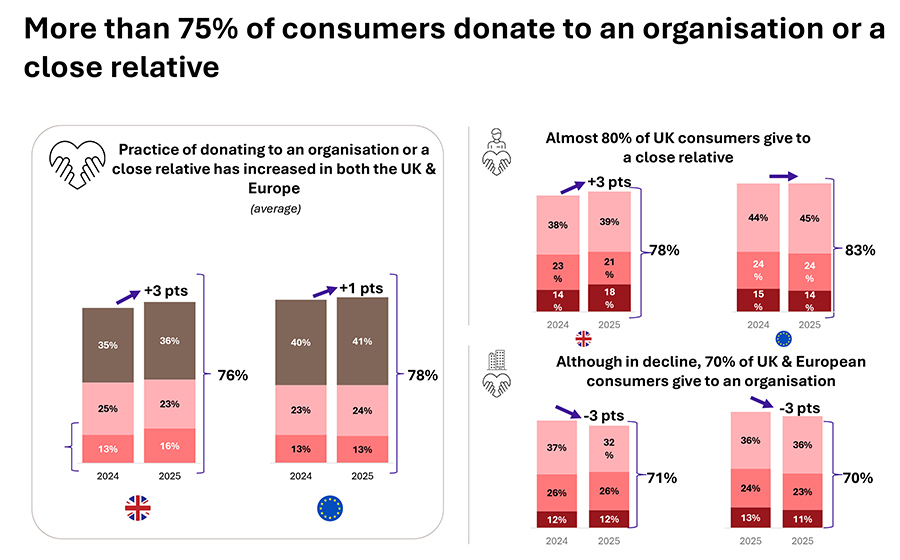
At the same time, the practice of donating goods is on the rise. A 76% majority of UK consumers have seen their habit of donating disused, pre-loved goods for re-use rise since 2024. And while 71% said they gave to organisations, the rise in household economic stress means that 78% give to a close relative – rising by 3%.
Source link
#Paying #sustainability #premiums #remains #sticking #point #consumers