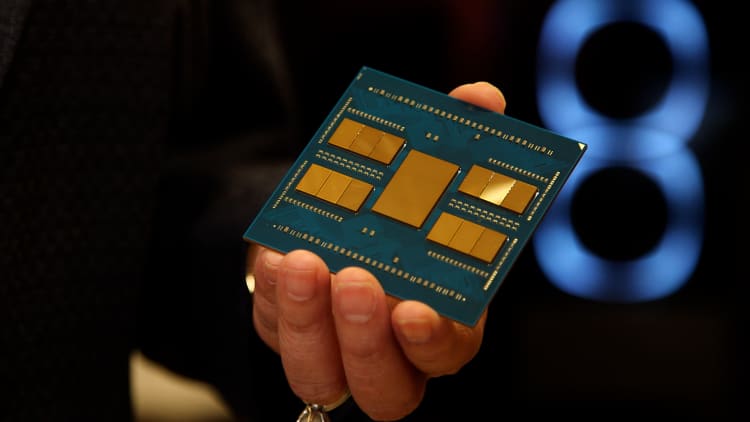
Lisa Su, chair and chief executive officer of Advanced Micro Devices Inc., displays an AMD Instinct MI455X GPU during the 2026 CES event in Las Vegas, Jan. 5, 2026.


Bloomberg | Bloomberg | Getty Images
A week after Meta committed to using millions of Nvidia’s processors to power its AI expansion, the social media company has inked another mammoth chip deal, this time with Advanced Micro Devices.
Meta said on Tuesday that the multiyear deal with AMD involves deploying up to 6 gigawatts of the company’s graphics processing units for artificial intelligence data centers and includes use of AI-optimized central processing units, or CPUs. Early shipments of MI450 GPUs in AMD’s Helios rack-scale servers will begin later this year.
AMD CEO Lisa Su said in a statement that her company is delivering “high-performance, energy-efficient infrastructure optimized for Meta’s workloads, accelerating one of the industry’s largest AI deployments and placing AMD at the center of the global AI buildout.”
The deal also includes a performance-based warrant for Meta to acquire 160 million AMD shares, about 10% of the company. The first tranche vests when the first 1GW of Instinct GPUs are shipped. Other tranches vest as Meta makes purchases to 6GW.
Vesting is also tied to stock price thresholds for AMD and technical and commercial milestones for Meta.
AMD struck a similar deal with OpenAI in October, marking it as a viable second option for AI giants and hyperscalers.
That agreement also gave OpenAI warrants to acquire 160 million shares of AMD and was tied to deployment and stock price benchmarks.
In its earnings report last month, Meta committed to up to $135 billion in capital expenditures this year as it tries to keep pace with its megacap peers as well as OpenAI and Anthropic in the global AI race. Overall, Meta has plans for 30 data centers, including 26 in the U.S.
Tuesday’s announcement is a critical development for AMD, which is far behind Nvidia in the AI chip market. Nvidia is now the world’s largest publicly traded company, with a $4.66 trillion valuation, and controls roughly 90% of the market, while AMD is valued at $320 billion.
“Meta is in a unique position to control the full stack and they can use whoever’s compute they want,” said chip analyst Ben Bajarin of Creative Strategies. “It’s just a punctuation point on the fact that we are compute constrained, and deals will be done across the board.”
Terms of the agreement weren’t provided, but Bajarin, who was briefed on the deal, estimates that it’s worth tens of billions of dollars over at least four years, because “six gigawatts would take quite some time to deploy,” he said.
Bajarin said a key piece of the agreement, and how it’s different from Meta’s pact with Nvidia, is that the first deployment involves customized GPUs.
“We don’t have any indication Nvidia is doing that,” Bajarin said. “It’s a good way for them to win some of these deals.”
AMD’s Helios represents the first large-scale competition to Nvidia’s Grace Blackwell systems, which have experienced soaring demand since launch in 2024.
Nvidia is scheduled to report quarterly earnings on Wednesday, and analysts expect revenue growth of 68% from a year earlier to $66 billion, according to LSEG. Earlier this month, AMD reported sales growth for the fourth quarter of 34% to $10.27 billion.
Meta has long been a customer of AMD and Nvidia. Meta also develops in-house processors and, according to a report late last year in The Information, had been in talks with Google about deploying the search company’s tensor processing units in Meta data centers in 2027.
WATCH: How AMD became a chip giant and finally caught Intel
Source link
#Meta #strikes #chip #deal #AMD #days #committing #deploy #millions #Nvidia #GPUs