

Speaking to CNBC-TV18, Himanshu Baid, Managing Director of Poly Medicure, said the company is moving away from low-technology products and building a portfolio centred on advanced medical devices, particularly in cardiology and orthopaedics.


“I think it’s a transition for the company, moving from low-technology to medium- and high-technology products,” Baid said. “Over the next four to five years, how this company will transition from a low- and medium-technology platform to a high-technology platform, that’s where we are.”
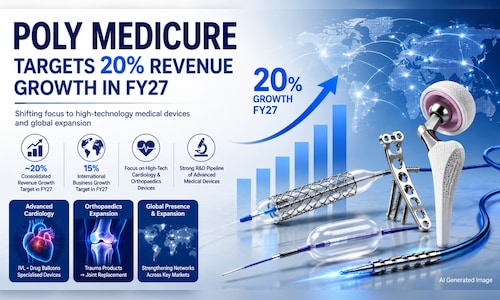
The company expects its international business to grow by 15% in FY27, while consolidated revenue growth could approach 20%, supported by a recovery in Europe and contributions from acquired businesses.
Poly Medicure is developing a range of advanced cardiology products, including intravascular lithotripsy (IVL) devices, drug-coated balloons and other specialised devices, many of which are expected to be launched in the coming months.
According to Baid, some products are set for launch shortly, while others are scheduled for release by the end of the year, subject to regulatory approvals and market access timelines.
“Products like drug-coated balloons, IVLs and some other high-end devices are what we are working on right now,” he said, adding that in-house research and development remains central to the company’s strategy.
The company is also expanding its orthopaedics business. Baid said Poly Medicure is currently focused on trauma products and completing the product portfolio at its acquired European business before moving into joint replacement devices over the next few years.
He said the strategy is aimed at reducing India’s dependence on imported medical devices while tapping larger global markets for advanced products. Baid also indicated that generating around ₹150 crore in revenue from these newer high-end products over the next three years is achievable.
While the infusion therapy business has historically accounted for a large share of Poly Medicure’s portfolio, its contribution is expected to remain at around 50% in FY27 as the company prioritises newer categories.
The company also expects an improvement in its international business after supply chain disruptions weighed on exports, particularly in Europe. Baid said disruptions linked to changing shipping routes around the Red Sea had created inventory mismatches with customers and affected revenue growth.
“I think we were caught a little off guard on that,” he said. “But over the last three to four months we have seen things picking up.”
Poly Medicure has added more distributors in Europe and expects the region to recover after growth slowed in FY26.
The company, however, continues to face external challenges. Baid warned that higher crude-linked raw material prices could put pressure on margins from the second quarter onwards, although currency depreciation and cost-saving initiatives may partly offset the impact. He said the company may consider another round of price increases towards the end of the second quarter or the beginning of the third quarter.
The West Asia business also remains under pressure because of elevated freight costs and shipment delays. Poly Medicure derives around 6–8% of its revenue from the region, where orders worth ₹20–30 crore were deferred in March, with similar delays continuing into the first quarter.
Poly Medicure recently reported a 27.8% year-on-year decline in fourth-quarter net profit to ₹66.3 crore, compared with ₹91.8 crore a year earlier. Revenue for the January–March quarter rose 21.3% to ₹534.5 crore, while EBITDA declined 7.8% to ₹110.3 crore. EBITDA margin stood at 20.6%, down from 27.1% in the corresponding period last year.
Despite the quarterly pressure, Baid said operational performance improved sequentially.
“Quarter four was much better for us compared to the other quarters,” he said, noting that standalone EBITDA margins had reached their highest level at around 27%.
Also Read | Poly Medicure shares down 15% in three sessions after Q4 results; Here’s what the management saidThis is an edited transcript of the interview.Q: Well, it appears that in the near term there are some challenging times. Now, going by the guidance that you have given, you’re guiding, I think, for around ₹2,300 crore of revenue. Could you tell us, infusion therapy, which has come down to around 50% of the total mix, towards 50% from, I think, 65-70%, how much will it contribute in FY27? And also, the receivable day cycle, that got a little elongated because of export weakness and customer support as well. What steps are you taking to bring back some working capital efficiency?
Himanshu Baid: I think quarter four was much better for us compared to the other quarters. And if you remember, when we had guided around quarter three, that we would start doing better from quarter four onwards, I think that has already started happening in terms of revenue and margins. In fact, the EBITDA margins have been the highest in quarter four, around 27%-odd on a standalone basis. Of course, when you look at the consolidated numbers, the margins have decreased because of some one-off expenses in the subsidiaries. But overall, I think the trajectory is fine.
On the infusion business, I think it will be around 50% even for FY27 because we are focusing on other businesses right now. I think it’s a transition for the company, moving from low-technology to medium- and high-technology products. So, I think that transition is driving this change, and I think that’s what we are planning over the next four to five years – how this company will transition from a low- and medium-technology platform to a high-technology platform, so that’s where we are.
In terms of working capital, yes, there was some stress last year because we gave extra credit to our customers in India and overseas. But I think now we are more or less at a level where we should not see cash flow cycles deteriorate further. Rather, I think we may be able to recoup more from where we are today.
Q: Do you want to give us a number on receivable days?
Himanshu Baid: See, the receivables currently are around 95 to 98 days. Hopefully, we should be able to bring that down to around 90 days, roughly in that range.
Q: You’ve spoken about several high-end products under development, such as IVL and advanced cardiology devices as well. Could you tell us what kind of commercialisation timeline you are looking at and what kind of revenue potential you see from these products in the next two to three years?
Himanshu Baid: See, basically, if you look at the cardio business, that’s a high-TAM business. India again depends a lot on imports, other than stents and some basic products. So, I think that is where we are focusing. Products like drug balloons, IVLs, and some other high-end devices are what we are working on right now. Some products are going to be launched shortly, while some are scheduled for launch at the end of this year. Of course, based on regulatory clearances and overseas markets, it will take a few years to be present in those markets.
But I think the important thing is to develop these devices internally and focus on R&D. That’s been the key area here.
Then the next one is orthopaedics, where we are focusing on trauma right now and completing the whole range in the company we acquired in Europe. Then, of course, we are going to focus more on joints in the next couple of years. So, I think it is already a movement towards high-technology products, where India still has import dependence, and moving into global markets where we see a larger opportunity for these kinds of products.
Q: ₹150 crore of revenue in three years should be possible?
Himanshu Baid: Yeah, correct.
Q: So, the India business, if I look at FY26 growth compared to FY25, is largely similar, around 18-19%. It’s the export side, especially in Europe, where growth has come off meaningfully. How much of this is due to cheaper Chinese imports or dumping into Europe?
Himanshu Baid: See, I think Chinese dumping is happening everywhere. It is happening in India and everywhere in the world, so that’s not a new phenomenon. But for us, I think it was more of a supply chain mismatch. Most of our products were going through the Red Sea, and then it got closed. We were using alternate routes, and suddenly the Red Sea opened again. So, I think there was an inventory mismatch with most of our customers. It was a one-and-a-half to two-month inventory mismatch, and that led to lower revenue.
I think we were caught a little off guard on that, but over the last three to four months we have seen things picking up. We have added more distributors in the European market, and things look much more positive. If you see, we have already guided for international revenue growth of 15%. We are not talking about global revenue here, but international revenue excluding India. So, I think now we are in much better shape. The business has already seen improvement.
Q: Mr. Baid, so international revenues will grow 15%, and consolidated revenues 20%?
Himanshu Baid: Yeah, that’s correct.
Q: And Europe will bounce back because FY25 growth was 25%, while in FY26 it was around 7-8%. That will go back now, given the situation as you say?
Himanshu Baid: If you look at Europe as a whole, including our acquisitions and ex-India operations, then yes, it should, because our current subsidiaries will also grow, including the companies we have acquired and the company we had acquired a few years ago. So, I think that will again grow, and we could see close to around 20% consolidated growth.
Q: Just on the point about commodity inflation, you have said crude-linked raw material prices are up about 20%. In the guidance you have given, what does that assume in terms of crude prices? If they stay here or if it gets worse, for how long? And secondly, is there going to be more from you in terms of a price increase? You’ve already secured a little from your customers, but will you push for more?
Himanshu Baid: See, first of all, I cannot predict what is going to happen in the future. Every day is a new day. But fortunately for us, in quarter one, because we had a reasonable amount of inventory, we did not have much impact from raw material pricing. It was a very marginal impact.
But yes, from quarter two, we may see a small impact. The most important thing is that we export around 70% of our products, so I think currency depreciation is going to help. The 7-8% currency depreciation that has happened from February onwards till date is going to help, along with some price increases.
Currently, we have assumed that if prices remain where they are today, we may see a little margin erosion, maybe 200-250 bps at the gross margin level. But we are trying to implement some cost-saving projects and ensure that we can recoup that back. We may do one further round of price increases, maybe towards the end of quarter two or early quarter three.
Q: And one more point about the West Asia conflict. You spoke about how you get 6-8% of revenues from the region. Demand is intact, but there are certain shipping and pricing issues. There are some pending orders, which you spoke about on the conference call, that you’re waiting to execute. Could you put a number to that? What is the deferred revenue we’re talking about?
Himanshu Baid: Basically, it’s around ₹20-30 crore of revenue that got deferred in March, and we are seeing similar revenue getting deferred in quarter one as well. I think the biggest challenge is the cost of shipping. It has almost become 5x, 6x, or 7x, and it is taking a few months for products to reach because people are using alternate routes and shipping lines are not confirming deliveries to customers right now.
So, I think that’s a big challenge. Hopefully, things gradually ease out a little, but the situation is still very fluid, especially for exports to West Asia.
Q: Renal care — I think that was around ₹190 crore in FY26. What growth are you looking at this year? And if you could help us with the number of dialysis machines you’re looking to sell — I think last year it was around 450. What does that number go up to?
Himanshu Baid: So, this year we are looking at the renal business growing around 20%-odd. Again, why I’m giving this muted number is because we are still suffering from Chinese dumping, as many Chinese companies are using the FTA route and pushing products into India at zero duty. We have been telling the government to curb that.
If that doesn’t happen, I think we will still have muted growth of around 20%. We managed around 20-22% growth from FY25 to FY26, and I think we should see similar growth in machine sales as well. From 450 machines, we may go to between 550 and 600 machines.
Q: Just a quick word regarding this dumping. What is the price of your dialysis machine if I compare it with, say, a Chinese machine or a European machine as well? If you could give us your closing comments with those price ranges.
Himanshu Baid: So, I think Chinese machines — of course, China being a very large manufacturer of equipment — are always lower priced, maybe around 10% lower than what we are quoting today. But European machines are probably around 20-25% more expensive than what we manufacture in India.
Source link
#Poly #Medicure #targets #FY27 #growth #expands #hightech #device #portfolio #CNBC #TV18





