

Professional services firms in the UK are entering a new phase of digital maturity, moving beyond experimenting with artificial intelligence (AI) to embedding it throughout the project lifecycle, leading to tangible business impact in both client delivery and internal operations. That is according to new research from Deltek.



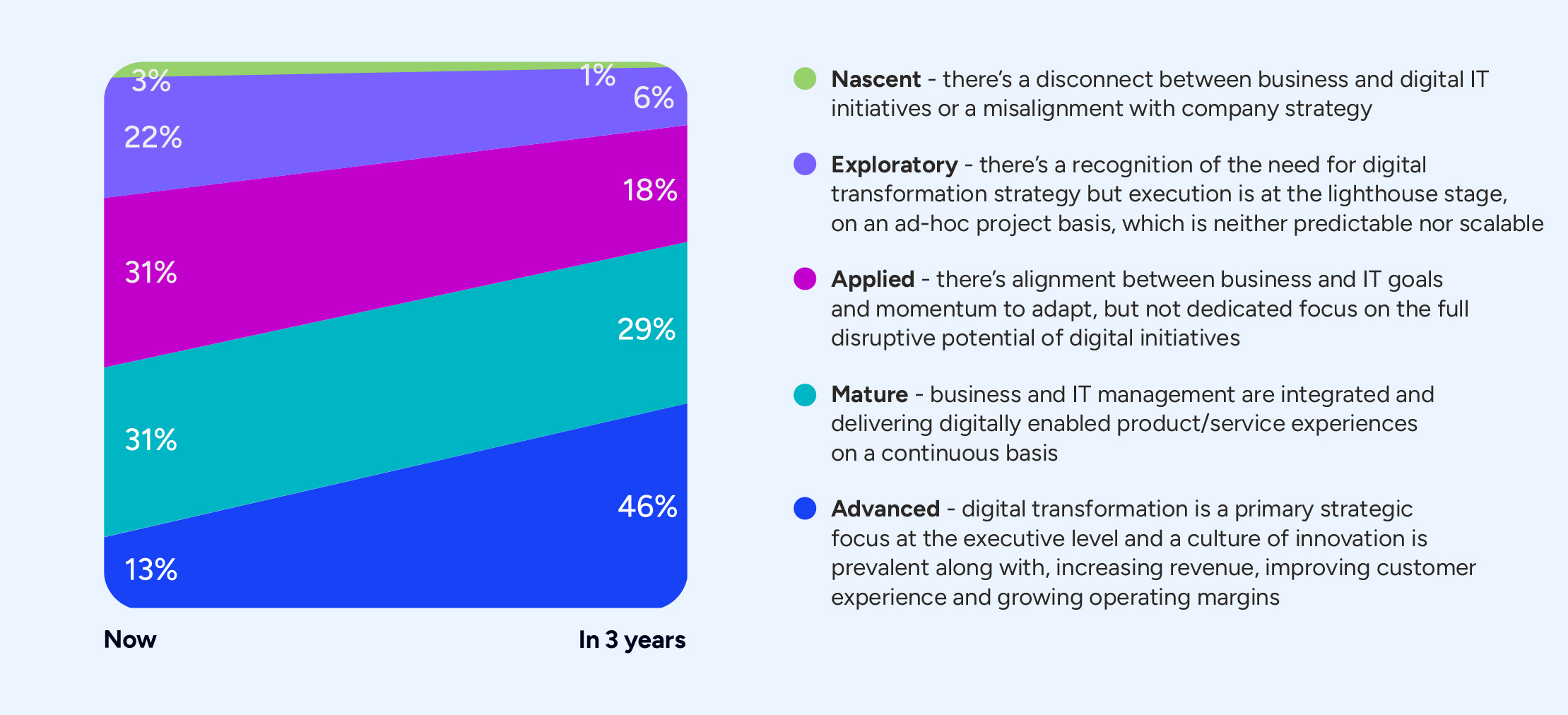
The research, conducted across 375 professional services firms including consulting firms and engineering groups, found that 55% of UK organisations describe themselves as either ‘advanced’ or ‘mature’ in their digital transformation journeys.
Firms that are advanced lead not only in technology, but also in organisation and culture. At these firms, digital transformation is a primary strategic focus at the executive level and a culture of innovation is prevalent. Additionally, business and IT management are integrated into day-to-day operations, enabling digitally enabled experiences for both clients and consultants.
Importantly, firms in the ‘advanced’ maturity level reap the benefits of their digital investments, including increased revenue, improved customer experience, and higher operating margins.
Source: Deltek Clarity
The researchers found that the bar around digital maturity has risen over the years, prompting some organisations to reassess their level of digital maturity. That explains why across the board, the proportion identifying as ‘advanced’ has fallen from 20% in 2025 to 15% in 2026, “highlighting a shift in how organisations are approaching digital transformation, rather than a slowdown in progress.”
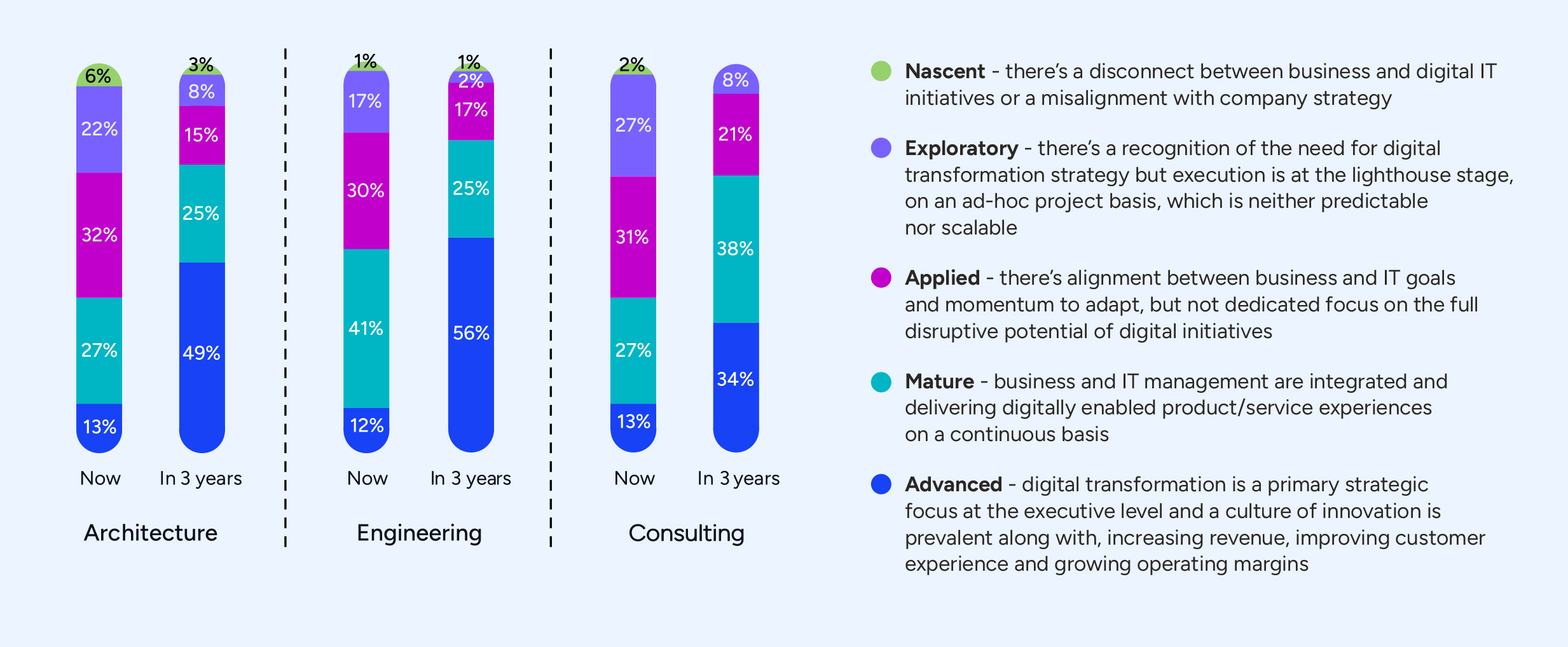
Looking deeper into sectoral differences, Deltek found that around 40% of management consulting firms self-evaluate their digital maturity as ‘advanced’ or ‘mature’, on par with architecture firms, but behind engineering groups. A major digital investment wave is expected in consulting, with over 7 in 10 firms expecting to hit ‘advanced’ or ‘mature’ stats in three years.
“Consulting firms are at a genuine inflection point,” said Neil Davidson, Vice President at Deltek. “After years of steady growth and significant investment in digital foundations, the industry is now asking a harder question: how do we convert that investment into measurable productivity gains? The firms that answer it decisively, embedding the right technology into the heart of how they run projects and serve clients, will set the benchmark for the next decade.”
Source: Deltek Clarity
The rise of AI
As organisations build on these digital foundations, AI is becoming a central strategic focus. The research shows that 29% of organisations identify operationalising and optimising AI as a strategic priority, as firms move beyond experimentation and begin embedding AI into areas like project planning forecasting, project forecasting, reporting and resource management.
Early results are already emerging. Nearly half of organisations report moderate productivity or cost improvements from AI, with a growing group (12%) already seeing significant measurable return on investment as adoption scales across the business.
Yet firms recognise that there is still work to be done to fully realise the benefits of operationalised AI, with 38% saying that adoption of AI is currently the greatest challenge for project management.
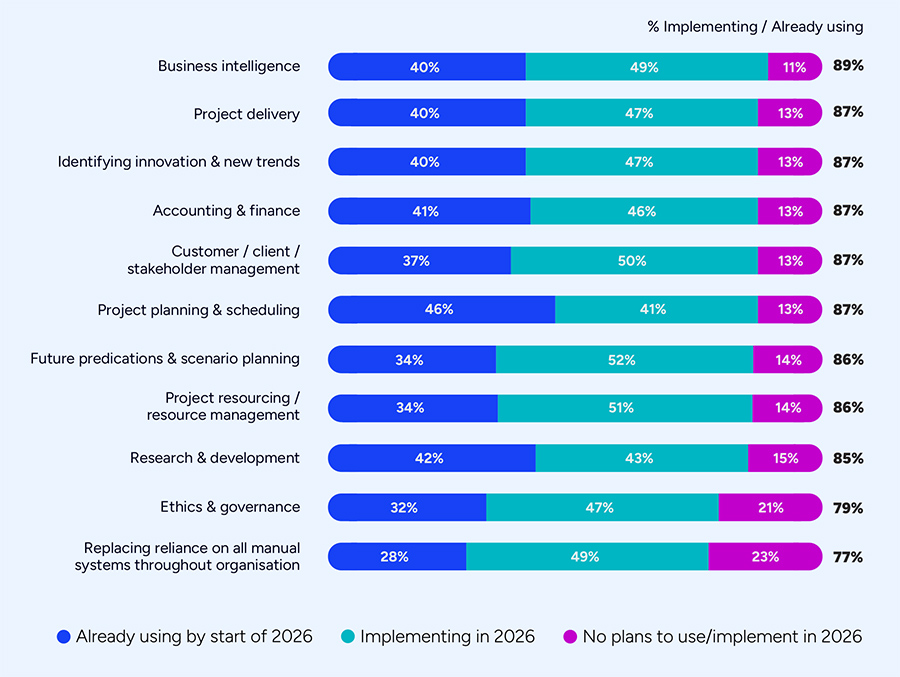
Consulting firms are significantly less likely than architecture and engineering groups to use or implement AI for accounting and finance, but are more focused on leveraging AI for business intelligence. This difference reflects each company type’s operating rhythm – consultants use AI to accelerate insight and strengthen client value, while architecture and engineering groups tend to use AI to manage complex delivery portfolios.
Source: Deltek Clarity
The research shows that implementation of AI is expected to be one of the biggest drivers of profitability in 2026, while better cost control is also seen as a key factor in improving financial performance as organisations manage increasingly complex project portfolios.
“Firms have spent the last few years building the digital foundations needed to modernise how they run projects. What we’re seeing now is a shift from experimentation to real results as AI becomes embedded into core business workflows. Many organisations are already seeing measurable ROI from AI investments, driving clear improvements in efficiency, insight, and overall business performance,” said Davidson.
Respondents said that growth areas for AI in 2026 are likely to be future predictions and scenario planning, project resourcing, and stakeholder management. Davidson: “As adoption becomes more consistent across organisations, the value of AI is set to scale even further.”
Priorities
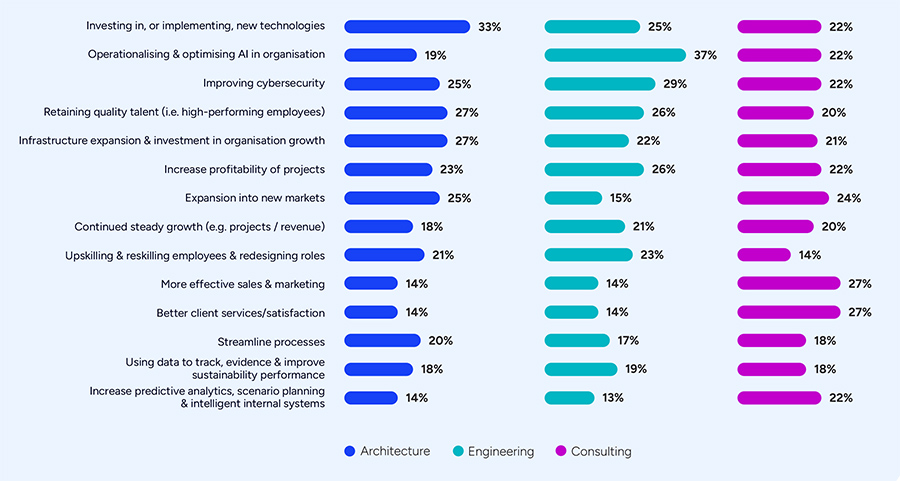
Technology is the top area of focus for professional services firms in 2026, with investing in or implementing new technologies (27%), operationalising and optimising AI (25%), and improving cybersecurity (25%) amongst many firms’ top three priorities.
Source: Deltek Clarity
Compared to the 2024 edition of Deltek’s research, investing in or implementing new technologies, retaining high-quality talent, and expansion into new markets have retained their relative importance to firms. Improving cybersecurity has increased in relative importance to professional services firms.
In contrast to their professional services peers, consulting firms are more likely to prioritise more effective sales and marketing and better client services.
Business model tweaks
In response to the major shifts taking place in the market and professional services landscape (for example: automation, collaboration, integrated systems, talent, and changing client expectations), 33% of professional services firms have already made significant changes to their business model in the last year or are expecting a major transformation in the next three years.
Six in ten (59%) firms are either exploring potential changes to their business model that they haven’t yet made, or are piloting or testing new business model approaches. Less than one in ten (8%) are not considering any changes to their business model at all.

Source link
#Deltek #Consulting #firms #move #phase #digital #maturity