

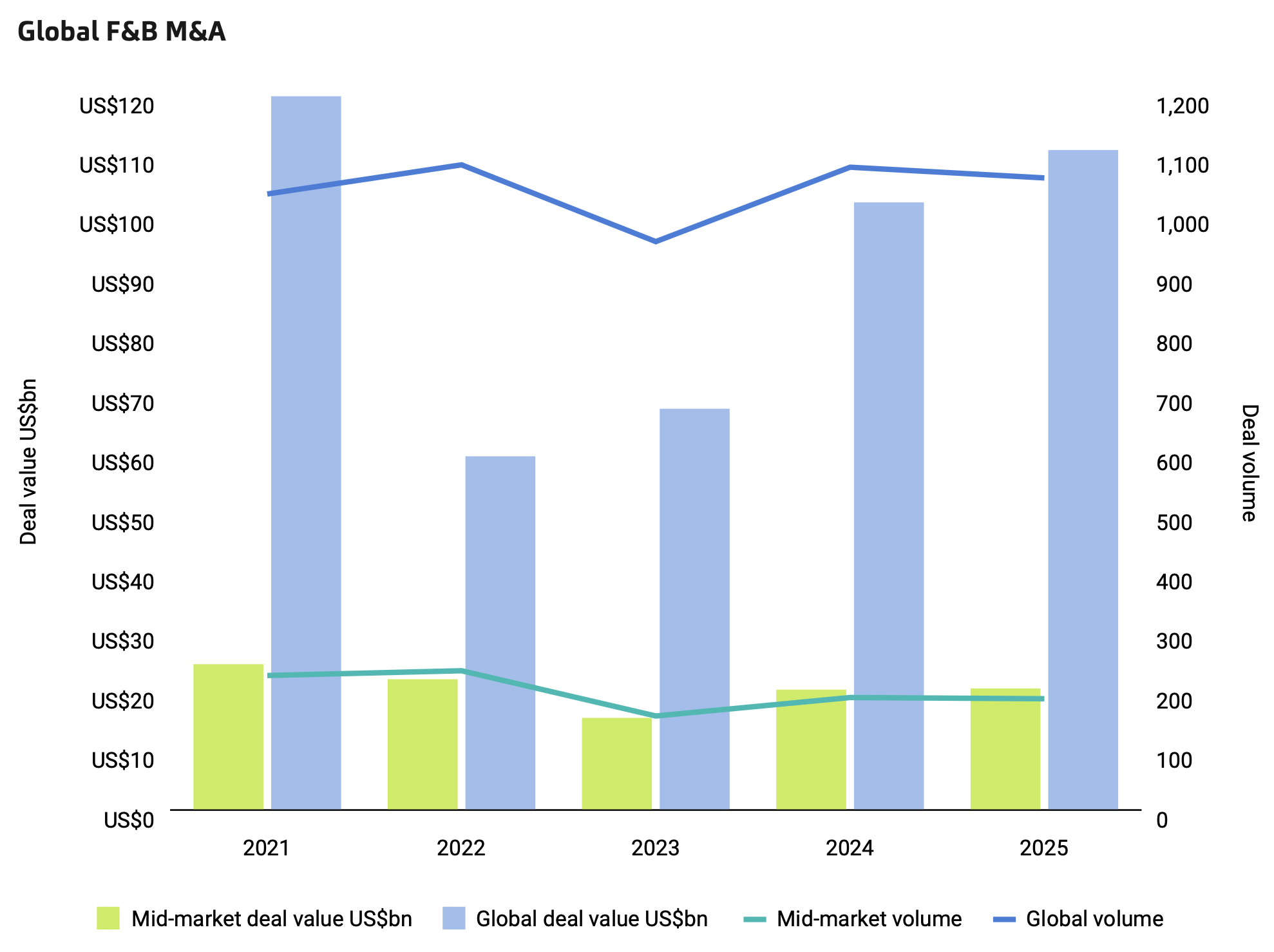
Global mid-market M&A activity across the food and beverage sector remained broadly stable in 2025. While deal volumes were largely unchanged year on year, total deal value increased modestly to $20.4 billion, according to a joint report from Baker Tilly and Mergermarket.



The report shows that mid-market deal value increased 1% year on year in 2025, while deal volume slipped 1% to 187 transactions. According to the researchers, the performance points to a market where buyers remain selective but are still willing to commit capital to businesses with differentiated profiles.
“Dealmakers appear willing to write bigger cheques but only for assets with clear strategic flavour: brands with pricing power, businesses tied to health and wellness, and platforms that add scale in slow-growth markets. At the same time, portfolio restructuring remains a dominant theme, as major food and beverage corporations divest non-core assets,” said Harsh Maheshwari, global advisory services leader at Baker Tilly.
Source: Baker Tilly
Deals by region
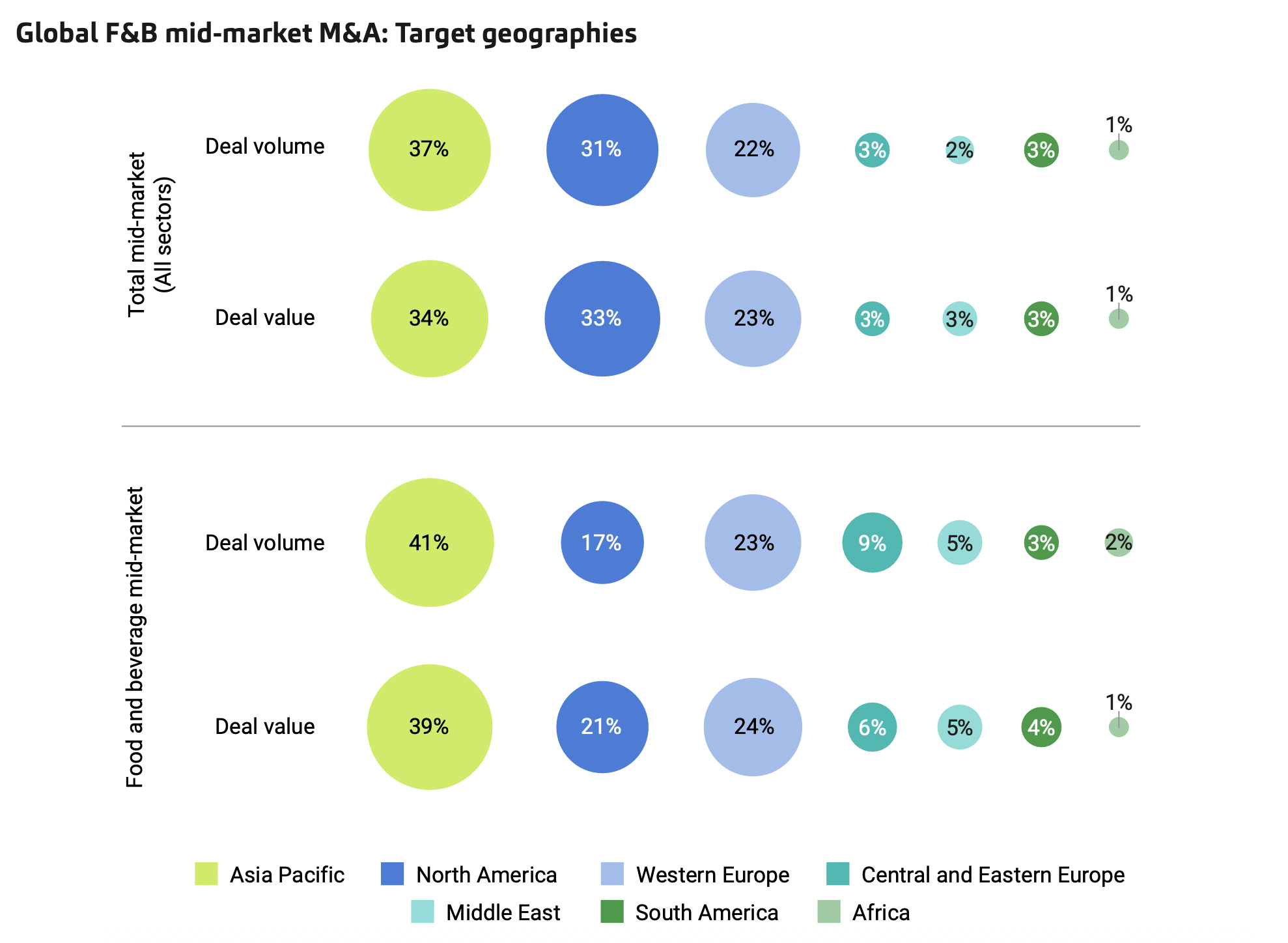
Regionally, Asia Pacific remained the leading market for mid-market mergers & acquisitions in 2025, accounting for 41% of deal volume and 39% of deal value, reflecting continued investor interest in the region’s favourable demographics, urbanisation and rising demand for premium and convenient food products.
While North America accounted for 21% of mid-market deal value and 17% of volume in 2025, totals across the year declined sharply: year-on-year drops of 27% by value and 24% by volume since 2024.
The region’s pullback reflects according to Baker Tilly more cautious M&A environment, with dealmakers pausing activity amid tariff uncertainty and evolving regulatory dynamics.
Western Europe meanwhile remained resilient, accounting for 24% of deal value and 23% of deal volume in 2025, broadly in line with its share of overall mid-market activity. Deal value rose 15% year-on-year and volume was up a modest 2%,.
Source: Baker Tilly
Cross-border deals
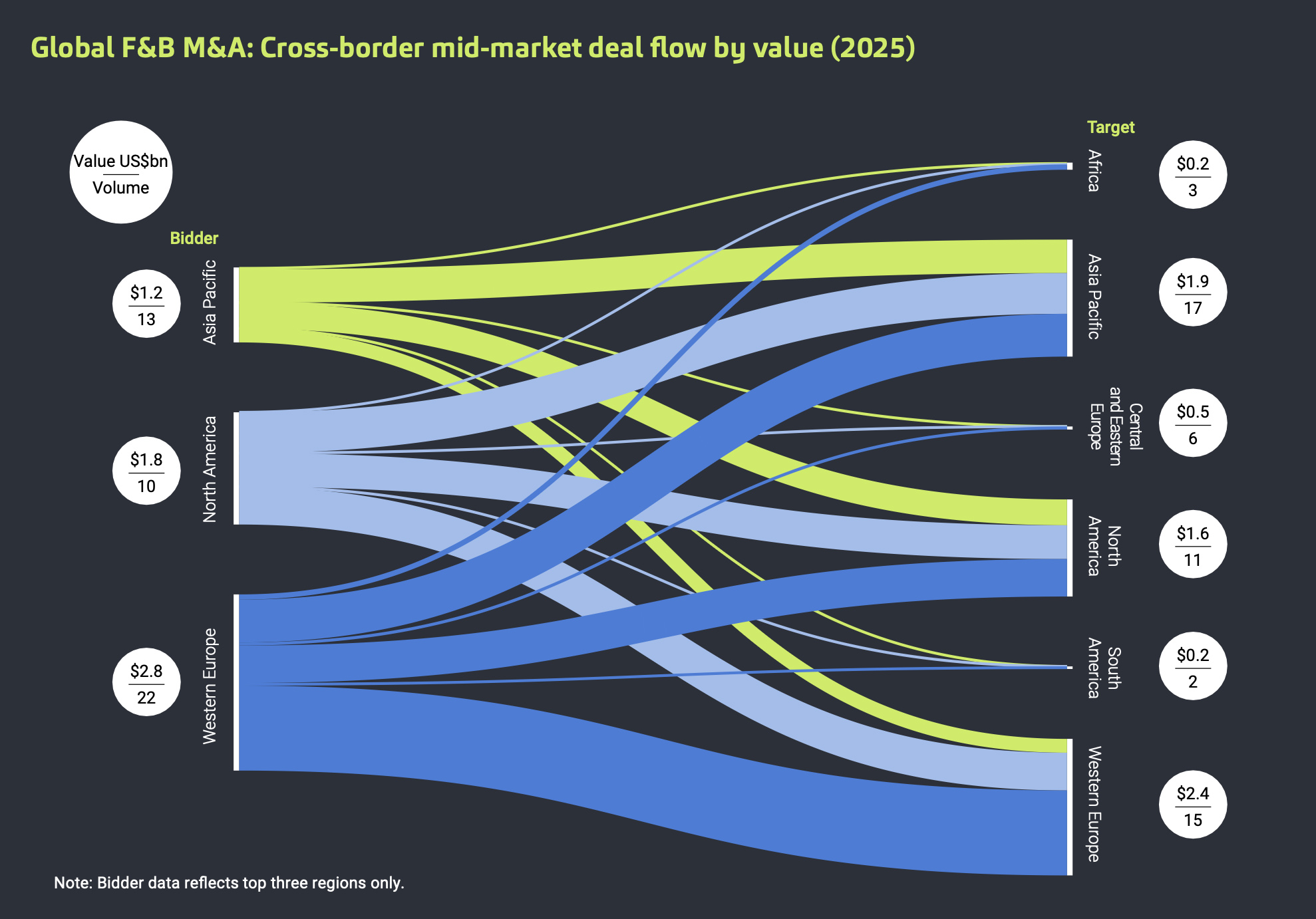
Across all major regions, cross-border activity was weaker, highlighting a more cautious approach to international expansion. Overall, cross-border mid-market deal value fell 31% to $6.6 billion, while volume dropped 27% to 54 deals, as buyers contended with geopolitical uncertainty, regulatory scrutiny and more complex execution conditions.
In Asia Pacific, cross-border deal value declined 13% to $1.9 billion and volume fell 15% to 17 deals, although the region still recorded the highest cross-border deal count of any market. North America saw a steeper pullback, with inbound deal value down 44% to $1.6 billion and volume falling 31% to 11 deals, while outbound activity by North American buyers also weakened, with value down 33% to $1.8 billion and volume down 44% to 10 deals.
In Western Europe, inbound deal value fell 26% to $2.4 billion and volume dropped 38% to 15 deals, while outbound activity declined 27% by value to $2.8 billion and 21% by volume to 22 deals, although European buyers remained the most active outbound bidders globally.
Source: Baker Tilly
Food versus beverage
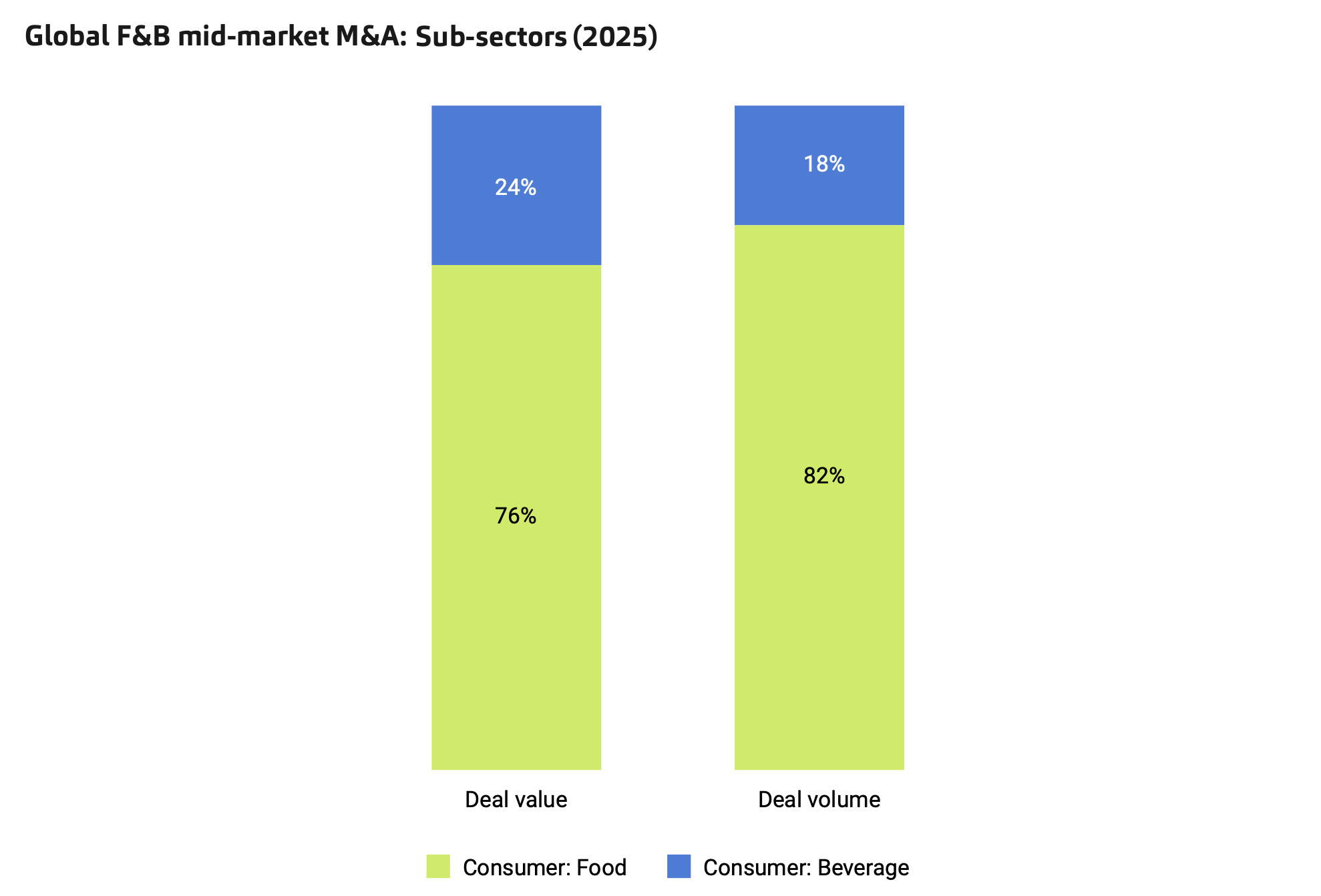
The report also shows that the food sub-sector continued to dominate mid-market dealmaking, accounting for 76% of deal value and 82% of volume in 2025.
The authors said that demand for healthier products, convenient formats and premium offerings is expected to continue shaping deal activity through 2026 and into 2027, with acquisitive interest likely to remain strongest in categories aligned to changing consumer preferences.
The beverage sub-sector accounted for 24% of deal value and 18% of deal volume, with activity increasingly shaped by demand for healthier, functional and premium products.
Source: Baker Tilly
The outlook for 2026
Commenting on the outlook for 2026, Maheshwari noted that deal activity is expected to remain supported by ongoing corporate portfolio reshaping, demand for health and wellness-focused assets, and a gradually improving financing backdrop.
“While cross-border activity may take longer to recover, the underlying fundamentals of the food and beverage sector continue to offer attractive opportunities for strategic investors,” he said.
Investors are expected to ramp up their focus on categories such as low- and no-alcohol drinks, functional beverages and other better-for-you alternatives, as consumers (particularly younger generations) continue to moderate alcohol consumption and move away from traditional sugary drinks.
The global market trajectory is expected to see diverging paths by deal type, segment and market. “What makes mid-market food & beverage so compelling right now is the diversity of deal flow. Mature markets are producing carve-outs and succession-driven opportunities, while high-growth markets are surfacing younger, faster-growing targets in categories that barely existed a decade ago. Both offer real opportunities for different reasons.”
Source link
#Midmarket #food #beverage #stable #path #buyers #remain #selective





